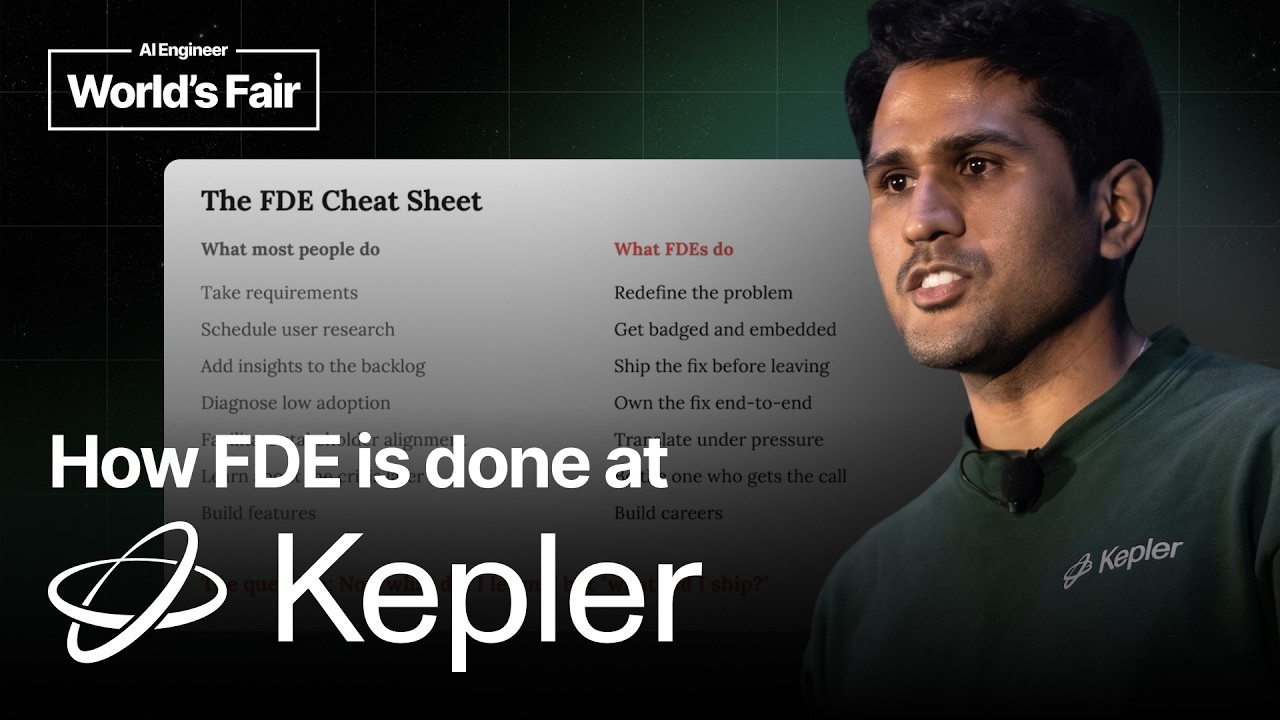
No clickbait detected — the title and thumbnail deliver what they promise.
AI Opinion
The episode most convincingly argues that Forward Deployed Engineering at Palantir has matured into a core product development function, with the crucial role of defining customer terminology serving as a means of both understanding needs and fostering platform adoption—a compelling observation given Palantir’s business model. However, the cautionary tale around the "venue.groovy" script, while illustrative of technical debt risks, lacks specific details regarding its scope or impact, making it difficult to assess the severity of the problem presented. Listeners should consider that Palantir's experience is unique and may not be directly transferable to organizations with different structures or product lifecycles; further investigation into how other companies implement similar practices would provide a more balanced perspective.
Voices are AI rewrites of the same facts — style changes, not substance.
Summary
This discussion explores the evolution of Forward Deployed Engineering (FDE) at Palantir, emphasizing its shift from a go-to-market strategy to a core product development function. A key insight is that FDEs should define and codify customer terminology, essentially becoming a linguistic foundation for the platform, which fosters customer lock-in. The talk cautions against short-term fixes and “temporary” hacks, highlighting how these can create long-term technical debt and support burdens—illustrated by an incident involving a persistent Groovy script. Furthermore, Palantir’s experience with the "Phoenix" project underscored the importance of co-building solutions with customers to avoid design flaws stemming from unrealistic assumptions about data usage. Ultimately, FDEs are positioned as extensions of product teams, responsible for identifying opportunities and generalizing solutions through direct customer interaction, rather than simply fulfilling pre-defined requirements or focusing solely on customer success.
Voices are AI rewrites of the same facts — style changes, not substance.
Insights
What this episode means but never says outright — each one grounded in the fact-checks and key points below.
The episode warns against temporary fixes but describes the 'venue.groovy' incident where a temporary script persisted for over a year, creating a long-term support burden.
Based on:
The episode advocates for FDEs to drive product strategy, yet the 'venue.groovy' incident shows a case where FDEs delivered a customer-specific solution that did not generalize into the product.
Based on:
Key Points
Defining Customer Vocabulary is Key to Lock-in
Vinoo emphasizes that a crucial aspect of forward deployed engineering (FDE) involves defining the terminology used by customers and codifying it within the platform. By becoming the 'linguistic foundation,' FDEs can essentially lock in customers, as they will be using the defined terms for their interactions and problem-solving. He provides examples like ‘skills,’ ‘MCPs’—terms that were not significant a year ago but are now essential components of the ecosystem.
The 'venue.groovy' Incident: A Cautionary Tale
A quick, temporary Groovy script was deployed to address a data retention issue for a large customer (approximately 100,000 users). While initially solving the problem, it became deeply embedded in the system and persisted for over a year. This resulted in Palantir having to support a 'hacky product' that wasn’t properly productized, highlighting the dangers of short-term fixes without considering long-term maintainability.
FDEs Should Drive Product Strategy, Not Just Customer Success
Vinoo clarifies that the role of a forward deployed engineer (FDE) isn't solely to ensure customer success through solutions architect roles. While customer satisfaction is important, FDEs should also be driving product strategy and contributing to the core offering. Simply addressing immediate pain points without considering long-term implications can lead to unsustainable technical debt and hinder overall product development.
Ship Like It's Permanent: The Long Tail of Hacks
Vinoo warns against the phrase 'this is just temporary' in engineering, as even seemingly minor hacks can persist indefinitely. He illustrates this with examples of legacy codebases still running on decades-old systems due to past quick fixes. The advice given is to ship everything as if it will run for 18 months, emphasizing that solutions often outlive their initial intent.
FDE's Evolution from a Go-to-Market Strategy to a Product Strategy at Palantir
Initially, Palantir used Forward Deployed Engineering (FDE) as a go-to-market strategy. However, the speaker emphasizes that its true value lies in being a product strategy – a method for discovering what to build through direct engagement with users and environments. This shift involved understanding customer needs and generalizing product solutions, rather than simply fulfilling predefined requirements.
The Phoenix Project Failure Highlighted the Need for Customer Co-building
Palantir's initial attempt to build a large-scale data storage system called Phoenix failed due to a lack of customer interaction. The team designed the system in isolation, leading to issues like Cassandra requiring excessive RAM (14 terabytes) when encountering imperfect real-world data. This experience underscored that software development should involve co-building with customers and understanding their usage patterns.
The Importance of Embedding FDs within Product Teams
The speaker stresses that Forward Deployed Engineers (FDEs) are an extension of the product function, not a go-to-market function. Their primary role is to identify opportunities and generalize solutions through direct customer interaction and problem solving within the product development process. This contrasts with traditional roles focused solely on sales or implementation.
The Dispatching Company Example: Redefining Requirements Through Observation
Palantir initially spent four months scoping a project for a dispatching company based on a 47-page requirements document. However, an FDE's simple observation – asking what the dispatcher did first thing Monday morning – revealed that the entire project could have been simplified to a basic Slack alert, demonstrating the importance of direct engagement over lengthy documentation.
Chapters
Claims & Fact Check
The first fundamental truth of FTE is that this is not a role this is a product strategy.
FTE is judged by their ability to be an extension of the product team to identify areas of opportunity and generalize product solutions out of it.
Forward deployed engineering is a product strategy.
Shipping fast without building for production can lead to long-term support burdens.
The most dangerous words in forward deployed engineering are 'this is just temporary'.
FTEEs should redefine the problem, not simply take requirements.
More from AI Engineer

Digest any single YouTube video — free.
3 free digests — no card, no sign-up wall.
Or just swap the domain of any YouTube link → instant digest