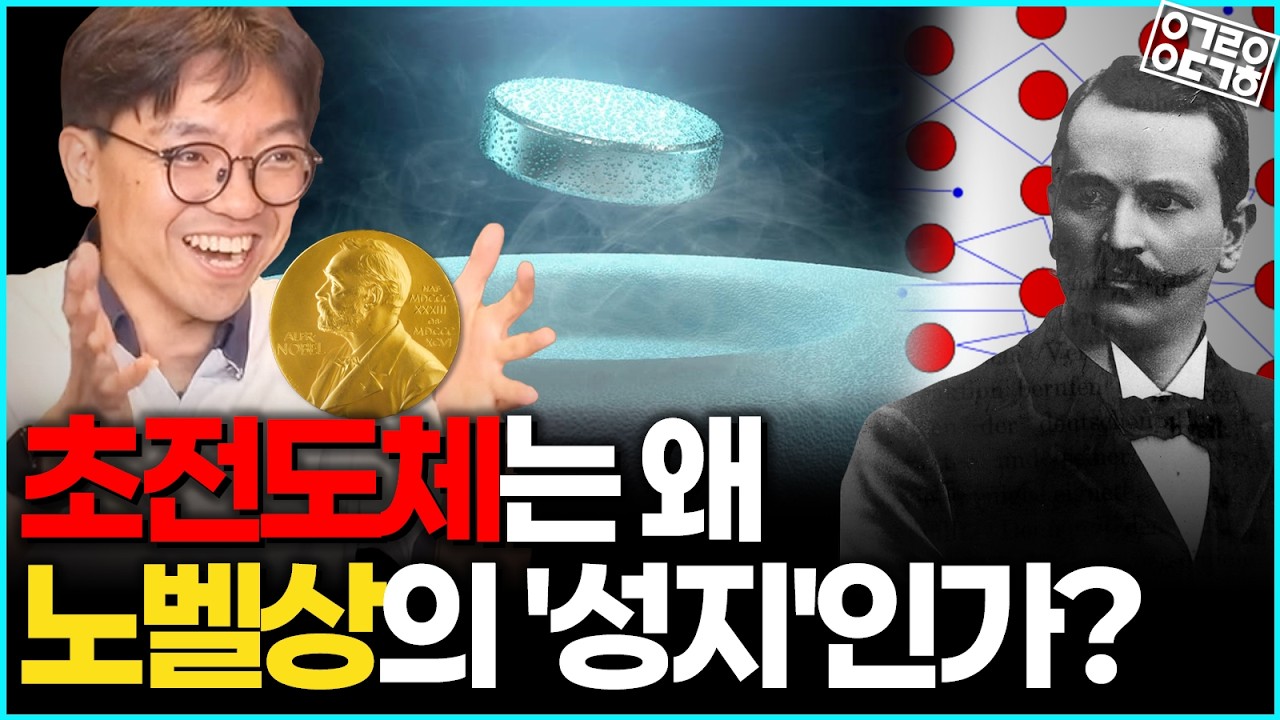
No clickbait detected — the title and thumbnail deliver what they promise.
AI Opinion
Professor Kim’s episode effectively conveys the initial excitement surrounding the discovery of LBCO and the subsequent validation of Leggett's macroscopic quantum tunneling theory as a potential explanation for high-temperature superconductivity. The presentation of Bednorz and Müller's work, alongside the community’s reaction, is well documented and convincing. However, the episode simplifies the complex theoretical landscape; while Leggett’s model gained support, alternative explanations for LBCO’s behavior remain actively debated within the field, a nuance not fully explored. Listeners interested in a more complete picture should seek out additional resources detailing competing theories of high-temperature superconductivity beyond the tunneling framework.
Avatars are AI rewrites of the same facts — style changes, not substance.
Summary
The episode explores the discovery of the LBCO superconductor in 1986 by Bednorz and Müller, a breakthrough that achieved superconductivity at 35 Kelvin and spurred significant research into high-temperature superconductors. This finding generated considerable excitement within the scientific community, leading to packed conferences and intense investigation. A key theoretical explanation for this phenomenon came from Anthony Leggett’s work on macroscopic quantum tunneling, where billions of electrons tunnel through a barrier simultaneously; initially controversial, his theory was later supported by calculations and experimental verification demonstrating a transition from thermal fluctuations to quantum tunneling at lower temperatures. This experimental confirmation provided crucial evidence for the process and has implications for advancements in fields like quantum computing.
Avatars are AI rewrites of the same facts — style changes, not substance.
Key Points
The LBCO Superconductor and the 35K Breakthrough
In 1986, Bednorz and Müller discovered superconductivity in a lanthanum barium copper oxide (LBCO) alloy. This material exhibited superconductivity at 35 Kelvin, surpassing the previously established limit of 25 Kelvin. This discovery triggered intense research into similar materials, leading to the emergence of high-temperature superconductors like IBC with temperatures reaching up to 90K. The initial findings were unexpected due to the presence of oxygen and magnetism in the material's composition.
The Intense Response from the Scientific Community
Following the LBCO discovery, the scientific community reacted with immense excitement. Physics conferences, such as the American Physical Society meeting in New York City in 1987, were overwhelmed with attendees eager to learn about the new findings. The conference featured 50 presentations within a single session and drew approximately 2,000 participants, extending late into the night.
Macroscopic Quantum Tunneling Explained
Anthony Leggett's Nobel Prize-winning work focused on macroscopic quantum tunneling – a phenomenon where billions of electrons tunnel through a barrier simultaneously. While initially dismissed by many physicists, Leggett theorized that this could occur if external interactions were minimized and the temperature was sufficiently low. His student, Kaldea, provided calculations supporting this theory, ultimately leading to experimental verification.
Experimental Verification of Macroscopic Quantum Tunneling
The experiment involved measuring the probability of electrons transitioning between states at different temperatures. Initially, thermal fluctuations dominated, but as the temperature decreased, a transition occurred where macroscopic quantum tunneling became the dominant mechanism. This was visually demonstrated through a graph showing a distinct change in behavior, providing definitive evidence for the phenomenon and paving the way for advancements in quantum computing.
Chapters
Claims & Fact Check
The LBCO superconductor exhibited superconductivity at 35 Kelvin.
The discovery of the LBCO superconductor led to a rapid increase in research and development efforts.
Macroscopic quantum tunneling was initially met with skepticism within the physics community.
Was this digest good?
Digest any single YouTube video — free.
3 free digests — no card, no sign-up wall.
Or just swap the domain of any YouTube link → instant digest