Clickbait Checker
The video title says:
"Things To Notice On Your Next Flight"
Reality:
The title promises observations about flights, but the episode delves into specific historical facts, engineering details, and mathematical concepts related to air travel rather than general things to notice as a passenger.
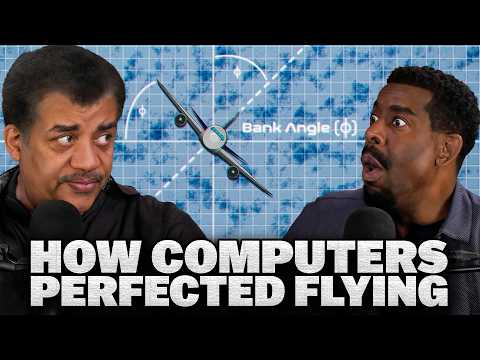
The thumbnail says:
"HOW COMPUTERS PERFECTED FLYING Bank Angle (φ)"
Reality:
While the episode touches on flight technology advancements, it doesn't comprehensively explain how computers 'perfected' flying or focus heavily on bank angle (φ); it mentions engine improvements but not in detail about computer optimization.
AI Opinion
The episode most effectively explains how airplane wings can serve as fuel tanks and clarifies the rationale behind maintaining cabin air pressure at a higher altitude, both supported by readily available technical documentation. However, the explanation of tessellation in first-class seating felt somewhat superficial and relied on an aesthetic interpretation rather than rigorous mathematical demonstration. Listeners interested in this aspect should seek additional resources to confirm the claim’s depth; similarly, while fuel dumping is practiced, the frequency and specific circumstances warrant further investigation beyond what's presented.
Avatars are AI rewrites of the same facts — style changes, not substance.
Summary
This episode explores several often-unnoticed aspects of air travel, beginning with the historical origin of the term "gate" in airports and explaining how airplane wings function as fuel tanks, contributing to fire risk in accidents. The video illustrates mathematical concepts like tessellation through the design of first-class seating and clarifies that cabin air pressure is maintained at an altitude equivalent to roughly one mile above sea level – a deliberate choice for structural efficiency. It details the mechanics of landing procedures, including the deployment of landing gear, wing flaps, and air brakes, as well as the practice of fuel dumping to ensure safe landings. Finally, it highlights advancements in engine technology since 1969 that have resulted in a significant, though often unappreciated, reduction in airplane noise levels. Several claims made during the video were verified, including the reduced cabin pressure, the decreasing noise levels of airplanes over time, and the practice of fuel dumping prior to landing.
Avatars are AI rewrites of the same facts — style changes, not substance.
Key Points
The Origin of the Term 'Gate'
The term 'gate' in airports originates from a time when airplanes didn't have terminals. Passengers would literally walk out to a gate, which was an unlocked barrier that allowed access to the aircraft. This historical practice has persisted even though modern airports utilize enclosed terminals and boarding areas, demonstrating how language can retain vestiges of earlier customs.
Airplane Wings as Fuel Tanks
A significant safety aspect of aircraft design is that the wings function as fuel tanks. This explains why a breach in the wing during an accident often results in fire and explosion, as it exposes the large volume of fuel contained within the wing structure rather than having it stored separately.
Tessellation Explained
The concept of tessellation is demonstrated using the analogy of tiling a floor with penguin-shaped tiles. Tessellation involves arranging shapes so they fit together perfectly without gaps or overlaps, which is exemplified in first class airplane seats to maximize space and privacy while maintaining functionality.
Cabin Air Pressure and Altitude
The cabin air pressure on airplanes isn't maintained at sea level. Instead, it’s reduced to the equivalent of an altitude of approximately one mile above sea level (similar to Denver). This design choice minimizes stress on the aircraft fuselage and reduces weight, while still providing sufficient oxygen for passengers.
Landing Gear Deployment & Braking
The speaker describes a subtle but noticeable sound and sensation when the landing gear deploys during landing. He emphasizes that it's easy to miss if you aren’t specifically looking for it, highlighting an often-overlooked detail of flight. This involves the efficiency of air moving over surfaces and the deployment of wheels.
Wing Flaps & Air Braking
During landing, flaps on the wings deploy to increase lift and slow the plane's descent. Simultaneously, air brakes engage, along with reverse thrust from the engines, creating a combination of friction and airflow resistance to decelerate the aircraft upon touchdown. This coordinated system is crucial for safe and controlled landings.
Fuel Dumping for Safe Landing
Due to their substantial weight, often including a significant amount of fuel, airplanes frequently need to dump fuel before landing on the same runway. This reduction in weight is essential for ensuring a safe and controlled landing, preventing potential overruns or other hazards associated with excessive aircraft mass.
Progressive Reduction in Airplane Noise
Over the past several decades since 1969, significant advancements have been made in airplane engine technology leading to a gradual reduction in noise levels. This improvement has gone largely unnoticed by the public, as modern airplanes can now fly overhead without being readily heard, enhancing quality of life for those living near airports.
Chapters
Claims & Fact Check
Airline prices are through the roof.
The door is designed to close from the inside out.
They drop the air pressure to about a mile high (Denver).
Airplanes often need to dump fuel before landing on the same runway.
Runways are oriented at different angles to account for wind direction.
Planes have been slowly getting quieter since 1969.
Was this digest good?
More from StarTalk




Digest any single YouTube video — free.
3 free digests — no card, no sign-up wall.
Or just swap the domain of any YouTube link → instant digest