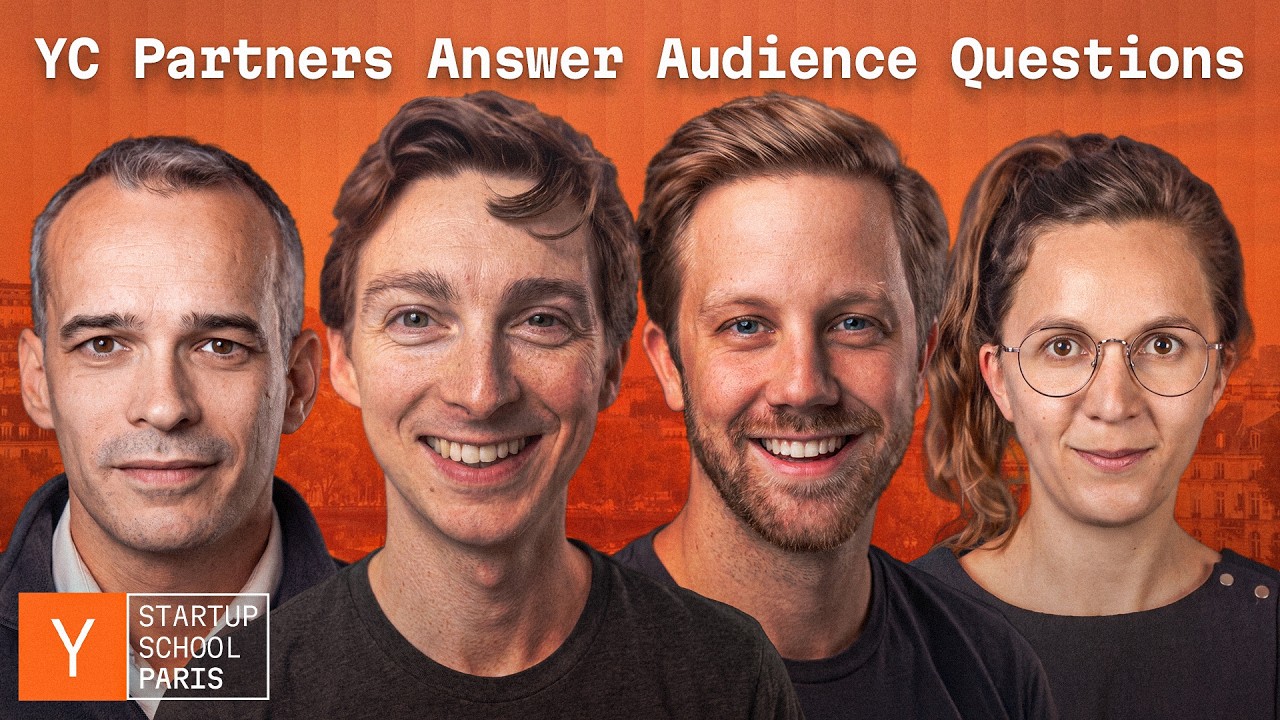
No clickbait detected — the title and thumbnail deliver what they promise.
AI Opinion
The episode makes its strongest case by reframing the co-founder’s role as emotional ballast rather than a skills gap filler—a practical insight backed by verified data that solo founders statistically underperform. However, its core argument that AI is making engineers “1,000x better” and that intelligence costs are dropping 10x annually rests on claims the episode itself flags as “Needs Research,” with no cited studies or benchmarks to support such dramatic multiples. Thoughtful viewers should treat the sweeping productivity ratios as illustrative speculation, not established fact, and independently verify the claim that no programming task remains where humans outperform models—a statement that contradicts current benchmarks in areas like novel reasoning and system design.
Voices are AI rewrites of the same facts — style changes, not substance.
Summary
The episode explores how AI is reshaping startup dynamics, particularly by rapidly lowering the cost of intelligence—potentially 10x per year—and making AI-assisted engineers far more effective than those without. While these claims are flagged as needing research, the discussion emphasizes that founders should focus on execution rather than current token costs. A central theme is the enduring value of co-founders, not for complementary skills (which AI can now help bridge), but for emotional support and resilience; solo founders statistically perform worse, and a co-founder’s primary role is to provide motivation and stability. The episode advises joining established startup hubs, launching early and often despite rejection, and treating startups as empirical exercises with rapid hypothesis-testing cycles. Founders should set ambitious goals and overwhelm their biggest bottleneck every two weeks. Distribution is highlighted as increasingly critical—software is no longer the hard part—and early-stage founders should differentiate through unscalable, white-glove service rather than competing on scale. The discussion also notes that while VC funding can accelerate growth, AI may reduce capital needs, and that founders should avoid using AI as a black box, instead engaging in a self-learning cycle to continuously improve.
Voices are AI rewrites of the same facts — style changes, not substance.
Key Points
Summary, Key Points and AI Opinion are shown in the selected voice. Claims & fact-checks, chapter names and clickbait checks always show in the neutral voice.
AI cost efficiency is rapidly improving, making it cheaper than human engineers
The cost of intelligence is dropping by roughly 10x per year for the same level of capability. Even if AI is not cheaper today, it will be within six to twelve months. YC advises founders not to worry about current token costs because the economics will solve themselves over time. An engineer using the best AI models is now 1,000x more effective than one without, and there is no single programming task where a human is more cost-effective than a model.
Join an existing startup hub rather than building a community from scratch
To maximize startup success, founders should join an existing community like San Francisco, London, or Paris where there is a critical mass of startups. Being the only founder in a city makes it difficult because peers push you forward, while people who don't understand your life can hold you back. The speaker recommends finding a great startup that embodies a strong culture, which in early days feels like a cult where you believe something no one else believes.
YC emphasizes building AI tools internally while preserving human judgment
YC has built internal AI tools that empower partners and founders, dramatically increasing organizational speed. However, the speaker personally writes most things to avoid delegating too much thinking to AI, citing a direct correlation between writing and thinking. Key areas where AI cannot replace humans include founder well-being, community building, and knowledge sharing among the 200 companies in a batch.
Co-founder value outweighs solo founder efficiency
The speaker argues that while a one-person billion-dollar company is theoretically possible, the marginal benefit of adding a second person almost always exceeds the marginal cost. They explain that coordination problems scale with team size (Metcalfe's law), making larger teams harder to manage, but AI can help compress companies to below Dunbar's number (~150 people). They cite a specific experiment from their batch where a strong solo founder became depressed and lost confidence after six weeks, illustrating that a co-founder provides emotional modulation and support that is critical for resilience.
AI reduces the need for skill complementarity in co-founders
Another panelist adds that AI now enables an average engineer to become great at selling and a non-salesperson to become good at sales, making skill complementarity less important. They reinforce that the primary value of a co-founder is emotional and motivational support, not filling skill gaps. This shifts the co-founder selection criteria from 'what skills do I lack?' to 'who makes me happier and more resilient?'
How to pick a great co-founder: focus on character, not complementary skills
The speaker advises choosing a co-founder based on intelligence, determination, work ethic, integrity, and shared values—someone you would fear competing against. They explicitly warn against seeking complementary skills, calling it a 'massive mistake,' especially for technical founders who think they need a business co-founder. Instead, they recommend finding a deeply technical partner who you work well with, because business skills are easy to learn later. The emotional support aspect is also crucial: the person should lift your morale when you're down.
VC funding remains valuable for fast growth, but AI may reduce capital needs
In response to a question about whether the traditional seed-to-series funding path is still relevant, the speaker says there is no fixed rule. VC money can still accelerate growth, especially for companies consuming expensive AI tokens. However, if a startup can leverage AI to move faster with less capital, alternative paths become viable. The key is whether access to capital enables faster execution, not whether it is mandatory.
Top founders launch early and often, embracing rejection
The most successful founders launch early and repeatedly, overcoming the fear of rejection. They avoid being too theoretical or waiting for perfection, as exemplified by the Cursor founder who launched on Hacker News multiple times with zero or few upvotes before eventually selling to xAI for $60 billion. This willingness to put work into the real world and gather data is critical for iterating and improving.
Startups are an empirical exercise, not a theoretical one
YC partners emphasize that academic habits like sitting in a library and thinking hard translate poorly to startup success. Instead, startups require forming quick hypotheses, running real-world tests, and updating plans based on data. The key activity is a rapid cycle of hypothesis, test, and iteration, not prolonged analysis.
Set ambitious goals and overwhelm bottlenecks every two weeks
The best founders set very ambitious goals and reassess them every two weeks, holding themselves accountable. They identify the single biggest bottleneck facing their startup and throw all their focus at overwhelming it, so that when they meet with YC partners, the problem has changed because they've solved the previous one. This tight timeline prevents distraction from smaller fires.
Avoid using AI as a black box; engage in a self-learning cycle
A common mistake is to use AI, look at the result, and move on—whether satisfied or not. Instead, founders should adopt a self-learning cycle, as presented by Tom, where they critically evaluate AI outputs and iterate. This approach ensures AI becomes a tool for continuous improvement rather than a one-off answer generator.
Differentiation is a constant founder obsession
The speaker uses the example of Brex buying all the billboards in San Francisco six years ago to stand apart, but notes that now billboards are no longer a differentiating tactic. The core message is that founders must continuously think about how to differentiate their company, and if the answer were obvious, everyone would do it. This requires constant obsession and finding an answer that is specifically better for your own company.
Distribution is more important than ever
The speaker agrees with Matild's point that distribution matters more than ever, and that the meta game for getting distribution is evolving very quickly. They emphasize that software is no longer the hard part of building a company; distribution has become one of the hardest challenges. Founders must figure out their own unique way to get reach and distribution, as seen with the founder mentioned who found a way to get reach.
Early-stage founders should play a different game than scaled companies
The speaker advises that early-stage founders are playing the minigame of getting towards product-market fit, finding first customers, and building what they need. When looking at how companies with product-market fit get customers via billboards, founders should remember those companies are playing a completely different game. To stand out, early-stage founders should offer real white-glove service, turn up in person, spend an inordinate amount of time on small contracts, and build something that exactly fits the customer's needs — the unscalable things that allow them to compete with companies putting up billboards.
Chapters
Claims & Fact Check
The cost of intelligence is dropping by roughly 10x per year for the same level of intelligence.
?UnverifiedAn engineer today with a model is 1,000x better than an engineer without AI.
?UnverifiedThere is no single programming task that a human is more effective at than a model.
?UnverifiedThe marginal cost of adding a second person is low relative to the benefit, but coordination costs grow dramatically with team size (Metcalfe's law).
?UnverifiedAI will compress companies from 2,000 people down to 100 or 50, keeping them below Dunbar's number (150).
?UnverifiedSolo founders statistically do worse than co-founder teams.
?UnverifiedThe founder of Cursor launched on Hacker News multiple times with zero or few upvotes before eventually selling to xAI for $60 billion.
?UnverifiedAcademic habits like sitting in a library and thinking hard translate extremely poorly to startup success.
?UnverifiedThe best founders overwhelm the biggest bottleneck every two weeks, so the problem changes each time they meet with YC partners.
?UnverifiedDistribution is more and more important than it ever was because software is no longer the hard thing about building the company.
?UnverifiedThe way to stand out from companies with product-market fit is by giving individual customers real white-glove service, turning up in person, and spending an inordinate amount of time on a small contract.
?UnverifiedDigest any single YouTube video — free.
3 free digests — no card, no sign-up wall.
Or just swap the domain of any YouTube link → instant digest