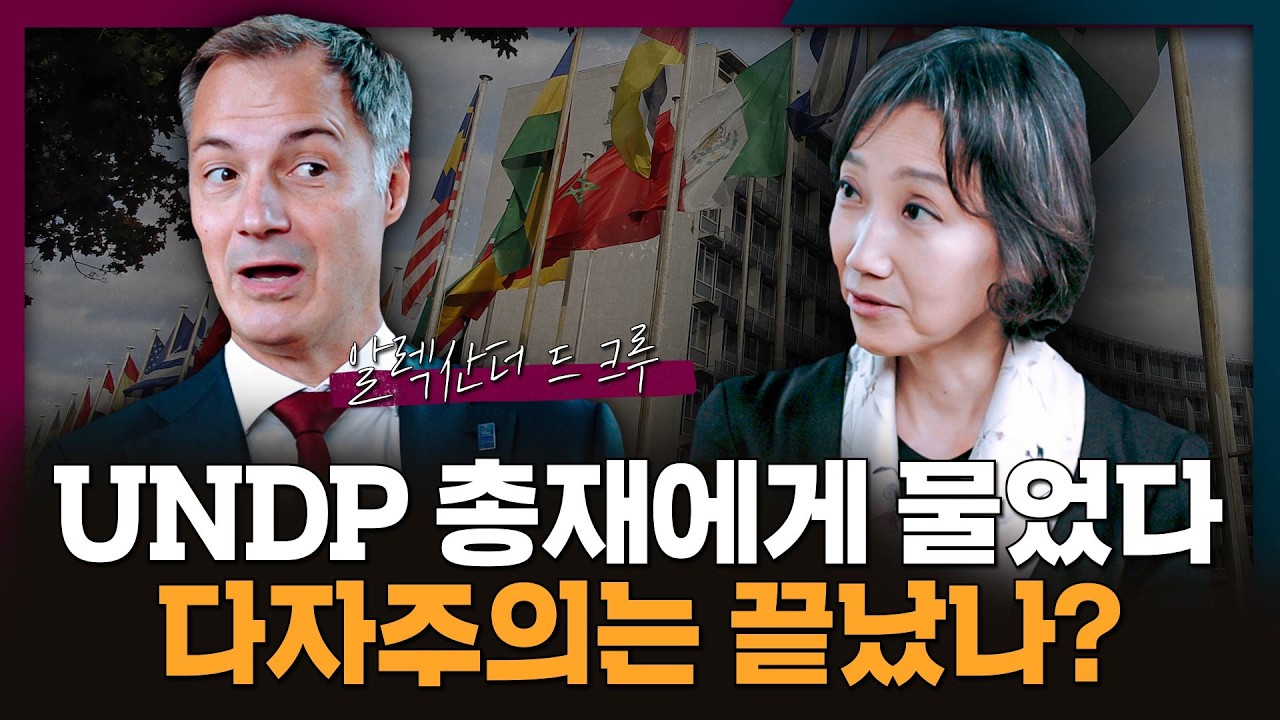
No clickbait detected — the title and thumbnail deliver what they promise.
AI Opinion
The episode convincingly argues that multilateralism remains vital for addressing global challenges like climate change and that the UN’s credibility is intrinsically linked to demonstrable progress. However, the claim that development assistance functions as a preemptive security strike rests on an interpretation of geopolitical strategy that requires further scrutiny; while poverty reduction and child mortality rate improvements are presented as evidence, attributing causality solely to international aid overlooks other contributing factors. Listeners should independently verify the specific data cited regarding development outcomes and critically evaluate the assumption that engagement with authoritarian regimes inevitably leads to positive change.
Voices are AI rewrites of the same facts — style changes, not substance.
Summary
The discussion centers on the ongoing relevance of multilateralism in a world facing complex challenges. Administrator De Croo argues that international cooperation is crucial for addressing issues like climate change and migration, emphasizing that no single nation can effectively resolve them alone. He connects the credibility of democracy to the demonstrable impact of multilateral institutions like the UN, suggesting both suffer when they fail to deliver tangible results. The speaker expresses concern over the erosion of international principles and reframes development assistance as a security measure, arguing it proactively mitigates future crises. While acknowledging criticisms of international aid, he points to significant progress in poverty reduction, child mortality rates, and access to education. Finally, De Croo encourages individual action and highlights technology's potential to accelerate development, advocating for engagement with challenging regimes rather than complete withdrawal.
Voices are AI rewrites of the same facts — style changes, not substance.
Key Points
Each key point shows the surrounding transcript with the exact relevant line highlighted — tap the timestamp to jump there.
Key points and summaries are AI-generated by Sumzup; the highlighted quotes are verbatim from the video's captions.
Want the full transcript?
We show short source quotes as evidence — not the full transcript, which belongs to the creator (republishing it could infringe copyright). The Sumzup desktop & mobile app (coming soon) generates the full transcript locally on your own device, for your personal use.
Multilateralism's Relevance in Crisis
Administrator De Croo emphasizes that global challenges like climate change and migration require international cooperation, stating that no single nation can effectively address them alone. He highlights the importance of multilateralism as a means to tackle these issues collectively, asserting that finding common ground on critical topics is essential for progress.
please explain as what exactly you meant by? Do you still believe that multilateralism can work? Well, definitely. If you look at the the big challenges which which we are confronted, being it climate change, being it managing migration flows, there is no country today in the world, even the most powerful one, that can…
Democracy and Multilateralism: A Cycle of Delivery
Drawing a parallel between the credibility of democracy and multilateralism, De Croo argues that both rely on delivering tangible results to maintain public trust. He explains that democracies weaken when they fail to address people's concerns, mirroring how the UN’s relevance diminishes if it cannot demonstrate concrete impact in complex situations.
bring concrete results. I mean, there is big discussions on is democracy still functioning or not? Well, yeah, there is places where democracy is being weakened, but very often it weakens because those are sometimes democracies that do not deliver on the expectations of people.
Erosion of International Principles
De Croo expresses concern over the ongoing erosion of fundamental principles underpinning global stability, specifically mentioning international law and humanitarian principles. He views this trend as a worrying development that necessitates vigilance and proactive efforts to uphold these values within the international system.
of the principles on on which stability in the world was based the last decades. International law, humanitarian principles, that is is eroding and that I find a very worrying trend. Well, as you pointed out, the United States cuts its aid budget and also doing serious restructuring.
Development as a Security Preemptive Strike
Addressing concerns about shrinking aid budgets, De Croo reframes development assistance as an integral part of national security strategies. He argues that investing in development acts as a 'preemptive strike,' mitigating the risk of future crises and offering a more sustainable approach than solely relying on military intervention or reactive measures.
part of your security agenda. we are the first line of defense in crisis. And you could even say that we are probably what you would call a preemptive strike. Something you do to avoid that a crisis takes place. We cannot guarantee that crisis will not take place.
The Power of Individual Contribution
The speaker emphasizes that progress isn't solely driven by politicians, but by individuals who take initiative and actively work towards solutions. He encourages young people to avoid complaining and instead focus on taking action, highlighting the accessibility of technology as a means for everyone to contribute positively to shaping the world’s future.
shaping the world. It's not only politicians who make great speeches. I mean, the world moves forward when you have young people who wake get in the morning and who say, "I'm not going to complain. I'm going to put my sleeves on.
Technology as an Accelerator for Development
The speaker highlights the transformative potential of technology, particularly in accelerating development. He specifically mentions artificial intelligence and South Korea's position to leverage this knowledge for upskilling populations. This underscores a belief that technological advancements can be powerful tools for progress.
the example of look, this this works and look what kind of society that has been built here. Element number two, I mean, this is a highly sophisticated technological society and I'm a big believer in technology. Technology is an incredible accelerator for development.
Significant Progress Despite Criticisms
Responding to criticisms of international aid, the speaker counters with statistical evidence demonstrating significant improvements in poverty reduction (halving extreme poverty in 25 years), child mortality (decreasing by 50% in 20 years), and access to education. While acknowledging that development investment isn't solely responsible, he emphasizes the unprecedented progress achieved in recent decades.
inequality, or conflict. I like to hear your very honest opinion on that. Honestly, let me push back on that with the numbers. If you say it hasn't changed anything on poverty, the last 25 years, extreme poverty has halved.
Engagement vs. Abstinence in Challenging Contexts
Addressing concerns about working with regimes that don't fully uphold human rights, the speaker argues against complete withdrawal from engagement. He posits that improving conditions and daily lives requires a long-term process of engagement and presence, rather than abstaining due to imperfections in political systems.
work in countries where political system is not always 100% in line with UN Charter. Now, there the question is, it's a choice. You can say, "Okay, it's not perfect.
Chapters
Claims & Fact Check
Multilateralism is essential for tackling global challenges like climate change.
±Partially supportedThe UN's relevance depends on its ability to deliver concrete results.
±Partially supportedDevelopment is part of a nation’s security agenda and acts as a preemptive strike against crises.
?UnverifiedTechnology is an incredible accelerator for development, particularly AI.
±Partially supportedExtreme poverty has halved in the last 25 years.
±Partially supportedChild mortality has decreased by 50% in the last 20 years.
±Partially supportedIt's better to engage with challenging regimes and work towards improvement than to abstain entirely.
±Partially supported