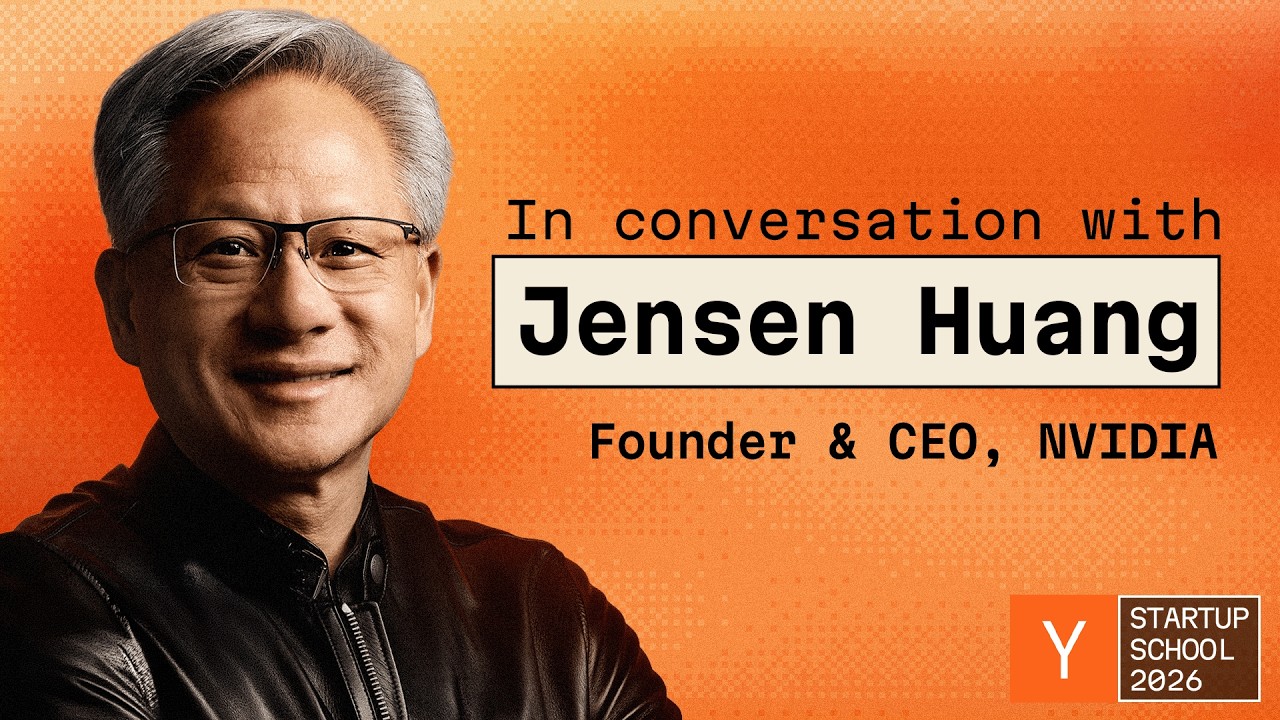
No clickbait detected — the title and thumbnail deliver what they promise.
AI Opinion
The episode’s most convincing argument is Huang’s insistence that confronting failure directly and learning any new domain from scratch—exemplified by NVIDIA’s pivot after its initial 3D technology was “absolutely wrong”—is a foundational mindset for long-term success. However, several of his broader claims rest on weaker or unverified evidence, such as the assertion that this is the greatest time in 60 years to start a company due to a complete technology reset, or that radiology jobs have increased 20% despite AI automating scan readings, both of which lack concrete data in the conversation. A thoughtful viewer should double-check the actual employment trends in radiology and software engineering, as well as the claim that NVIDIA invented most major computer graphics breakthroughs, to separate Huang’s compelling personal narrative from broader industry facts.
Voices are AI rewrites of the same facts — style changes, not substance.
Summary
In this episode, Jensen Huang reflects on the mindset and key decisions that built NVIDIA, beginning with the company’s near-failure when its foundational 3D graphics technology proved “absolutely wrong.” He describes how confronting that reality and learning OpenGL from textbooks saved the company and established a lasting principle: technology changes, but the ability to learn any new domain is what matters. Huang argues that great companies are built on a unique perspective—NVIDIA’s was that it should accelerate algorithm domains, not just build chips—and that CEOs should shape their organizations to fit their own strengths, like an F1 car built for its driver. He predicts systems thinking will become the most critical skill as AI automates low-level tasks, and he counters fears about job destruction by asserting that AI eliminates tasks, not jobs, citing growth in software engineering and radiology roles despite automation. Huang also notes that generative video convinced him robotics articulation was imminent, and he calls this the greatest time in 60 years to start a company due to a complete technology reset. Throughout, he emphasizes an optimistic, almost naive mindset—“how hard can it be?”—alongside continuous learning and resilience as the most important qualities for entrepreneurial success.
Voices are AI rewrites of the same facts — style changes, not substance.
Key Points
Summary, Key Points and AI Opinion are shown in the selected voice. Claims & fact-checks, chapter names and clickbait checks always show in the neutral voice.
NVIDIA's Foundational Technology Was Wrong
Jensen Huang reveals that the initial technology NVIDIA chose to reinvent 3D graphics was 'absolutely wrong.' By 1995, the company realized the algorithm didn't work, and there were already 35-40 competitors building 3D graphics for PCs. Huang confronted the team, stating they wouldn't have a company if they didn't acknowledge the failure, and bought three textbooks on OpenGL from Fry's for a couple hundred dollars to learn the correct approach from scratch.
The Key Lesson: Confront Reality and Learn Any Technology
Huang emphasizes that the big lesson from NVIDIA's early struggle is that technology is constantly changing, so the specific technology doesn't matter as long as you can confront reality and learn. Since then, NVIDIA has approached every new domain—particle physics, fluid dynamics, molecular dynamics, image processing, inverse physics, and deep learning—with the same attitude: 'If it's important to do, we're going to go learn it. And how hard can it be?' This mindset allowed them to reinvent computer graphics and become the world leader.
Great Companies Are Built on a Unique Perspective, Not Just Technology
Huang explains that what makes great companies is a unique perspective about the world that you deeply believe in, not just the technology or the market. While having the right technology for the right market at the right time makes life easier, the core insight that drove NVIDIA was that it's not about building a great chip but about accelerating an algorithm domain. This perspective led them to augment CPUs to solve problems that were otherwise too difficult, such as molecular dynamics and deep learning.
CEO as F1 Driver: Adapting the Company to Your Strengths
Huang argues that a CEO should treat the company like an F1 race car built to fit the driver. Rather than conforming to conventional management techniques, leaders should constantly reshape business processes and organizational structures to maximize their own effectiveness. He acknowledges that when he eventually leaves, the next CEO will reshape the company to fit their personality, which he views as natural and necessary for sustained high performance.
Systems Thinking as the Future's Most Useful Skill
Huang predicts that systems understanding, awareness, design, and organization will become the most critical skill as low-level tasks become automated by AI agents. He explains that in chip design, most work is already about systems design rather than transistor-level synthesis, and the same shift is coming to software. The key is to think abstractly about problems, constraints, inputs, outputs, and information flow rates.
AI Automates Tasks, Not Jobs
Huang argues that the narrative about AI destroying jobs is backwards; AI eliminates tasks, not jobs. He explains that a job consists of many tasks, and while some can be automated, others cannot, leading to job growth. He cites evidence that software engineer jobs have increased 10% year-over-year despite coding automation, and radiology jobs have grown 20% even with AI reading scans, due to high patient backlogs enabling hospitals to admit more patients and hire more staff.
Productivity Growth Drives Employment
Huang presents a classic economic argument that productivity increases growth, which in turn drives more employment. He uses the example of law firms: AI tools like Harvey were predicted to eliminate paralegal jobs, but paralegal positions are growing because the backlog of lawsuits is high, and firms can process more cases with automation, requiring more hires. He concludes that this is why there is more employment today than when he graduated.
Generative Video Led to Physical AI and Robotics Breakthrough
Huang describes how seeing NVIDIA generate video of articulation—like a finger moving or a hand picking up a glass—convinced him that robotics articulation was imminent. This realization spurred NVIDIA's work on physical AI, including world foundation models that understand physics, friction, tension, and causality. He states that the 'ChatGPT moment' for robots occurred a couple of years ago, when robots could walk using reinforcement learning, even though they weren't yet productive, opening imaginations about possibilities.
The Greatest Time to Start a Company
Huang declares that this is the single greatest time in the last 60 years to start a company, because the entire technology industry has undergone a complete reset. He notes that the computer—the most important technology in human history—has been completely reinvented, creating unprecedented opportunities. He expresses jealousy toward new entrepreneurs for the incredible opportunities ahead, while also acknowledging that the fast pace of change requires the right mindset to navigate.
The Entrepreneurial Mindset: 'How Hard Can It Be?'
Jensen Huang advocates for an optimistic, almost naive mindset when approaching new challenges. He suggests telling yourself 'how hard can it be?' to avoid being paralyzed by anxiety about future difficulties. He acknowledges that in reality, things are much harder than you anticipate, but the key is to let the suffering come to you a little at a time rather than imagining all the hardships upfront. This attitude, combined with a belief in your ability to learn, is what drives successful entrepreneurs.
Learning as the Greatest Superpower
Huang states that learning is the single greatest superpower an entrepreneur can have. He encourages approaching new technologies and markets with the attitude that 'if anybody can do it, I can do it,' and then committing to learn whatever is necessary along the way. He reflects on his own experience of buying a textbook to learn about a new area, illustrating that continuous learning is essential in a rapidly changing world.
Resilience as the Single Most Important Quality
Huang emphasizes that resilience is the most critical trait for long-term success. He advises that you don't need to overcome your entire life in one day—just get through today, work toward tomorrow, and keep following your dreams. If you stick with it long enough, 'video happens' (meaning success eventually materializes). He frames resilience as the ability to keep going despite fear, anxiety, or lack of confidence, and to learn your way through any obstacle.
Chapters
Claims & Fact Check
The initial technology NVIDIA started the company with was exactly wrong.
?UnverifiedNVIDIA invented most of the major breakthroughs in computer graphics over the last 25 years.
?UnverifiedNVIDIA's approach to every new technology is to learn it with the attitude 'how hard can it be?'
?UnverifiedMost of our designers are systems designers.
?UnverifiedMost software is going to be done agentically anyhow.
?UnverifiedAI eliminates tasks, not jobs; software engineer jobs have increased 10% year-over-year despite coding automation.
±Partially supportedRadiology jobs have increased 20% in the last several years even though AI has automated reading scans.
?UnverifiedThe ChatGPT moment for robots happened a couple of years ago, with robots walking using reinforcement learning.
?UnverifiedThis is the greatest time in the last 60 years to start a company, because the entire industry has been reset from a technology perspective.
?UnverifiedLearning is the single greatest superpower.
?UnverifiedResilience is probably the single most important thing for success.
?UnverifiedDigest any single YouTube video — free.
3 free digests — no card, no sign-up wall.
Or just swap the domain of any YouTube link → instant digest