No clickbait detected — the title and thumbnail deliver what they promise.
AI Opinion
Tim Urban’s most convincing argument is his relatable metaphor of the Instant Gratification Monkey and the Panic Monster, which vividly captures the internal tug-of-war that many procrastinators experience. However, his claim that procrastinators’ brains are physically different based on an MRI scan of just two people is presented as humorous speculation rather than rigorous science, and the broader assertion that the Monkey “lives only in the present” is a poetic simplification, not a verified neurological fact. Thoughtful viewers should treat the talk as a powerful, accessible framework for self-reflection rather than a peer-reviewed explanation of brain function, and double-check whether Urban’s personal anecdotes align with established research on impulsivity and temporal discounting.
Voices are AI rewrites of the same facts — style changes, not substance.
Summary
Tim Urban uses a humorous TED talk to explain the psychology of procrastination, drawing on his own experience of writing a 90-page senior thesis in a 72-hour all-nighter after a year of delay. He introduces a metaphor for the procrastinator's brain, claiming it contains an "Instant Gratification Monkey" alongside the "Rational Decision-Maker," while a non-procrastinator's brain has only the latter. The Monkey, he argues, lives only in the present and seeks easy, fun activities, often hijacking the Rational Decision-Maker's plans for productive work. This conflict leads to procrastination, as the Monkey's tribal-era instincts clash with the demands of modern, long-term planning. Urban's claims about actual brain differences based on an MRI scan are presented as humorous speculation rather than scientific fact, with the talk's value lying in its accessible, relatable framework for understanding the internal struggle between immediate gratification and rational long-term goals.
Voices are AI rewrites of the same facts — style changes, not substance.
Key Points
The 90-Page Thesis Disaster
Tim Urban describes his college experience as a government major, where he procrastinated on papers by doing almost no work until the last moment. For his 90-page senior thesis, he planned a year-long schedule with gradual progress, but ended up writing the entire thesis in 72 hours, pulling two all-nighters. He submitted it just at the deadline, but the thesis was very bad, contrary to a humorous fake ending where the school praised it.
The Procrastinator's Brain vs. Non-Procrastinator's Brain
Urban hypothesizes that procrastinators' brains are different from non-procrastinators'. He claims to have tested this by getting an MRI scan of his own brain and that of a 'proven non-procrastinator.' He shows the audience two brain images: the non-procrastinator's brain has only a 'Rational Decision-Maker,' while the procrastinator's brain also contains an 'Instant Gratification Monkey.' This metaphor is central to his explanation of procrastination.
The Instant Gratification Monkey Takes the Wheel
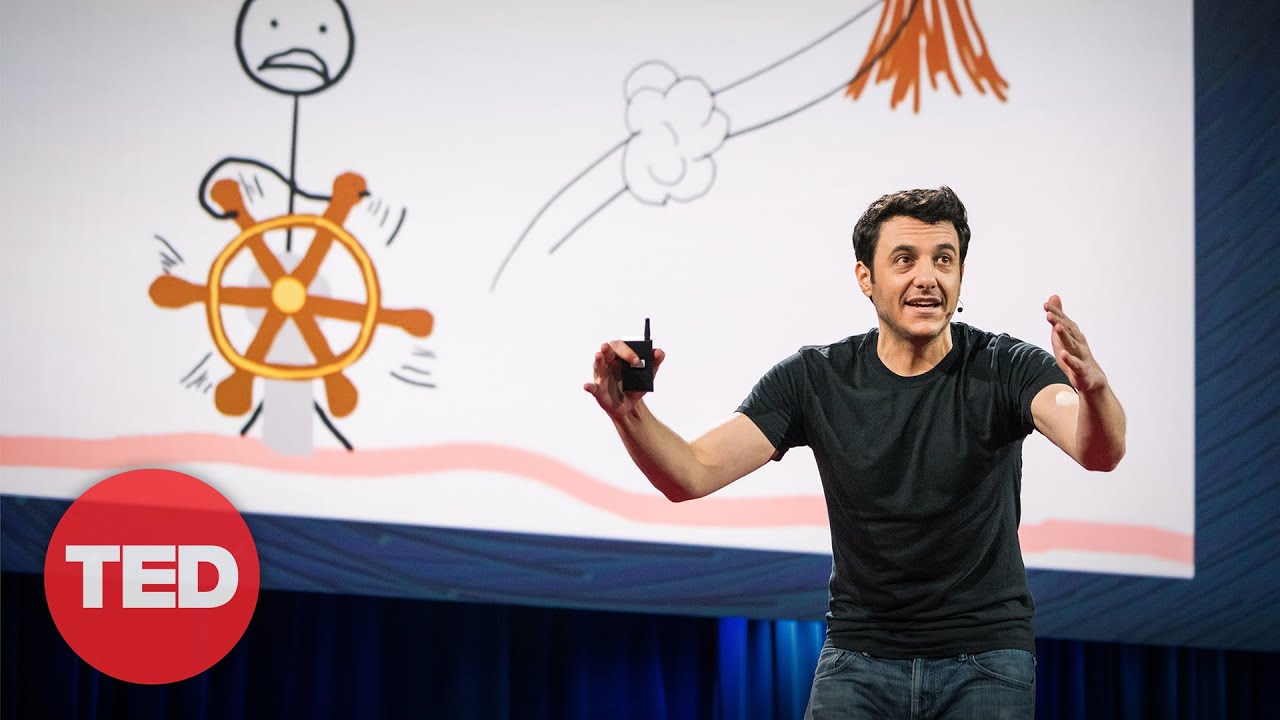
Urban explains that when the Rational Decision-Maker plans to do productive work, the Instant Gratification Monkey 'takes the wheel' and diverts attention to easy, fun activities. Examples include reading the entire Wikipedia page of the Nancy Kerrigan/Tonya Harding scandal, checking the fridge repeatedly, and going on a YouTube spiral from Richard Feynman to Justin Bieber's mom. The Monkey's actions leave no room for work, leading to procrastination.
The Rational Decision-Maker and the Monkey's Conflict
Urban contrasts the Monkey, who lives only in the present and cares only about easy and fun, with the Rational Decision-Maker, who can visualize the future, see the big picture, and make long-term plans. He notes that in an advanced civilization, the Monkey's tribal-era instincts are maladaptive. Sometimes the two agree (e.g., during leisure time), but often they conflict, leading to procrastination when the Monkey overrides rational planning.
Chapters
Claims & Fact Check
The brains of procrastinators are actually different than the brains of other people, as shown by an MRI scan of my brain and a non-procrastinator's brain.
?UnverifiedThe procrastinator's brain has an Instant Gratification Monkey that takes the wheel and diverts attention to easy, fun activities, preventing productive work.
?UnverifiedThe Instant Gratification Monkey lives entirely in the present moment, with no memory of the past or knowledge of the future, caring only about easy and fun.
?Unverified