Clickbait Checker
The video title says:
"We've Been Using The Wrong Science In Court For 50 years"
Reality:
The episode thoroughly covers how flawed forensic methods like hair analysis, bite marks, and fingerprint bias have been used in courts for decades, directly supporting the claim that the wrong science has been used for 50 years.
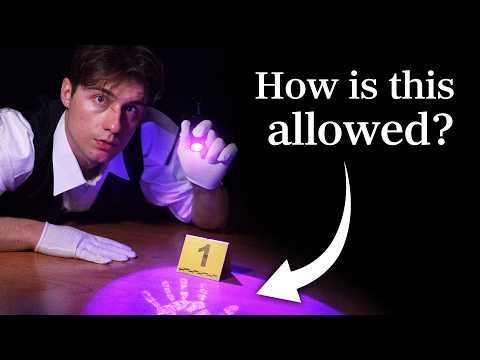
The thumbnail says:
"How is this allowed?"
Reality:
The thumbnail's promise to reveal why an action indicated by a red arrow is allowed in a crime scene setup is not addressed in the summary or key points, which focus on systemic forensic failures rather than a specific procedural question.
AI Opinion
The episode convincingly argues that the legal system has long relied on forensic techniques—like bite mark and hair analysis—that lack rigorous scientific validation, with the 2009 NAS report and the 96% false match rate in hair cases providing stark, verified evidence of systemic failure. Its claims about DNA transfer risks and mixture errors are also well-supported by documented cases and a 2013 NIST study, though the episode could overstate the frequency of such errors in routine practice, as the cited study tested a deliberately complex sample. A thoughtful viewer should double-check the broader context of DNA mixture analysis, since the 69% error rate reflects a specific, challenging scenario, not the typical performance of accredited labs, and consider that the episode’s focus on worst-case examples may not represent the average reliability of modern forensic work.
Voices are AI rewrites of the same facts — style changes, not substance.
Summary
A 2009 National Academy of Sciences report concluded that, aside from nuclear DNA analysis, no forensic method has been scientifically proven to reliably link evidence to a specific individual. This finding is supported by decades of flawed practices. For instance, FBI microscopic hair analysis produced a 96% false match rate in 268 cases, leading to wrongful convictions and executions. Bite mark analysis, still admissible in courts worldwide as of 2025, has no scientific foundation, as studies show skin distorts impressions. Even fingerprint analysis is vulnerable to conformity bias, as seen in the 2004 Brandon Mayfield case, where examiners confidently matched a print to the wrong person. While modern DNA analysis is highly sensitive, it introduces new risks: in 2012, paramedics accidentally transferred a homeless man's DNA to a murder victim, resulting in a false arrest and death penalty charges. Furthermore, DNA mixtures from multiple individuals are prone to error; a 2013 NIST study found that 69% of labs incorrectly analyzed a four-person sample. The episode highlights a systemic failure in forensic science, where techniques lacking rigorous validation have been used for decades, and even advanced methods like DNA require careful interpretation to avoid miscarriages of justice.
Voices are AI rewrites of the same facts — style changes, not substance.
Key Points
The 2009 National Academy of Sciences Report
In 2009, the National Academy of Sciences published a 350-page report stating that, with the exception of nuclear DNA analysis, no forensic method has been rigorously shown to consistently demonstrate a connection between evidence and a specific individual. The report also declared that some forensic tests do not meet the fundamental requirements of science, challenging the validity of techniques still used in court today.
Microscopic Hair Analysis: 96% False Match Rate
Between the 1970s and 1999, the FBI used microscopic hair analysis in 268 cases, but when later reexamined with DNA evidence, 96% of those cases were declared false. Even the most experienced FBI examiners routinely claimed matches between hairs from different people and sometimes could not distinguish human hair from dog hair. This led to 33 death sentences and nine executions before the errors were discovered.
Bite Mark Analysis: No Scientific Foundation
Forensic dentist Mary Bush noted that there was no scientific exploration into bite marks before they were used in court. A study using model teeth to create 89 bite marks in cadavers found that none matched the measurements of controlled marks in wax or the original teeth. After 12 studies, the conclusion was that bite mark transfer to skin is not reliable because skin is soft and distorts under pressure, yet the evidence remains admissible in courts worldwide as of 2025.
Conformity bias in fingerprint analysis
The FBI's 2004 case against Brandon Mayfield shows how conformity bias can corrupt forensic science. Fingerprint examiners claimed with 100% certainty that a print matched Mayfield, but it actually belonged to a Spanish terrorist. The error occurred because verification examiners likely knew the original analyst's verdict and the stakes of the case, making them more likely to agree. Even the defense's own expert initially concurred, illustrating how social pressure can override objective analysis.
DNA sensitivity creates transfer risks
Modern DNA analysis can work with as little as 0.4 nanograms of DNA, solving cold cases like a 61-year-old murder. However, this extreme sensitivity also leads to false positives through secondary transfer. In 2012, paramedics accidentally transferred a homeless man's DNA from their equipment to a murder victim's fingernails, causing Lucas Anderson to be charged with murder and face the death penalty despite being hospitalized at the time. He spent five months in jail before charges were dropped.
DNA mixtures cause widespread interpretation errors
DNA mixtures—samples containing profiles from multiple individuals—are the most common source of error in DNA interpretation. The standard STR test examines 20 genomic locations for repeat sequences, giving 40 markers total, which makes individual identification highly reliable for single-contributor samples. But with four or more contributors, overlapping peaks become impossible to distinguish, like hearing five people talk at once. A 2013 NIST study sent a four-person DNA mixture to labs across the US, and 69% of them got the analysis wrong.
Chapters
Claims & Fact Check
With the exception of nuclear DNA analysis, no forensic method has been rigorously shown to consistently demonstrate a connection between evidence and a specific individual.
?UnverifiedOut of 268 cases using microscopic hair analysis, 96% were declared false.
?UnverifiedBite mark evidence is still allowed in courts worldwide as of 2025.
±Partially supportedFingerprint examiners claimed with 100% certainty that a mark matched Mayfield's fingerprint, but it actually belonged to a man linked to terrorist organizations in Spain.
?UnverifiedIn 2012, paramedics transferred a homeless man's DNA to a murder victim's fingernails, leading to his arrest and death penalty charges despite his hospitalization.
?Unverified69% of labs got a four-person DNA mixture analysis wrong in a 2013 NIST study.
?Unverified