Clickbait Checker
The video title says:
""빛"의 정체를 밝힌 연구는 어떻게 노벨상을 받았나? (KAIST 김갑진 교수, 이근희 박사)"
Reality:
The title accurately reflects a discussion about the research behind Einstein's Nobel Prize, focusing on how it revealed the nature of light through the photoelectric effect.
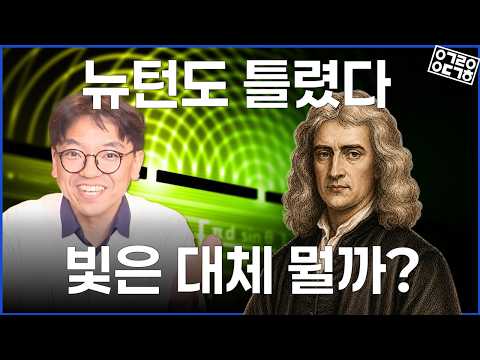
The thumbnail says:
"뉴턴도 틀렸다 빛은 대체 뭘까? 0720 0518"
Reality:
While the thumbnail mentions challenging Newton’s view and asking 'what is light?', the episode primarily details the historical context and scientific process surrounding Einstein's work rather than a fundamental re-evaluation of Newton's understanding.
AI Opinion
The episode most convincingly argues that understanding the history of science, particularly Einstein’s work on the photoelectric effect, illuminates not only complex physics but also the crucial role of societal acceptance in scientific progress. While the discussion effectively connects historical context to quantum mechanics, it glosses over potential nuances in Millikan's experimental design and interpretation—his initial results were initially disputed—and presents Compton scattering as straightforward confirmation when it too sparked debate within the scientific community. Listeners should consider that even well-regarded experiments are subject to revision and reinterpretation with new data or methodologies.
Avatars are AI rewrites of the same facts — style changes, not substance.
Summary
This discussion explores the historical development of our understanding of light, culminating in Einstein's Nobel Prize-winning explanation of the photoelectric effect. The conversation highlights that scientific progress isn’t solely about factual accuracy but also hinges on societal acceptance and persuasive communication, drawing parallels to figures like Galileo and Newton. Dr. Lee Geun-hee emphasizes the value of studying the history of science to grasp complex concepts like quantum mechanics, illustrating how revolutionary ideas often face resistance before gaining widespread acceptance. Early experiments with the photoelectric effect revealed unexpected anomalies that Einstein resolved by proposing light exists as discrete particles or quanta, a concept later validated by Robert Millikan’s precise measurements and further supported by Arthur Compton's scattering experiments. These findings demonstrated that light exhibits both wave-like and particle-like properties, fundamentally changing our understanding of physics.
Avatars are AI rewrites of the same facts — style changes, not substance.
Key Points
Kim Gap-jin's Aspirations and the Nobel Dream
Professor Kim Gap-jin, when teaching his students at KAIST, asks them about their dreams. His own stated dream is to have two of his students win a Nobel Prize, specifically in Physiology or Medicine – though he jokingly accepts Literature as well. This ambition stems from a desire to validate his educational philosophy and demonstrates the importance of impactful mentorship.
The Significance of Understanding Scientific Acceptance
The discussion highlights that scientific truth isn't solely about factual accuracy; it’s deeply intertwined with societal acceptance and the ability to persuade others. The example of Galileo and Newton illustrates how even groundbreaking discoveries require a receptive audience for widespread adoption, demonstrating that science is as much a social process as it is an intellectual one.
Lee Geun-hee's Motivation: Exploring the Nature of Science
Dr. Lee Geun-hee’s initial interest in science stemmed from a philosophical question posed during his undergraduate studies – what *is* science? This led him to study scientific history, revealing that even revolutionary ideas like heliocentrism faced resistance and required complex social and intellectual shifts for acceptance.
Understanding Quantum Mechanics Through Historical Context
Dr. Lee emphasizes that understanding difficult concepts like quantum mechanics is best achieved by examining their historical development. By tracing the evolution of ideas and the debates surrounding them, one can gain a deeper appreciation for the challenges and breakthroughs that shaped these theories, making complex topics more accessible.
Initial Photoelectric Effect Experiments Reveal Unexpected Behavior
Early experiments investigating the photoelectric effect involved creating a vacuum and applying pressure to thin oil layers. These initial setups revealed anomalies, such as the unexpected force exerted on the material due to the pressure difference between the vacuum and atmospheric conditions. Further investigation showed that the speed of emitted electrons was independent of brightness, defying conventional expectations.
Einstein Explains Photoelectric Effect with Particle Hypothesis
To resolve the discrepancies in experimental data, Albert Einstein proposed a revolutionary hypothesis: light is not solely a wave but also exists as discrete particles, or 'quanta.' This concept aligned with Planck's earlier work on blackbody radiation and provided a framework for explaining both the spectral distribution of radiation and the photoelectric effect. Einstein suggested that these light quanta carried energy proportional to their frequency.
Millikan’s Experiment Quantifies the Relationship Between Light Frequency and Electron Energy
Robert Millikan meticulously designed an experiment to test Einstein's predictions, varying the light frequency and measuring the corresponding kinetic energy of emitted electrons using a retarding potential. His results precisely matched Einstein’s equation, confirming the linear relationship between light frequency and electron energy—a crucial validation of the particle hypothesis and allowing for the determination of Planck’s constant (H).
Compton Scattering Provides Further Evidence for Light's Particle Nature
Arthur Compton’s experiments involving X-ray scattering provided additional compelling evidence supporting the particle nature of light. By observing a shift in wavelength after X-rays interacted with metals, he demonstrated momentum transfer consistent with collisions between particles. This phenomenon, known as Compton scattering, further solidified the concept that light exhibits both wave and particle properties.
Chapters
Claims & Fact Check
The book 'How Did We Come to Believe in Science?' is ranked #12 on Aladdin's science bestseller list.
Professor Kim Gap-jin's dream is to have two of his students win a Nobel Prize.
Scientific advancements require societal acceptance and persuasion, not just factual accuracy.
Einstein's theory explained the photoelectric effect by proposing light exists as discrete particles (quanta).
Millikan’s experiment precisely verified Einstein's equation relating light frequency and electron energy.
Light can behave as both a wave and a particle.
Was this digest good?
Digest any single YouTube video — free.
3 free digests — no card, no sign-up wall.
Or just swap the domain of any YouTube link → instant digest