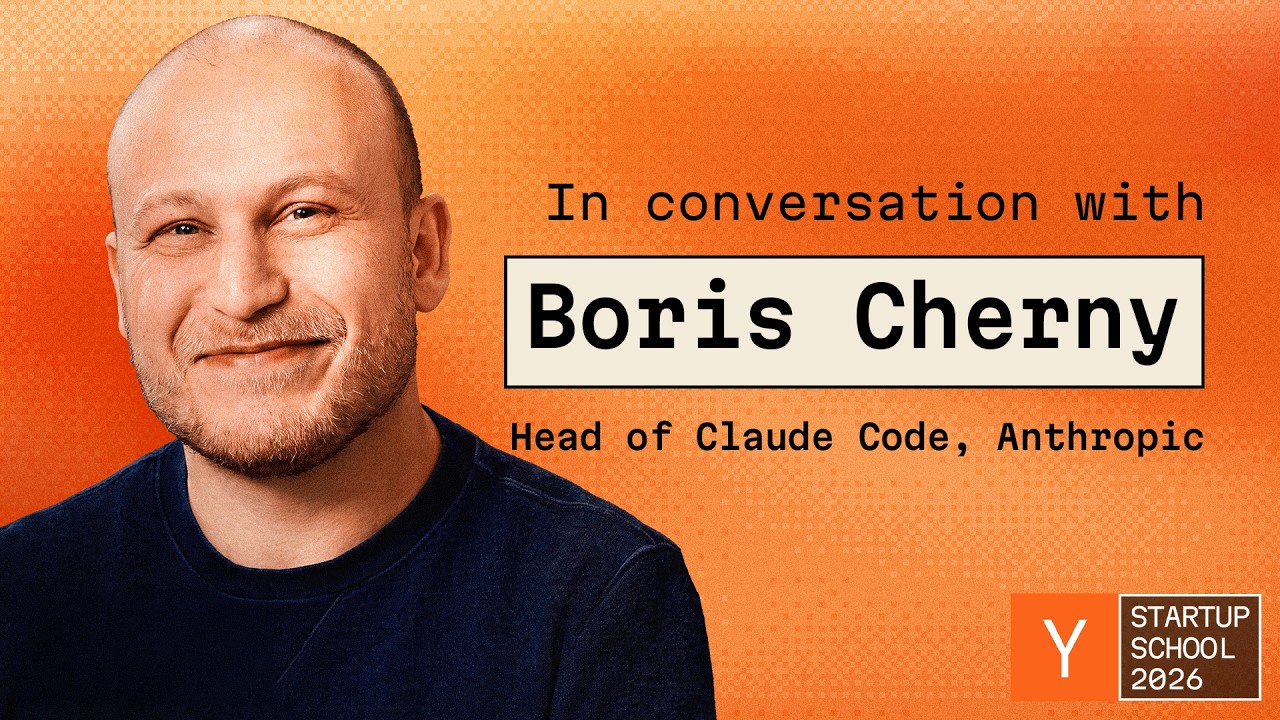
No clickbait detected — the title and thumbnail deliver what they promise.
AI Opinion
The episode’s most convincing argument is that Opus 5’s long-running autonomy and three-layer prompt-injection defense represent a genuine leap in agent reliability, backed by the verified claim that it can run for weeks without external scaffolding and resists injection via a mechanistic interpretability classifier. However, the claim that deleting 80% of the system prompt makes the model “slightly more intelligent” is only partially supported, as the evidence for intelligence gains is anecdotal and lacks controlled benchmarks. The assertion that there are “dozens or hundreds of undiscovered capabilities” in current models is marked as needing research, so a thoughtful viewer should treat this as speculation rather than fact. Keep in mind that the Bun team’s 11-day rewrite from Zig to Rust, while verified, is a single high-profile example that may not generalize to less structured or more complex codebases.
Voices are AI rewrites of the same facts — style changes, not substance.
Summary
In this episode, Boris Cherny discusses the capabilities of Opus 5 and its integration with Claude Code, highlighting several key advancements. Opus 5 can run autonomously for days or months without external scaffolding, and it features a three-layer defense against prompt injection, including a mechanistic interpretability classifier, making it effectively unprompt-injectable. The Claude Code team deleted 80% of the system prompt for Opus 5, finding that a simpler prompt can make the model slightly more intelligent. Cherny advises users to give high-level instructions rather than specific steps, as the model now handles autonomy well. A notable example is the Bun team using Claude Code to rewrite their JavaScript runtime from Zig to Rust in 11 days with a single prompt, a task that would have taken top engineers over a year. Cherny introduces the concept of "product overhang"—re-testing older problems with new models—and notes that capabilities like drawing with OpenCV emerge without explicit training. He emphasizes a shift from prompt engineering to context engineering, and that coding is solved for common tasks but not for deep systems or distributed systems. The best users adopt an empirical mindset, letting go of past assumptions and experimenting freely. For students, Cherny recommends learning programming by solving real problems and building products, starting with something personal before scaling to something others want.
Voices are AI rewrites of the same facts — style changes, not substance.
Key Points
Opus 5 Achieves Long-Running Autonomy
Opus 5 can run for days, weeks, or months without stopping, even without external scaffolding like LangGraph (SLGO). When combined with auto mode, it sustains long tasks autonomously, a capability no other model has demonstrated. This is a key advancement for agentic workflows.
Opus 5 Resists Prompt Injection via Three-Layer Defense
Boris Cherny states Opus 5 is no longer prompt injectable, a breakthrough built on three layers: a well-aligned model (three years of alignment research), a prompt injection classifier based on Chris Olah's mechanistic interpretability that monitors neurons lighting up during injection attempts, and an auto mode classifier. Together, they make prompt injection undemonstrable.
80% of Claude Code's System Prompt Deleted for Opus 5
With each new model, the Claude Code team deletes and rebuilds the system prompt from scratch. For Opus 5, they removed 80% of the prompt because the model is intelligent enough to handle tasks without many prior corrections. A 'simple mode' (CLAUDE_CODE_SIMPLE=1) deletes all prompts including tool prompts, and surprisingly the model is slightly more intelligent without them, though some prompts remain for product usability.
Effective Prompting: High-Level Instructions Over Specific Steps
Boris Cherny advises users to avoid overly specific instructions when using Claude Code. Instead, he recommends describing the task, guardrails, and exit criteria at a high level, then letting the model work autonomously. This approach, which would not have worked six months ago, now yields surprising results due to model improvements.
Bun Codebase Rewrite from Zig to Rust in 11 Days
The Bun team used Claude Code to rewrite their entire JavaScript runtime from Zig to Rust in a single dynamic workflow that ran for 11 days. The model was given one prompt with steering, leveraging Bun's extensive test suite to validate correctness. This task, which would have taken over a year for the best engineers, is now in production and powers Claude Code itself.
Product Overhang: Re-Testing Models on Unsolved Problems
Cherny introduces the concept of 'product overhang'—continuously re-testing the latest model on previously unsolved business or engineering problems, as new models may succeed where older ones failed. He emphasizes that users should experiment freely, as capabilities emerge without explicit training, such as Opus 5's ability to draw using OpenCV, discovered accidentally.
Model Elicitation and the Shift from Prompt Engineering
Cherny notes that the skill of eliciting model capabilities is evolving from 'prompt engineering' to 'context engineering.' He suggests that the focus is now on providing the right context and framing rather than crafting intricate prompts, as models become more capable of understanding high-level instructions.
Coding is solved for common tasks but not for deep systems or distributed systems
Boris Cherny clarifies that coding is solved for the kind of coding he does, but not for everyone. He notes that Claude still struggles with super deep systems code bases, distributed systems, and in-the-weeds UI verification like pixel-perfect checks. He highlights that Opus 5 was a big leap in vision and computer use but is still not perfect, and he polls the audience on how much of their code is written using agents, finding that many use it for over 50% of their work.
Exceptional builders adopt an empirical mindset over theoretical knowledge
Cherny explains that the best users of Claude bring an empirical mindset: they forget past model behaviors and computer science theory, instead looking at the model, trying a task, seeing where it struggles, and adjusting based on that. He emphasizes that this is no longer a theoretical science but an empirical one, and the key skill is being able to let go of priors and remain open to trying again, which is now very successful.
Students should learn programming practically by solving real problems
When asked what students should still learn the hard way, Cherny shares his personal story of learning to code on a TI-83 calculator in middle school to cheat on math tests, starting with BASIC and later learning assembly for calculus. He advises students to learn not just computer science theory but also how to apply it by building startups, products, developing design and business sense, doing data science, and talking to users, as combining these with engineering is where true value lies.
Start by making something you want, then level up to make something people want
The interviewer summarizes Cherny's advice as starting with making something for yourself first, then leveling up to make something people want. Cherny agrees, and then announces a special offer for the audience: they are getting max 20x credits, encouraging them to build something that runs for multiple months with thousands of agents.
Chapters
Claims & Fact Check
Opus 5 runs for days, weeks, or months at a time without needing scaffolding like LangGraph.
Opus 5 is not prompt injectable anymore, thanks to a three-layer defense including a mechanistic interpretability classifier.
Deleting 80% of the system prompt and using simple mode makes the model slightly more intelligent.
Claude Code can rewrite any codebase from one language to another, and the Bun team used it to rewrite their JavaScript runtime from Zig to Rust in 11 days with one prompt and steering.
Opus 5 can draw portraits, animals, and landscapes using OpenCV, a capability not explicitly trained for.
There are likely dozens or hundreds of undiscovered capabilities in current models that no one has realized yet.
Opus 5 was a big leap in vision and computer use, but it's still not perfect.
The best users of Claude bring an empirical mindset, forgetting priors and being open to trying again.
Students should learn not just computer science but also how to apply it by building startups and developing business sense.
Digest any single YouTube video — free.
3 free digests — no card, no sign-up wall.
Or just swap the domain of any YouTube link → instant digest