Clickbait Checker
The video title says:
"Khan Academy CEO: The Real AI Opportunity Is in Boring Industries | Sal Khan"
Reality:
While the episode features Sal Khan discussing opportunities related to AI, it doesn't directly address a scenario where $10,000 definitively 'beats' Harvard; rather, it mentions a potential $10,000 degree program as an alternative.

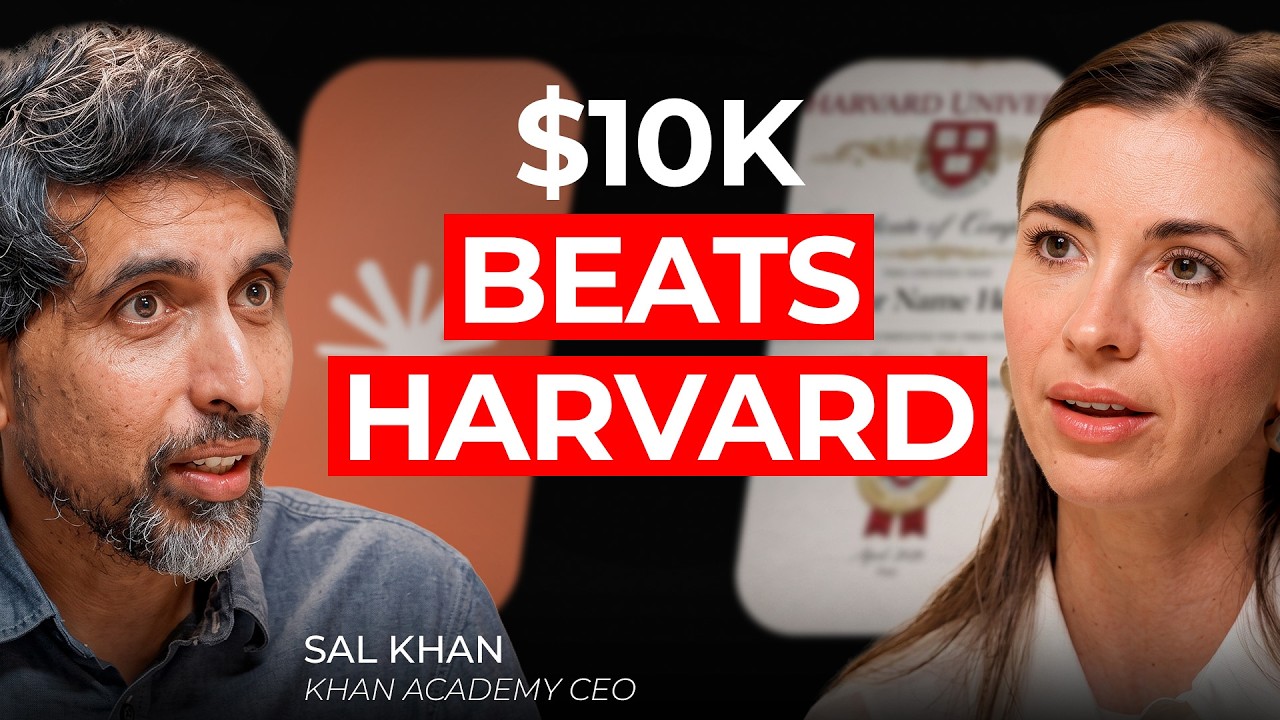
The thumbnail says:
"$10K BEATS HARVARD SAL KHAN KHAN ACADEMY CEO"
Reality:
The thumbnail’s claim that $10,000 beats Harvard is a sensationalized hook not supported by the episode content, which focuses on affordability and competency-based learning within Khan Academy's Content Institute.
AI Opinion
Khan convincingly argues that the most significant near-term impact of AI will be felt in traditionally "boring" industries, driven by efficiency gains and rapid adoption—a point supported by his experience with Khan Academy’s own integration and a verified example of call center automation. However, claims regarding student dropout rates from elite universities and Content Institute's adaptability compared to traditional institutions rest on anecdotal observations and require further substantiation; the assertion about the Philippines' GDP also warrants independent verification. Listeners should critically evaluate projections around the $10,000 degree cost for Content Institute and consider whether Khan Academy’s accelerated development cycles are universally applicable across educational contexts.
Avatars are AI rewrites of the same facts — style changes, not substance.
Summary
Sal Khan, CEO of Khan Academy, discusses the rapid evolution of AI and its implications across various sectors. Initially concerned about obsolescence, he’s observed AI's swift integration into areas like university admissions, highlighting the unpredictable nature of technological advancement. The conversation explores concerns around job displacement due to automation, drawing parallels to past industrial revolutions and emphasizing the need for proactive planning and reskilling initiatives. Khan Academy itself is rapidly integrating AI tools—resulting in significant compute costs but accelerating development cycles and streamlining operations through AI-powered assistance and content creation. He also addresses the polarization of higher education and introduces Content Institute, a program aiming to provide an affordable, competency-based alternative degree costing potentially as low as $10,000, catering to ambitious students seeking job-ready skills and entrepreneurial opportunities, possibly in conjunction with local colleges.
Avatars are AI rewrites of the same facts — style changes, not substance.
Key Points
AI's Rapid Evolution & Obsolescence Concerns
Sal Khan explains that when writing about AI and education in 2023, he initially feared his work would quickly become obsolete due to the rapid pace of change. However, he found it remained relevant as AI's influence expanded beyond tutoring into areas like admissions processes at top universities, demonstrating a quicker adoption than anticipated. This highlights the unpredictable nature of technological advancement and its impact on established knowledge.
Khan Academy's Proactive Approach to AI Integration
Khan Academy is moving beyond initial versions of AI tutors, focusing on a more proactive approach that prioritizes student motivation and teacher involvement. The new version aims to provide personalized practice and support while keeping educators in the loop, signaling a shift from simply using AI for AI's sake towards a more pedagogical and human-centered integration.
The Growing Concern of Job Displacement Due to Automation
Khan’s conversation with a VC friend revealed a significant automation event at a portfolio company's call center, where 80% of the workforce was replaced by generative AI. This incident sparked concerns about potential widespread job displacement, particularly in regions like the Philippines where business process outsourcing is a major economic driver and many jobs are precarious. The conversation prompted discussions around reskilling initiatives to mitigate these impacts.
Learning from Past Industrial Revolutions - A Call for Planning
Khan argues that the historical narrative of the Industrial Revolution leading to overall job creation is incomplete, as it overlooks significant societal upheaval and conflict. He emphasizes the need for proactive planning and strategies to address potential negative consequences of AI-driven automation, drawing a parallel to past industrial transitions and advocating for a more considered approach than simply assuming positive outcomes.
Khan Academy's AI Compute Costs & Rapid Development
Khan Academy engineers are experimenting heavily with AI models, resulting in significant compute costs—one engineer spent $3,000 in a single day. However, this investment led to the completion of projects that would have previously taken months within just a few hours, demonstrating the potential for rapid development cycles using AI tools like Opus and Gemini.
Shifting Engineering Priorities: Speed Over Design
Traditionally, engineering efforts prioritized extensive design phases to avoid building valueless products. Khan Academy is now shifting towards a model of rapid prototyping and deployment, emphasizing quick testing and iteration. While careful consideration remains crucial for certain aspects, the focus has shifted to quickly validating hypotheses and accelerating organizational velocity.
AI-Powered Operational Assistance
Khan Academy is integrating AI tools by connecting them to internal platforms like Slack, Gmail, and Google Docs. This allows AI to act as a 'chief of staff,' proactively surfacing potential issues and drafting communications. Sal Khan personally uses these AIs daily to manage his workload and ensure tasks don’t fall through the cracks.
Accelerated Content Creation with AI
Sal Khan utilizes AI to expedite content creation, particularly when addressing complex financial literacy topics with numerous edge cases. The AI assists in researching and gathering information from sources like IRS.gov, significantly reducing the time spent on preliminary research before video production.
The Polarization of Higher Education
Sal Khan discusses the stark contrast in higher education, highlighting the elite institutions with limited capacity and high exclusivity versus online programs that often lack prestige. He explains that aspirational employers frequently target graduates from these elite universities, creating a gap for students who attend other institutions or online programs. This polarization motivates Content Institute's approach to provide an alternative pathway with verifiable quality.
Content Institute's Cost-Effective Degree Program
Khan reveals that a degree from Content Institute is projected to cost a maximum of $10,000, significantly less than the typical $400,000 spent on a traditional four-year university education. He emphasizes that this figure could be even lower due to the competency-based nature of the program, potentially allowing students to complete their degree in just two years and reduce opportunity costs by accelerating earning potential.
The Changing Landscape of Higher Education and Entrepreneurship
Khan observes a growing trend among ambitious students, even at top universities, to drop out and pursue entrepreneurial ventures due to the rapid pace of technological change driven by AI. He suggests that these students may find Content Institute's adaptability and focus on job-ready skills more appealing than traditional academic programs, allowing them to quickly acquire relevant expertise and capitalize on emerging opportunities.
Combining Local Colleges with Content Institute
Khan envisions a future where students combine the affordability and accessibility of local community colleges or regional state universities with the specialized skills training offered by Content Institute. He believes this blended approach can provide a valuable education for high-potential students who may not have access to elite institutions, bridging the gap between traditional academia and practical job readiness.
Chapters
Claims & Fact Check
One of his portfolio companies automated 80% of their call center workforce with generative AI.
Business process outsourcing accounts for 5-7% of the Philippines' GDP.
The 20th century was the bloodiest due to experimentation with communism and other systems.
One engineer spent $3,000 on compute costs in a single day.
Khan Academy’s organizational velocity is at least 50% faster than it was two or three years ago.
AI has dramatically shortened the research time for content creators.
Content Institute degrees will cost a maximum of $10,000.
Content Institute can adapt faster to new tools than traditional universities.
Students at elite universities are dropping out to pursue entrepreneurial ventures due to AI's rapid advancement.
Was this digest good?
More from Silicon Valley Girl


Digest any single YouTube video — free.
3 free digests — no card, no sign-up wall.
Or just swap the domain of any YouTube link → instant digest