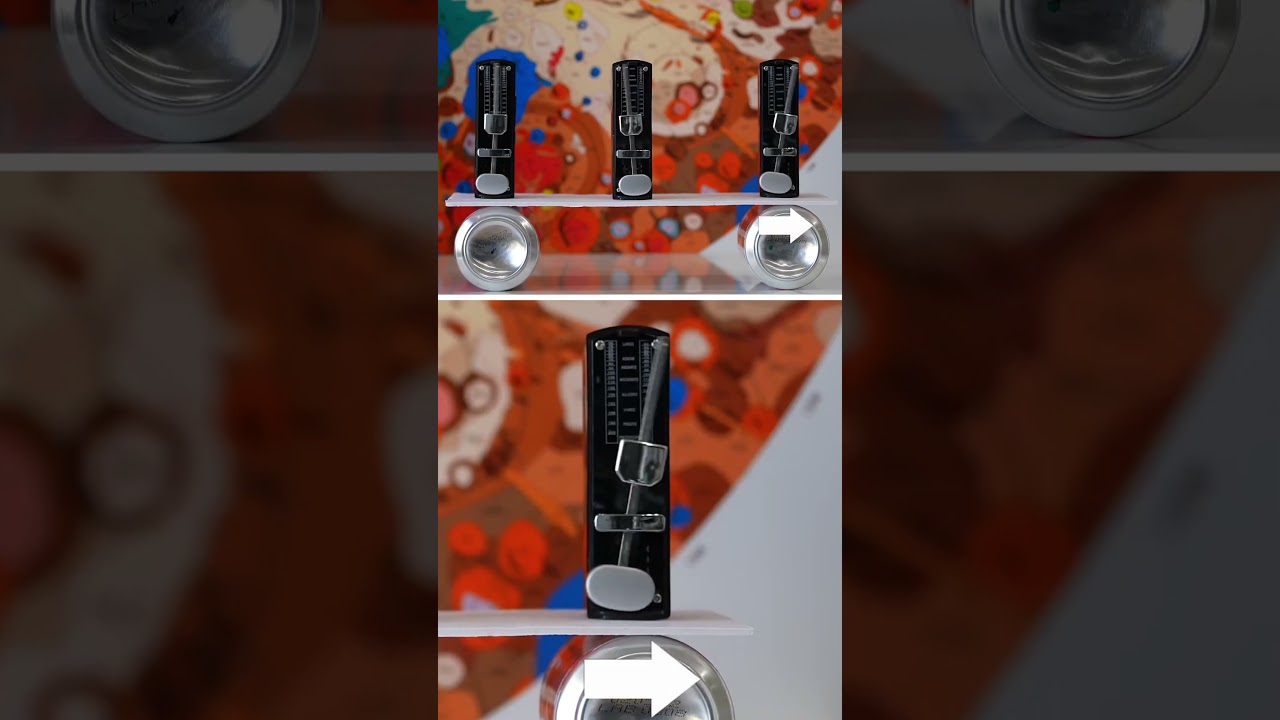
No clickbait detected — the title and thumbnail deliver what they promise.
AI Opinion
The episode convincingly demonstrates that metronomes synchronize on a wobbly platform through a mechanical feedback loop: the platform moves in response to the majority's motion, delivering corrective impulses to out-of-sync metronomes until they align. Its claim that this works even for metronomes with different natural frequencies is verified but relies on the assumption that the platform is sufficiently light and responsive—an ideal condition not always met in real-world setups. A thoughtful viewer should double-check whether the platform's mass and damping characteristics are explicitly accounted for, as these factors could limit synchronization in practice.
Voices are AI rewrites of the same facts — style changes, not substance.
Summary
When two or more metronomes are placed on a light, wobbly platform, they tend to synchronize because the platform moves in response to their collective motion. When metronomes are in sync, their coordinated acceleration pushes the platform in the opposite direction, keeping the system's center of mass roughly stationary. If a metronome is out of sync, the platform's movement—dominated by the majority—delivers a corrective impulse every half swing, gradually adjusting its timing until it aligns. This mechanism scales to many metronomes: the platform simply moves in whichever direction the majority are pushing at any moment, ensuring eventual synchronization even if the metronomes have different natural frequencies.
Voices are AI rewrites of the same facts — style changes, not substance.
Key Points
Center of Mass Conservation
When two metronomes oscillate in sync, their large masses accelerate left and right together, pushing the platform in the opposite direction. This coordinated motion ensures the center of mass of the entire system remains roughly stationary. The platform's movement is a direct reaction to the metronomes' collective acceleration.
Out-of-Sync Metronome Correction
If a third metronome starts completely out of sync with the first two, the platform's motion delivers a kick to it every half swing. This periodic impulse gradually speeds up or slows down the out-of-sync metronome until it aligns with the others. The process relies on the platform's movement being dominated by the majority of metronomes.
Scalability to Many Metronomes
The synchronization mechanism works regardless of the number of metronomes on the platform. The platform simply moves in the direction that the majority of metronomes are pushing at any given moment. This majority rule ensures that even with many metronomes, they all eventually synchronize.
Chapters
Claims & Fact Check
Metronomes with different natural frequencies can still synchronize when placed on a light wobbly platform.
?UnverifiedThe center of mass of the system always stays roughly in the same spot when metronomes are in sync.
?UnverifiedThe platform goes whichever way the majority of metronomes are pushing it.
?Unverified