Clickbait Checker
The video title says:
"Notion's Token Town — Sarah Sachs, Notion"
Reality:
The title 'Notion's Token Town' is a playful reference, but the episode focuses on Notion’s strategic vision for AI integration and associated challenges, not a literal 'town' or token economy within Notion.
AI Opinion
Sachs convincingly argues that cost instability, particularly vendor pricing fluctuations, is a substantial impediment to scaling AI solutions within platforms like Notion, and that open-weight models offer a promising path toward greater affordability and control. The claim that the gap between open-weight and proprietary models will close remains speculative, as does the assertion about Kimmy 26’s performance relative to GPT-52; listeners should seek independent validation of these comparisons. While Notion's exploration of CPU usage for AI tasks is presented as a cost-saving measure, assessing its practical impact on workflow speed requires further scrutiny and benchmarking against GPU alternatives.
Avatars are AI rewrites of the same facts — style changes, not substance.
Summary
Notion's Sarah Sachs discusses the company’s vision for AI integration, positioning Notion as a durable system of record facilitating collaboration between humans and AI agents. She outlines a progression in AI usage, from initial experimentation to AI functioning as a teammate within critical workflows. A significant challenge highlighted is the high cost associated with scaling AI solutions, exacerbated by vendor pricing instability and unexpected costs related to model upgrades. The rise of open-weight models is presented as a key factor lowering this barrier to entry, providing customers with more accessible options and negotiation leverage. Sachs emphasizes that performance evaluations should move beyond generic benchmarks towards system-specific expertise and highlights Notion's use of CPUs for certain AI tasks as a cost-saving alternative to GPUs. Finally, she introduces the "lethal trifecta" of AI security risks – access to private data, exposure to untrusted content, and external communication capabilities – underscoring the need for proactive security measures in AI product development.
Avatars are AI rewrites of the same facts — style changes, not substance.
Key Points
Notion's Vision: Durable System of Record for Human-AI Collaboration
Sarah emphasizes that Notion’s core mission is to serve as a durable system of record, not just for human collaboration but now also encompassing the interaction between humans and AI agents. This means providing a central place where both humans and AI can collaborate effectively, creating a more streamlined and efficient workflow. The company believes this foundational element is crucial for successful software factories and overall business operations.
The Progression of AI Usage: From Thought Partner to Teammate
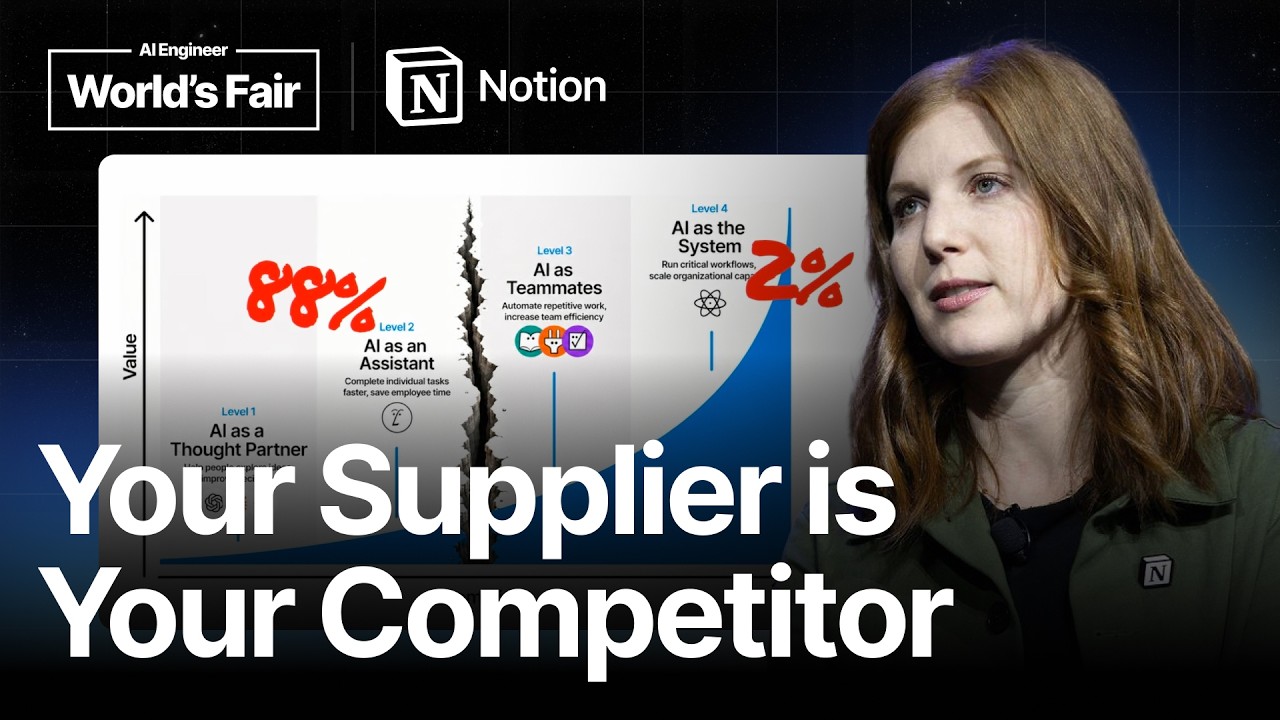
Sarah outlines the evolution of AI usage, starting with 'AI as a thought partner' (early experimentation) progressing to 'AI as an assistant' (executing individual tasks), and culminating in 'AI as teammates' (integrating into critical workflows). The transition to AI as a teammate involves repetitive work automation and process interfacing, marking a significant step towards more sophisticated AI integration.
Cost is a Significant Barrier to Scaling AI
Sarah argues that cost represents a major obstacle for companies aiming to implement large-scale AI systems. She highlights examples of companies struggling with expensive commitments and inefficient processes, leading to frustration and ultimately hindering progress. This understanding is crucial for anyone working in applied AI to navigate the trade-offs involved in building durable products.
Vendor Pricing Instability Hinders AI Progress
Sarah points out a concerning trend of vendor pricing instability, where model upgrades don't necessarily bring cost savings and can even increase token usage or introduce entirely new pricing tiers. She uses examples like upgraded reasoning models with unchanged per-token pricing and new model families with significantly higher costs to illustrate this problem, which Notion actively faces.
Open Weight Models Lowering Barrier to Entry
Sarah Sachs explains that open-weight models significantly reduce the cost barrier for customers, making AI solutions more accessible. These models also provide negotiation leverage by offering a credible alternative to proprietary providers, putting downward pressure on pricing which would otherwise be unavailable. This shift challenges the dominance of a few top providers and democratizes access to advanced AI capabilities.
Beyond Benchmarks: System-Specific Expertise
The speaker emphasizes that relying solely on external benchmarks is insufficient for evaluating model performance. Instead, organizations need internal expertise to understand their specific system's error rates and latency requirements. She highlights the importance of tailoring AI solutions to unique operational needs rather than blindly following generic benchmark scores.
CPUs Offer Viable Alternative to GPUs
Notion has recently launched 'workers' which demonstrates that GPUs aren’t always necessary for every AI task. Many jobs, such as converting CSVs to PDFs or interacting with Notion tool calls via a CLI, can be efficiently handled by CPUs. This approach helps avoid becoming ‘token poor’ by optimizing resource utilization and reducing unnecessary GPU costs.
The 'Lethal Trifecta' of AI Security Risks
Sarah Sachs introduces the concept of a “lethal trifecta” for AI security: access to private data, exposure to untrusted content (like emails or web searches), and the ability to communicate externally. The combination creates significant risk, which is amplified by autonomous systems. She argues that building secure and trustworthy AI products requires addressing these risks proactively.
Chapters
Claims & Fact Check
88% of people can't even get past AI as an assistant.
Cost is one of the largest reasons why things do not happen at scale successfully today.
Vendor pricing models are unstable and often lead to increased costs for users.
Open weight models provide negotiation leverage.
Kimmy 26 was the first model to outperform GPT-52.
The gap between open weight models and proprietary models will eventually close.
Was this digest good?
More from AI Engineer



Digest any single YouTube video — free.
3 free digests — no card, no sign-up wall.
Or just swap the domain of any YouTube link → instant digest