Clickbait Checker
The video title says:
"What's Next After RLHF? — Diogo Almeida, TypeSafe AI"
Reality:
The title accurately reflects the episode's discussion about advancements beyond RLHF, though it doesn't fully convey the focus on assistance vs. automation and business practices.
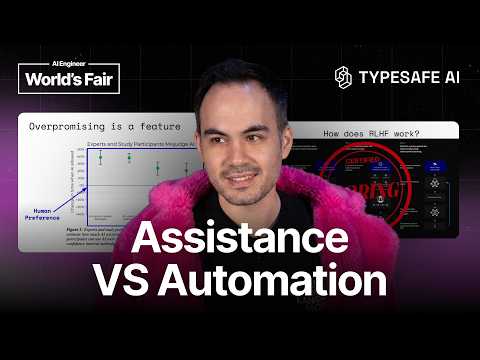
The thumbnail says:
"AI Engineer World's Fair TYPESAFE AI Overpromising is a feature. Human Preference How does RLHF work? Assistance VS Automation"
Reality:
While the thumbnail references 'AI Engineer World's Fair,' its connection to the actual content – a nuanced discussion of AI limitations and post-RLHF techniques – is tenuous and primarily serves as an attention-grabbing hook.
AI Opinion
Almeida’s most compelling argument is that current business applications of AI frequently prioritize cost-shifting over genuine automation or improved decision-making, a point supported by his direct experience with large language models. The claim that minor decisions during ChatGPT's development have widespread consequences feels speculative without more concrete examples; while intriguing, it rests on an insider perspective difficult to independently assess. Listeners should consider the potential for confirmation bias in Almeida’s critique of "cult one" and "cult two" AI perspectives, and investigate alternative explanations for observed limitations beyond those he proposes regarding task definition and data quality.
Avatars are AI rewrites of the same facts — style changes, not substance.
Summary
Diogo Almeida, who has experience with foundational AI models like GPT-4 and RLHF, offers a nuanced perspective on the current state of artificial intelligence, observing a divide between those overly optimistic about its progress and those dismissing its value. He distinguishes between AI applications designed for human assistance – which perform well – and those intended for full automation, which often struggle due to inherent limitations. A key theme is that businesses are increasingly using AI to shift costs onto users rather than for critical decision-making, acknowledging the risks associated with relying on current AI models. Almeida emphasizes that data quality and precise task definition are more important than sheer computational power, highlighting a shift away from simply scaling up resources. His team’s work focuses on developing new post-training methods with distinct optimization goals—moving beyond alignment with human preferences to prioritize factual accuracy and calibrated decision-making—requiring novel API designs that differ significantly from existing approaches like RLHF.
Avatars are AI rewrites of the same facts — style changes, not substance.
Key Points
Diogo's Unique Perspective on ChatGPT
Despite contributing to the development of foundational AI models like GPT-4 and RLHF, Diogo Almeida expresses a degree of skepticism towards ChatGPT. He acknowledges its world-changing potential but emphasizes its limitations and believes many current challenges in the field stem from design choices made during its creation. This perspective sets him apart within OpenAI.
The Spectrum of AI Opinions: 'Cult One' vs. 'Cult Two'
Diogo highlights a stark division in opinions regarding the current state of AI, characterizing them as 'cult one' (AI is progressing incredibly well) and 'cult two' (AI is overhyped and generating little value). He observes that these viewpoints are often extreme, with limited nuance or middle ground, prompting him to seek a more balanced understanding.
The Core Distinction: Assistance vs. Automation
Diogo posits that the key difference between seemingly disparate AI applications lies in their intended purpose: assistance versus automation. Tasks designed to 'please the human in the loop,' like Claude code, excel but are not suitable for true automation. Conversely, tasks meant to operate autonomously often fall short due to limitations inherent in current AI models.
Business Practices and AI Risk
Diogo observes a common business practice of leveraging AI for user-facing tasks, shifting costs onto the user rather than employing it for critical decision-making. He cautions against using AI for high-stakes decisions due to its current limitations and emphasizes that businesses are acutely aware of this risk, prioritizing cost mitigation over efficiency in many applications.
The Importance of Data and Task Definition
Diogo Almeida emphasizes that in real-world applications, data matters more than compute power, a departure from the experience in game development. He further argues that defining the correct task is even more crucial than the quality of the dataset itself. This shift highlights a need to prioritize careful problem formulation and targeted data collection over simply increasing computational resources.
Distinct Optimization Goals Across LLM Post-Training Methods
Different approaches to post-training large language models (LLMs) have unique objectives, or 'North Stars.' RLHF focuses on aligning model outputs with human preferences. Conversely, RLVR aims to minimize log error rates related to factual correctness. The speaker's team is pursuing a third approach centered around calibrated decision-making and integrating the intelligence of pre-trained models into practical software applications.
Novelty in API Design for New Optimization Techniques
The speaker notes a significant difference in the design of Application Programming Interfaces (APIs) across various LLM post-training methods, including RLHF and RLVR. Their team is developing an entirely new approach, which necessitates a fresh API design from the ground up. This indicates that their optimization technique represents a substantial departure from existing paradigms.
Chapters
Claims & Fact Check
Many challenges in the field can be traced back to minor decisions made during ChatGPT's creation.
AI is continuously surpassing human performance across benchmarks.
People aren't really talking about a transformative AI revolution anymore; they’re talking about it being like massively valuable B2B SaaS.
Today's AI is incredible at tasks involving a human in the loop, but not for automation tasks.
Algorithms matter more than compute.
Data matters more than compute.
Doing the right task matters way more than data.
Was this digest good?
More from AI Engineer
Teaching AI to Find Real Vulnerabilities — David Brumley, Bugcrowd
Aug 1, 2026
Rethinking Environments for Long-Horizon Work — Rayan Garg, Theta Software
Aug 1, 2026
Data Quality Is the Compute Multiplier — Ari Morcos, DatologyAI
Jul 31, 2026
Learning on the Job: The Future of Post-Training — Raymond Feng, Applied Compute
Jul 31, 2026
Digest any single YouTube video — free.
3 free digests — no card, no sign-up wall.
Or just swap the domain of any YouTube link → instant digest