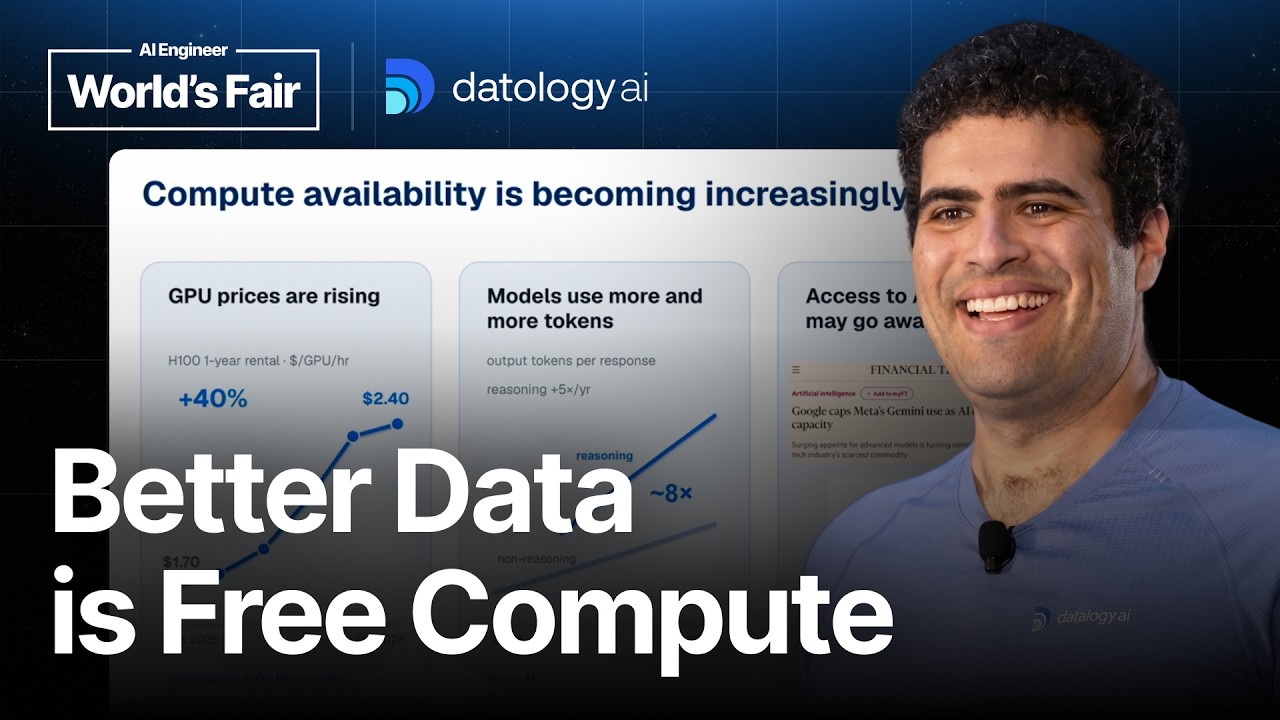
No clickbait detected — the title and thumbnail deliver what they promise.
AI Opinion
The episode convincingly argues that prioritizing data quality offers a significant, and currently undervalued, opportunity to improve large language model performance while reducing computational costs—a compelling case supported by Datology AI’s demonstrations of substantial gains from post-training refinement. While the claim that compute availability has become extremely scarce in just the last six months feels somewhat accelerated, and Google's actions toward Meta remain partially substantiated, the core concept of data quality as a multiplier is well illustrated. Listeners should critically evaluate the specific cost figures presented, as these are likely tied to Datology AI’s proprietary methods and infrastructure, and consider that effectively quantifying and improving "signal per token" remains an ongoing research area with inherent uncertainties.
Avatars are AI rewrites of the same facts — style changes, not substance.
Summary
The episode explores the growing scarcity of computational resources for training and running large language models, driven by factors like increased model complexity and token consumption – particularly with reasoning models which use significantly more tokens than their counterparts. A key insight is that data quality acts as a "compute multiplier," allowing for improved model performance or reduced resource needs. Datology AI’s approach focuses on refining existing data rather than acquiring new data, employing techniques to clean, curate, create, and compose higher-quality datasets. Demonstrations show substantial gains from post-training methods and the ability to achieve competitive model performance at a significantly lower cost—under $20 million—through strategic use of high-quality data. Ultimately, the discussion emphasizes that prioritizing “signal per token” through improved data quality is more valuable than simply increasing training dataset size, representing an underleveraged opportunity for optimizing model development and efficiency; however, effectively scoring and understanding data remains a frontier research challenge.
Avatars are AI rewrites of the same facts — style changes, not substance.
Key Points
Compute Availability is Decreasing
Ari Morcos highlights that compute availability has become extremely scarce over the last six months, with H100 prices increasing by 40% from their lows at the end of the previous year. This scarcity is driven by increased model complexity and token usage, leading to potential limitations on access to frontier APIs.
Reasoning Models Consume Significantly More Tokens
The transcript states that reasoning models utilize eight times as many tokens compared to non-reasoning models, with a projected 5x increase in token usage within the next year. This exponential growth in token consumption exacerbates compute constraints and contributes to concerns about API access limitations.
Data Quality Acts as a Compute Multiplier
Ari Morcos emphasizes that data quality serves as a 'compute multiplier,' enabling improved model performance with the same compute budget or achieving similar performance with reduced computational resources. He illustrates this concept using a schematic showing how better data quality can steepen the learning curve, represented by a shift from a gray to a blue curve.
Datology AI's Approach: Refining Existing Data
Datology AI differentiates itself by refining existing data tokens rather than sourcing new ones. They operate as an 'oil refinery for data,' taking data from public, proprietary, and licensed sources and enhancing its quality through a process involving four key steps: cleaning, curating, creating, and composing.
Post-Training Harness Significantly Boosts Performance
The TR team applied a sophisticated post-training harness to a mid-train model, and the resulting gain nearly tripled compared to applying it to a default instruction tune model. This demonstrates that improving the initial policy of the model through techniques like post-training can dramatically enhance its inference capabilities even without changing the training data itself.
RC Model Achieves Competitive Performance at Lower Cost
The RC team trained a large language model on 17 trillion tokens of publicly available data, achieving performance comparable to models like Open Frontier and GLM5. Remarkably, the total cost for training this competitive model, including salaries, compute, and R&D, was less than $20 million – demonstrating that high-quality data can significantly reduce training costs.
Data Quality is a Key Compute Multiplier
Ari emphasizes that focusing on 'signal per token'—i.e., data quality—is more valuable than simply increasing the number of tokens used for training. He states that repeating high-quality data is preferable to showing low-quality data, and ultimately concludes that data quality remains the single most underleveraged compute multiplier for model development.
Data Scoring and Understanding is a Frontier Research Problem
Ari highlights that effectively leveraging data quality requires advanced techniques to score and understand data across multiple dimensions. This involves scaling these methods to massive datasets (pabytes) and represents an area of ongoing research, offering significant potential for improving model performance and efficiency.
Chapters
Claims & Fact Check
Compute availability has become extremely scarce over the last six months.
Reasoning models use eight times as many tokens as non-reasoning models.
Google capped Meta's Gemini usage due to inference constraints.
Applying a post-training harness to a mid-train model nearly tripled the gain compared to a default instruction tune model.
The RC team trained a competitive model for less than $20 million total.
Data quality is the single most underleveraged compute multiplier.
Was this digest good?
More from AI Engineer

Teaching AI to Find Real Vulnerabilities — David Brumley, Bugcrowd
Aug 1, 2026

Rethinking Environments for Long-Horizon Work — Rayan Garg, Theta Software
Aug 1, 2026

What's Next After RLHF? — Diogo Almeida, TypeSafe AI
Jul 31, 2026
Learning on the Job: The Future of Post-Training — Raymond Feng, Applied Compute
Jul 31, 2026
Digest any single YouTube video — free.
3 free digests — no card, no sign-up wall.
Or just swap the domain of any YouTube link → instant digest