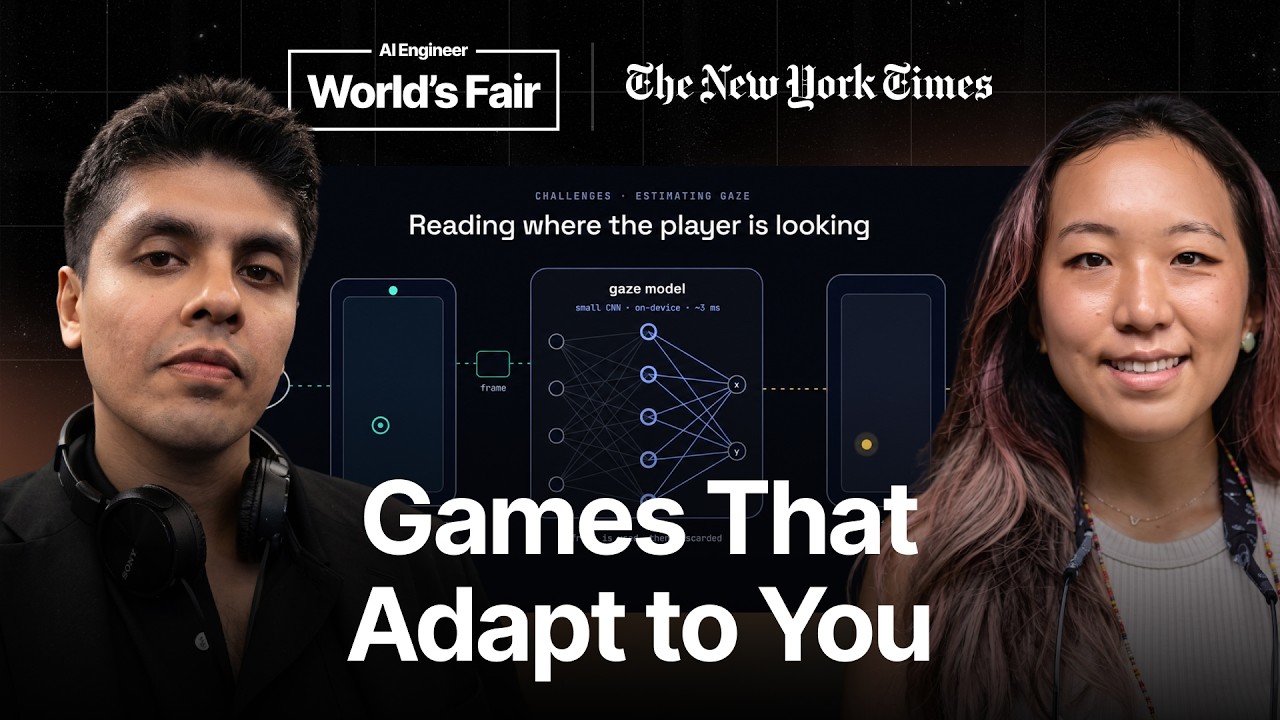
No clickbait detected — the title and thumbnail deliver what they promise.
AI Opinion
The episode convincingly argues that on-device AI processing offers significant advantages for mobile games, particularly in latency and user privacy, and thoughtfully explores the potential for personalized game experiences through agentic systems like EfficientZero. However, the discussion surrounding "empathetic partners" and the extent to which current AI can achieve truly responsive personalization feels speculative, relying more on aspirational vision than demonstrated capability. Listeners should critically evaluate claims regarding long-term memory integration and predictive capabilities, as these remain substantial technical challenges for agentic AI in gaming.
Avatars are AI rewrites of the same facts — style changes, not substance.
Summary
Shafik Quoraishee and Joanne Song from The New York Times discussed the application of agentic AI in mobile games, emphasizing their commitment to human-designed puzzles rather than AI generation. They traced the history of AI in gaming back to early examples like Pac-Man, highlighting the evolution of techniques. A key advantage presented was on-device AI processing, which minimizes latency, enhances privacy, and enables offline functionality. The presentation introduced EfficientZero as a sample-efficient reinforcement learning model and explored how agentic systems can dynamically audit layouts and resize controls for improved accessibility and user experience—illustrated through a tug-of-war analogy representing personalized game tuning. Future development focuses on improving processing speed, predictive capabilities, and incorporating long-term memory to create highly individualized gaming experiences, advocating for decentralized "local brains" over centralized AI models and the need for standardized game state languages.
Avatars are AI rewrites of the same facts — style changes, not substance.
Key Points
The New York Times' Approach to AI in Games
Shafik and Joanne from The New York Times emphasized that their puzzles are created by human designers, not AI. They explicitly state there is no AI or AI features within the games themselves, including things like Wordle Bot which is a separate tool. This commitment to human-created content distinguishes their approach from AI-generated game development.
Historical Context: AI in Games from the 1980s
The discussion traces the history of AI in gaming back to the 1980s, citing Pac-Man as an early example utilizing finite state machines. These systems used conditional logic to dictate ghost behavior based on Pac-Man's actions, representing a basic form of symbolic AI that has evolved significantly over time.
Advantages of On-Device AI Processing
The presentation highlights the benefits of running AI computations locally on devices, rather than relying on cloud infrastructure. This approach reduces latency by eliminating round trips to servers, improves privacy as data remains within the device's security zone, and enables functionality even without an internet connection – crucial for scenarios like subway rides.
EfficientZero: Sample Efficient Reinforcement Learning
Shafik introduces EfficientZero and EfficientZero V2 as state-of-the-art reinforcement learning models. These models are characterized by their 'sample efficiency,' meaning they learn quickly with less data compared to traditional methods, representing a significant advancement in training AI agents for complex games.
Agentic Layout Auditing and Dynamic Resizing
The agent acts as a 'live layout auditor' constantly measuring the interface and dynamically resizing controls to accommodate user needs. This goes beyond traditional accessibility features, actively responding to issues like shaky taps or difficulty with targets. For example, it can catch violations and rewrite the layout live, adapting to the human rather than forcing the human to adapt to the game.
The Tug-of-War Analogy for Personalized Game Tuning
Shafik uses a tug-of-war analogy to illustrate how the system dynamically tunes the game to the player, rather than maintaining a fixed state. This means accessibility and challenge are not treated as separate concerns but become two ends of a single dial constantly adjusting for optimal user experience. The goal is to create a responsive and empathetic gaming environment.
Future Needs: Speed, Prediction, and Long-Term Memory
To truly understand games, local agents need significant improvements in speed – decisions must be made within a 16ms frame to prevent stuttering. They also require predictive models to anticipate the impact of layout changes before implementation. Crucially, long-term memory is needed to learn an individual's unique habits and needs over time, leading to highly personalized experiences.
Chapters
Claims & Fact Check
The New York Times' puzzles are not created using AI.
Running AI on local devices reduces latency and improves privacy.
EfficientZero models learn faster than traditional reinforcement learning methods.
On-device AI can move past fixed menus and turn our devices into responsive empathetic partners.
We need a shared game state language so one agent can work across multiple games instead of being rebuilt from scratch.
The future of AI doesn't have to be one giant centralized brain; it can be billions of small local brains.
Was this digest good?
More from AI Engineer

MCP Tasks (async): Why Aren't Any Agents Supporting Them? — Cornelia Davis, Temporal
Aug 2, 2026

When Will The Benchmaxxing Plague End? — Nick Heiner, Surge AI
Aug 2, 2026

Teaching AI to Find Real Vulnerabilities — David Brumley, Bugcrowd
Aug 1, 2026

Rethinking Environments for Long-Horizon Work — Rayan Garg, Theta Software
Aug 1, 2026
Digest any single YouTube video — free.
3 free digests — no card, no sign-up wall.
Or just swap the domain of any YouTube link → instant digest