Clickbait Checker
The video title says:
"MCP Tasks (async): Why Aren't Any Agents Supporting Them? — Cornelia Davis, Temporal"
Reality:
The title accurately reflects the episode's focus on why MCP tasks, a relatively unadopted feature within Temporal, haven't gained widespread support despite their potential benefits.
The thumbnail says:
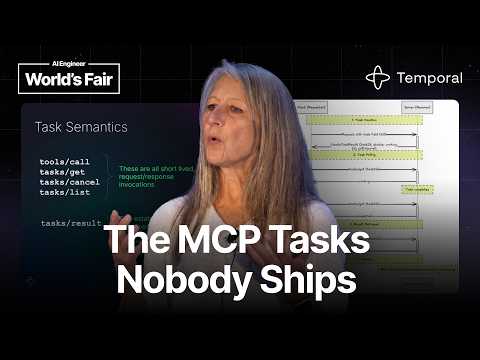
"AI Engineer World's Fair Task Semantics tools/call tasks/get tasks/cancel tasks/list tasks/result These are all short lived request/response invocations The MCP Tasks Nobody Ships Temporal"
Reality:
The thumbnail’s 'AI Engineer World's Fair' and listed task semantics are tangentially related as they represent the technical aspects discussed, but don't fully convey the core issue of adoption challenges and protocol evolution.
AI Opinion
Cornelia Davis effectively argues that MCP tasks’ inherent complexity and the significant engineering effort required for implementation have hindered broader adoption despite their potential benefits for asynchronous process control and durability. The explanation of invoice processing clearly illustrates these challenges, though the discussion occasionally presents the shift to a stateless protocol as an unequivocal improvement without fully acknowledging potential trade-offs in functionality or developer experience. Listeners should independently investigate the practical implications of client-side task ID persistence—particularly given its current non-mandatory status—to assess its impact on operational overhead and system resilience.
Avatars are AI rewrites of the same facts — style changes, not substance.
Summary
The discussion centers on MCP tasks, a specification for asynchronous signaling within long-running processes, and why adoption has been limited. Initially marked as experimental in November, the complexity of MCP tasks—illustrated by an invoice processing example involving multiple systems and human interaction—has deterred widespread integration. A core benefit is enabling asynchronous control over these processes while guaranteeing durability even through infrastructure failures or human unavailability, a significant implementation challenge. Recent efforts are transitioning from a stateful to a stateless protocol to improve scalability, alongside changes in task management functionality between versions 1 and 2. While the specification now recommends clients persist task IDs for recovery purposes, this isn't currently mandatory, which is seen as an area needing further refinement within the protocol.
Avatars are AI rewrites of the same facts — style changes, not substance.
Key Points
MCP Tasks are Marked Experimental
Cornelia explains that the MCP tasks specification, released in November, was initially marked as experimental. This designation is a key reason why many agents and clients haven't adopted it yet, as developers often avoid integrating features labeled as experimental due to potential instability or future changes.
MCP Tasks Involve Complexity & Long-Running Processes
Cornelia states that MCP tasks are inherently complex and involve long-running processes, which she intends to explain throughout the presentation. The example of invoice processing demonstrates this complexity, involving validation against an ERP system, human approval loops, reconciliation, and parallel inventory updates and payments.
MCP Tasks Enable Asynchronous Signaling
Cornelia highlights that the core value of MCP tasks lies in their ability to enable asynchronous signaling into long-running processes. The 'reject or approve' mechanism within the invoice processing example demonstrates this, allowing external systems to influence and control ongoing operations without blocking.
MCP Tasks Guarantee Durability
A crucial aspect of MCP tasks is their durability. The specification mandates that once a task is launched, it must persist even in the face of infrastructure failures like network issues, human unavailability (e.g., vacations), or server crashes. This requirement adds significant complexity to implementation.
Complexity of MCP Client Protocol Handler
The speaker highlights the complexity of the MCP client protocol handler, describing it as 'ugly' and requiring a long-running connection. This necessitates mechanisms to handle connection failures and resume tasks from where they left off, emphasizing durability considerations within the task specification. The visual representation shown demonstrates the intricate nature of this protocol.
Transition to Stateless MCP Protocol
Angie Jones at Agoric AI Foundation initiated a shift towards a stateless MCP protocol, which is a significant improvement. The speaker emphasizes that stateful protocols are problematic in large-scale distributed systems, and this change aims to address those issues. This transition involves several improvements including a stateless core and structured MCP with extensions.
Changes to Task Management from V1 to V2
The task list functionality has been removed in the V2 protocol, replaced by an endpoint allowing clients to send updates. This shift aligns with Temporal's signal mechanism, enabling a more efficient and flexible approach to long-running tasks. The removal of the task list is attributed to its limited usefulness at scale.
Client-Side Persistence of Task IDs
The MCP specification now strongly encourages clients to persist task IDs, although it's currently presented as a recommendation rather than a mandatory requirement. The speaker expresses surprise that this isn’t enforced with an 'all caps must,' noting the lack of persistence would make recovery impossible. This highlights an ongoing refinement in the protocol's design and implementation.
Chapters
Claims & Fact Check
The MCP tasks specification was marked as experimental in November.
MCP Tasks V1 is being replaced by a new version coming out in July.
MCP tasks are designed to be durable and survive infrastructure failures.
Stateful protocols are the absolute worst thing in large-scale distributed systems.
The MCP specification says clients should persist task IDs, but it's not a requirement.
With the removal of the list functionality in V2, clients must persist task IDs to recover them.
Was this digest good?
More from AI Engineer


Digest any single YouTube video — free.
3 free digests — no card, no sign-up wall.
Or just swap the domain of any YouTube link → instant digest