Clickbait Checker
The video title says:
"Ray Dalio: I Predicted The 2008 CRASH, I Know What Comes Next"
Reality:
The title claims Dalio predicted the 2008 crash and knows what comes next, but the episode focuses on AI bubble warnings, debt cycles, and geopolitical risks, not a specific prediction of an imminent collapse or a direct sequel to 2008.

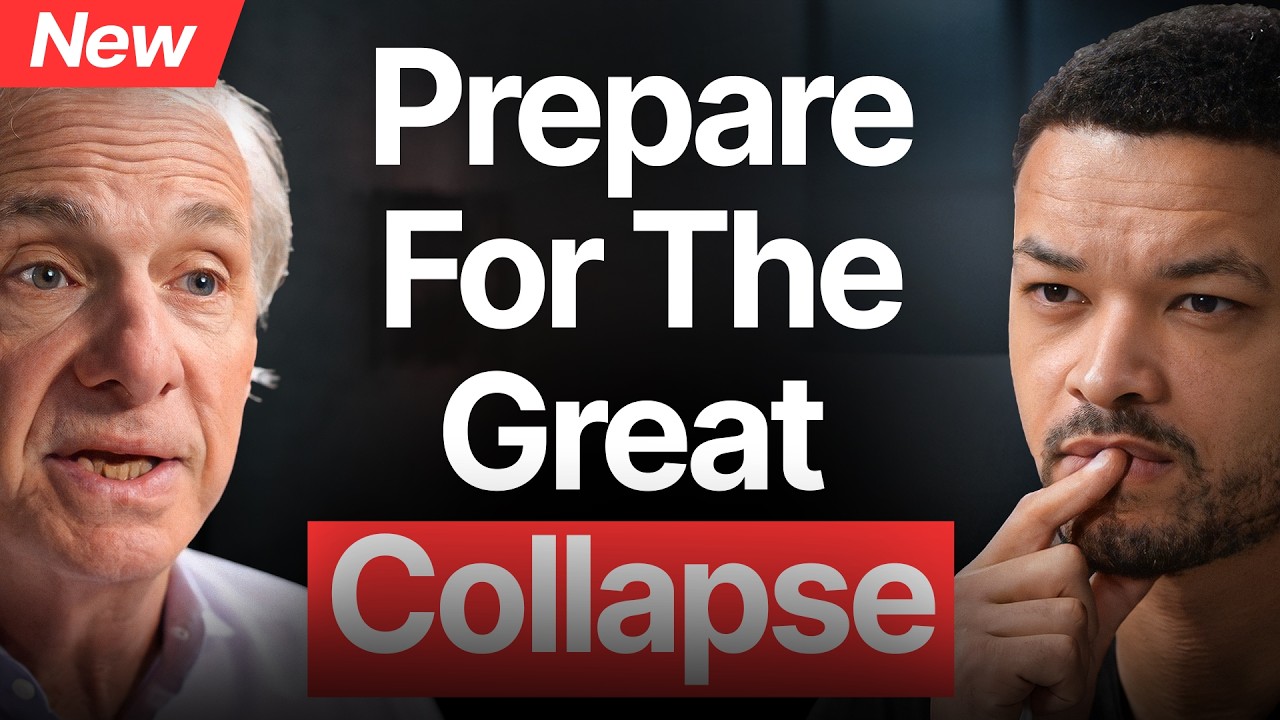
The thumbnail says:
"New Prepare For The Great Collapse"
Reality:
The thumbnail promises preparation for a 'Great Collapse,' but the episode discusses economic cycles, AI disruption, and diversification advice, not actionable steps for an imminent societal or economic collapse.
AI Opinion
Ray Dalio’s most convincing argument is his structural warning that the AI investment frenzy mirrors classic bubble mechanics—overvaluation, leveraged speculation, and a dangerous confusion of wealth with money—supported by his firm’s verified track record of navigating the 2008 crash. However, his claims rest on weaker ground when he asserts that the current AI environment is “the biggest investment bubble in American history,” a superlative that requires more rigorous comparative data across historical bubbles, and his predictions about Taiwan’s reunification without US-China war or US decline signaled by the Iran conflict are speculative geopolitical forecasts lacking concrete evidence. A thoughtful viewer should double-check the verified data on Bridgewater’s returns and inflation rates, while treating Dalio’s broader historical analogies and societal bifurcation timelines as informed opinions rather than proven forecasts.
Avatars are AI rewrites of the same facts — style changes, not substance.
Summary
In this episode, Ray Dalio warns that the current AI investment frenzy exhibits classic bubble characteristics, including overvaluation, leveraged speculation, and a confusion of wealth with money, mirroring patterns seen in 1929 and 2000. He argues that while AI is revolutionary, its disruption will bifurcate society, benefiting a small cutting-edge group while replacing many thinking jobs, a shift he sees as faster than the Industrial Revolution due to massive capital flows. Dalio emphasizes that internal factors—such as debt, education, and political conflict—determine national power more than external conflict, citing the UK as a cautionary tale of a debt trap where leaders cannot raise taxes or cut benefits without backlash. He predicts the Taiwan issue will be resolved without direct US-China war, and that US military involvement in Iran reflects broader internal decay. On investing, Dalio advises diversification over market timing, notes that cash is a poor long-term asset due to inflation, and points to his firm’s verified track record of positive returns during the 2008 crash. He also stresses that beyond basic financial security, happiness is not correlated with wealth, and advises young people to align their work with their innate nature.
Avatars are AI rewrites of the same facts — style changes, not substance.
Insights
What this episode means but never says outright — each one grounded in the fact-checks and key points below.
The episode claims Bridgewater's 53 billion gains and 12% return are unverified, yet key point 9 states Bridgewater delivered about 53 billion in cumulative net gains with a 12% average return, creating a conflict between the claim and the episode's own content.
Based on:
The episode claims Bridgewater posted positive returns of 9.5% in 2008 while the S&P 500 fell nearly 40%, but the fact-check verdict is unverified, even though key point 9 explicitly states that the fund posted positive returns of 9.5% in 2008 while the S&P 500 fell nearly 40%.
Based on:
The episode claims the UK has had six new prime ministers in the last seven years, but the fact-check verdict is unverified, even though key point 3 explicitly states that the UK has had six new prime ministers in the last seven years.
Based on:
The episode claims privately owned capitalist businesses are typically more productive than government entities, but the fact-check verdict is unverified, even though key point 2 explicitly asserts that privately owned capitalist businesses are typically more productive than government entities.
Based on:
The episode claims the US war in Iran is a sign of US decline recognized by world leaders, especially in Asia, but the fact-check verdict is outside-corpus, even though key point 8 states that Dalio suggests the US war in Iran reflects a broader international recognition that the United States is in decline and that world leaders, especially in Asia, see the US as struggling.
Based on:
Key Points
Ray Dalio warns of an AI bubble with classic signs of overvaluation
Dalio agrees with Jeremy Grantham that current AI enthusiasm mirrors past bubbles like 1929 and 2000. He explains that while AI is revolutionary, investors ignore price, borrow money to bet, and confuse wealth with money. When interest rates rise or taxes change, forced selling pricks the bubble, causing a reverse wealth effect that hurts the economy and society.
Bridgewater's 53 billion in gains and 2008 crisis foresight
Dalio states Bridgewater delivered about 53 billion in cumulative net gains with a 12% average return and no significant losses, uncorrelated with other investments. In 2008, the fund posted positive returns of 9.5% while the S&P 500 fell nearly 40%, because Dalio foresaw the crisis. This track record underpins his credibility on macro risks.
Bubble mechanics: price, debt, and the wealth illusion
Dalio breaks down how bubbles form: a revolutionary technology (like AI) attracts excitement, people buy without regard to price, often borrowing money. Wealth is not spendable until sold; when debt service or tax changes force sales, the bubble bursts. He cites 1929 and 2000 as examples where the same pattern led to depressions and economic pain for real people.
Bubble indicators and the AI stock supply dynamic
Ray Dalio explains that a key bubble sign is when investors pour leveraged money into assets, treating them like crapshooting. He uses the example of an AI company founder who raised hundreds of millions of dollars easily, which increases the supply of AI stock and contributes to the bubble. This dynamic shows how easy fundraising itself can be a warning signal of frothy markets.
Diversification and the importance of not timing the market
Dalio advises that even sophisticated investors struggle to time bubbles, so the key principle is diversification. He shares his personal experience of building financial security by counting how many months he could survive without income, starting from having no money. The message is to prepare for uncertainty by spreading risk rather than trying to predict crashes.
Why cash is not a safe long-term investment
Dalio argues that holding cash in bank deposits or money market funds is actually the worst investment over long periods because inflation erodes purchasing power. With inflation around 3.5–4% per year, even if you earn a similar interest rate, taxes on the nominal gain mean you lose real value. He emphasizes that cash feels safe but guarantees a poor real return over time.
Major asset classes and their cycle risks
Dalio outlines the main investment choices: stocks, cash, gold, bonds, real estate, and Bitcoin. He notes that stocks can experience bear markets with declines of 60–70%, driven by the same bubble-and-bust cycles. Each asset class changes for specific reasons, and understanding these cycles is crucial for managing risk.
AI will bifurcate society: top 0.1–10% thrive, thinking-job workers risk replacement
Dalio argues that AI will split the workforce into a small cutting-edge group that uses AI to accelerate and a larger group in thinking jobs who face replacement. He frames this as part of an evolutionary progression where machines first replaced physical labor (agriculture, factories) and now move up to replace higher levels of reasoning and thinking. He notes that the share of revenue going to workers is declining while the share going to business owners is rising, and that college graduates already face increased difficulty finding employment because many tasks can be done faster by AI and computerization.
Historical analogy: AI disruption is faster than the Industrial Revolution due to capital flow
The interviewer highlights that the speed of AI disruption is unprecedented because massive capital is flowing into frontier models like Anthropic and OpenAI, unlike the Industrial Revolution where building tractors took time. Dalio agrees and adds that typically a bubble bursts, creating a cyclical dynamic where technology evolves but supply-demand and debt problems then cause unemployment from a combination of financial crisis, falling collateral, and reduced asset purchases. He contrasts this structural AI-driven job loss with cyclical economic downturns.
Uber CEO envisions 9 million delivery drivers replaced by autonomous vehicles and robots
Humans must leverage unique emotional and intuitive skills as AI replaces mental labor
Dalio argues that as artificial intelligence replaces both physical and mental work, humans will be left with only emotions and intuitions that AI cannot replicate. He gives examples like the quality of a massage or other human touch services. He emphasizes that for the foreseeable future, those who can combine exceptional human intelligence with AI partnership will be at the cutting edge.
Advice for 16-year-olds: prioritize happiness and health over maximum income
When asked what a 16-year-old should do given the future, Dalio first stresses that there is little correlation between money and happiness beyond a basic level. He advises getting above the level of financial panic, then making your work and passion the same thing. He tells his own grandkids to understand their innate nature—whether adventurous, conceptual, or concrete—and find a path that matches it, while not forgetting the money part.
Balancing Wealth Redistribution with Productivity
Dalio argues that simply making transfer payments for consumption undermines a society's productivity because it diverts money from capital expenditures and investments that enhance productive capacity. He emphasizes that any wealth redistribution must be paired with improvements in education and other productivity-boosting measures to avoid long-term economic decline. The goal should be to establish a minimum standard of living while simultaneously fostering conditions that allow most people to become productive contributors.
Private Sector vs. Government Efficiency
Dalio asserts that privately owned capitalist businesses are typically more productive than government entities because they attract entrepreneurial, efficiency-driven individuals. He criticizes government as often dysfunctional, plagued by arguing and poor distribution, and notes that the most productive people tend to avoid government work. He stresses that entrepreneurship and efficient management are indispensable, whether in the private sector or within government itself.
UK as a Cautionary Tale of the Classic Debt Cycle
Dalio identifies the UK as a classic example of a country that has become over-indebted, underproductive, and out of financial options, leading to intense internal political conflict. He points out that the UK has had six new prime ministers in the last seven years as leaders make promises they cannot keep, eroding public trust. The combination of heavy debt, low productivity, and large wealth gaps leaves policymakers trapped: they cannot raise taxes (people will leave) nor cut benefits (sufferers will revolt), and lenders become unwilling to finance deficits.
The Mechanics of a Debt Trap for Nations
Dalio explains the mechanical dilemma facing indebted nations: they run large deficits but cannot raise taxes or cut benefits without severe political backlash. As a result, they struggle to find sources of money and risk being unable to finance their deficits because lenders lose confidence. This creates a self-reinforcing cycle where lack of funds exacerbates political instability and economic decline, mirroring the pattern seen in the UK.
Historical pattern of superpowers and the emerging multipolar world
Dalio explains that over the last 500 years, when the world became interconnected after World War I and II, there tended to be one dominant superpower. However, he argues that the current decline of the US and rise of China will likely lead to a regionalized world rather than a single dominant power. He notes that China's cultural objective is not to occupy other countries but to avoid being cut off and to compete within its own top-down Confucian system.
Internal factors determine national power more than external conflict
Dalio states that the relative strength of countries like the US and China will be determined by how they educate their populations, spend money, and manage themselves internally. He warns that the US faces risks from debt and internal conflict that could erode its power from within, while China's power could shift if it mismanages its own system. This internal focus is key to understanding future global balance.
Taiwan issue likely resolved without direct US-China war
Dalio predicts that the Taiwan issue will most likely be handled without a great military war between the US and China. Instead, he believes pressures will be created that lead to a reunification of China. He emphasizes that both sides have enough wisdom to avoid a catastrophic conflict, though tensions will remain.
US war in Iran seen as part of broader internal decay
When asked about the US war in Iran, Dalio suggests it reflects a broader international recognition that the United States is in decline. He notes that world leaders, especially in Asia, see the US as struggling with internal issues like debt and conflict, which weakens its global standing. The war is framed as a symptom of deeper problems rather than a strategic success.
Chapters
Claims & Fact Check
Bridgewater produced about 53 billion in cumulative net gains with a 12% return and no significant losses, uncorrelated with other investments.
Bridgewater posted positive returns of 9.5% in 2008 while the S&P 500 plunged by almost 40%.
The current AI investment environment is the biggest investment bubble in American history.
Cash is the worst investment over a long period of time because inflation will eat it away.
The current inflation rate is about 3.5 to 4% per year.
Bear markets can see stocks go down 60–70%.
The share of revenue going to workers is going down, while the share going to business owners is going up.
College graduates' difficulty to get employment has increased significantly.
Uber's 9 million drivers will be replaced by autonomous vehicles and robots.
Whisper Flow is four times faster than typing.
There is very little correlation between the amount of money you have and the level of happiness past the basic level.
Privately owned capitalist businesses are typically more productive than government entities.
Government does not attract many productive people and is almost dysfunctional due to arguing and poor distribution.
The UK has had six out of the last seven years with a new prime minister because leaders make promises that don't pan out and people quickly lose trust.
China has no desire to occupy or control other countries due to cultural reasons rooted in Confucianism.
Taiwan will be reunified with China without a great military war between the US and China.
The US war in Iran is a sign of US decline recognized by world leaders, especially in Asia.
Was this digest good?
More from Diary of a CEO

This Doctor Quit To Warn You: If You Wake Up At 3AM, You NEED To Know This!
Jul 27, 2026

URGENT UPDATE - Iran War Expert: A Mass Casualty Attack Is Coming! | Robert Pape
Jul 23, 2026

The Man Who Made $100M Before 32: The Secret Was To Stop Letting Them Control Me | Alex Hormozi
Jul 20, 2026

Cancer Scientist: This Common Daily Diet May Be Feeding Cancer! - Thomas Seyfried
Jul 16, 2026
Digest any single YouTube video — free.
3 free digests — no card, no sign-up wall.
Or just swap the domain of any YouTube link → instant digest