Clickbait Checker
The video title says:
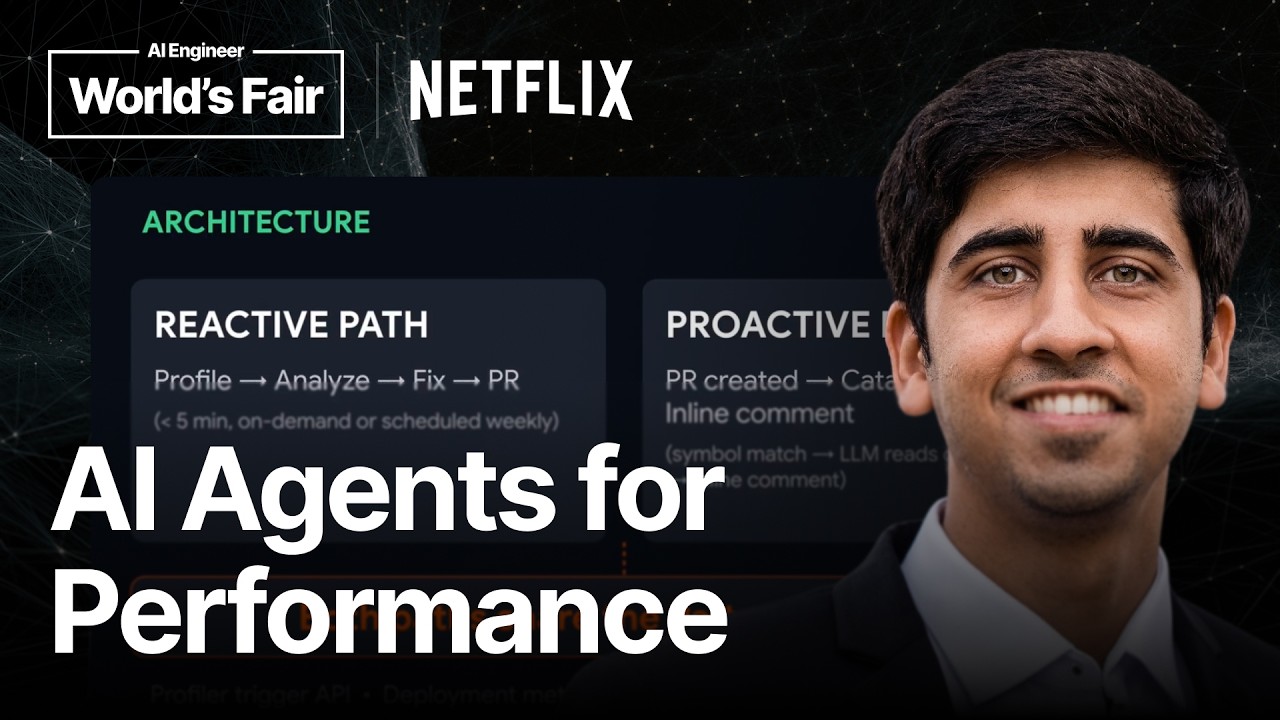
"AI Agents for Performance: Ship Faster, Pay Less — Rajat Shah, Netflix"
Reality:
The title accurately reflects the episode's discussion about using AI agents to improve performance engineering processes at Netflix, though it implies a more immediate and substantial impact than is presented.
AI Opinion
The episode convincingly demonstrates how Netflix is using AI agents to streamline performance engineering by identifying common coding inefficiencies, particularly those related to data structure patterns—a pragmatic application leveraging LLMs and a centralized knowledge base. However, the claim that compute costs are increasing at a similar pace to coding speed feels like an oversimplification; while increased velocity can strain resources, it’s not necessarily a direct, proportional relationship needing further investigation. Listeners should also be mindful that the discussion focuses primarily on problem identification, and the full impact of automated optimization remains largely unexplored beyond acknowledging its necessity.
Voices are AI rewrites of the same facts — style changes, not substance.
Summary
Netflix is exploring the use of AI agents to automate performance engineering, addressing a bottleneck created by the tedious and time-consuming manual processes currently in place. These agents leverage large language models (LLMs) that can identify common coding inefficiencies – such as O(n²) loops – across various programming languages due to consistent data structure patterns in profiling information. A key component of this approach is a centralized catalog of performance patterns and anti-patterns, drawing from both public resources and internal playbooks. While AI agents accelerate code creation, they don't inherently guarantee performant code, leading to rising compute costs that necessitate automated optimization solutions. The initial focus is on problem identification with human review remaining crucial for ensuring code stability and security; higher levels of autonomy require significant investment in robust security measures to mitigate risks like prompt injection. Ultimately, scheduled runs will enable proactive detection of new performance issues as codebases evolve.
Voices are AI rewrites of the same facts — style changes, not substance.
Insights
What this episode means but never says outright — each one grounded in the fact-checks and key points below.
The episode claims that an O(N^2) implementation is a common problem across languages, but the checked evidence finds this unverified, while the episode itself uses this as a key assumption for LLM pattern recognition.
Based on:
The episode states that human review remains essential for code changes, yet the claim that human approval is still needed is marked as outside-corpus, creating a tension between the episode's assertion and the fact-check's inability to verify it.
Based on:
The episode's claim that compute cost increases at a similar pace to coding speed is outside-corpus, but the episode itself notes that coding speed is outpacing optimization, implying a potential imbalance that could lead to higher costs.
Based on:
Key Points
Manual Performance Engineering is Tedious & Time-Consuming
The traditional process of human performance engineers involves profiling production instances, analyzing raw data (often JSON call stacks), and manually searching codebases for bottlenecks. This process takes a significant amount of time – 'many, many minutes' – to identify issues, creating a bottleneck that limits the frequency of optimization efforts.
Profiling Data Structure is Consistent Across Languages
A core assumption for using LLMs in performance engineering lies in the consistent structure of profiling data regardless of the programming language used (Java, Python, Go). Profilers capture call stacks, CPU time (self and inclusive), and sample data at high frequency. This standardized output allows an LLM agent to process data from diverse services uniformly.
LLMs Can Leverage Common Coding Patterns
Rajat highlights that AI agents have learned common coding patterns through training on vast codebases. These include inefficiencies like O(n²) loops, redundant calculations within loops, and frequent object allocations. LLMs can leverage this knowledge to identify and suggest optimizations applicable across various projects.
Long-Term Memory for Coding Agents
To create coding agents as efficient as human engineers, a long-term memory system is crucial. This allows the agent to reuse past experiences and avoid redundant work. The initial approach involves building a catalog of patterns and anti-patterns that can be leveraged by an LLM agent, creating a stateful memory for the entire fleet.
Centralized Pattern Catalog as a Foundation
The core of this system is a central, ever-growing catalog of patterns and anti-patterns. This catalog should not be team or product specific but rather serve as a shared resource across the organization. Generalizable findings, such as the O(N^2) implementation issue in various programming languages, can be incorporated to broaden its applicability.
Leveraging Existing Resources for Pattern Identification
Organizations don't have to start building a pattern catalog from scratch. Public resources like Jeff Dean’s blog post on C++ optimizations and PyTorch’s torch fix code repository can serve as valuable starting points. Existing performance playbooks within the organization are also excellent sources for identifying common patterns and anti-patterns.
Human Review Remains Essential
Even with advanced AI agents, human review remains a critical step in the optimization process. Modifying production code carries inherent risks if the business context and test coverage are not fully understood. This ensures that changes don’t inadvertently introduce breaking issues or negatively impact system stability.
Initial AI Agent Implementation Focuses on Problem Identification
The initial implementation of AI agents in the software development lifecycle should focus on identifying potential problems, even if it requires manual intervention. This involves integrating an LLM to suggest fixes and triggering profilers to generate output which is then fed into the agent. While a canary test might still be manually run, this approach significantly reduces the time spent analyzing flame graphs and focusing on problem identification.
Level Two Automation Involves Tool Integration and Workflow Hooks
Netflix's level two automation, part of their agentic spectrum, centers around integrating AI agents with existing tools and workflows. This involves establishing key harnesses and hooks to enable the agent to identify problems and offer solutions across various development areas. The goal is to provide opportunities for code base improvement beyond simple problem identification.
Scheduled Runs Enable Proactive Problem Detection
Once a standard workflow is established, scheduled runs can be implemented to continuously identify new problems that may have been introduced since the last run. This proactive approach allows for problem identification closer to when the code was written, enabling faster resolution and reducing potential impact on services. The frequency of these runs (e.g., weekly) should align with the rate of change in the codebase.
Higher Levels of Autonomy Require Significant Security Investment
While higher levels of AI agent autonomy, involving planning and reasoning capabilities, offer potential benefits, they also introduce significant security risks. Prompt injection and other attacks pose a threat that current agent infrastructure may not adequately address. Consequently, substantial investment in evaluation sandboxing and robust security guardrails is essential before pursuing level three autonomy.
The Coding Speed Discrepancy & Compute Costs
Rajat explains that the rapid increase in coding speed due to AI-powered coding agents is outpacing performance optimization efforts. While these agents accelerate code creation, they don't inherently produce performant code, leading to a rise in compute costs as systems become more complex and less efficient. This creates a need for automated performance engineering solutions.
Chapters
Claims & Fact Check
An engineer spends 20 minutes identifying hot paths in profiling data.
Coding agents are getting better at solving problems.
Compute cost is increasing at a similar pace to coding speed.
AI agents don't always write performant code.
An O(N^2) implementation is a common problem across programming languages.
Public resources like Jeff Dean's blog post can be used to improve coding agents.
Human approval is still needed for code reviews even with AI agents.
Introducing an LLM into the software development lifecycle improves efficiency.
Level two automation focuses on tool integration and workflow hooks.
Higher levels of AI agent autonomy require substantial security investment.
More from AI Engineer


Digest any single YouTube video — free.
3 free digests — no card, no sign-up wall.
Or just swap the domain of any YouTube link → instant digest