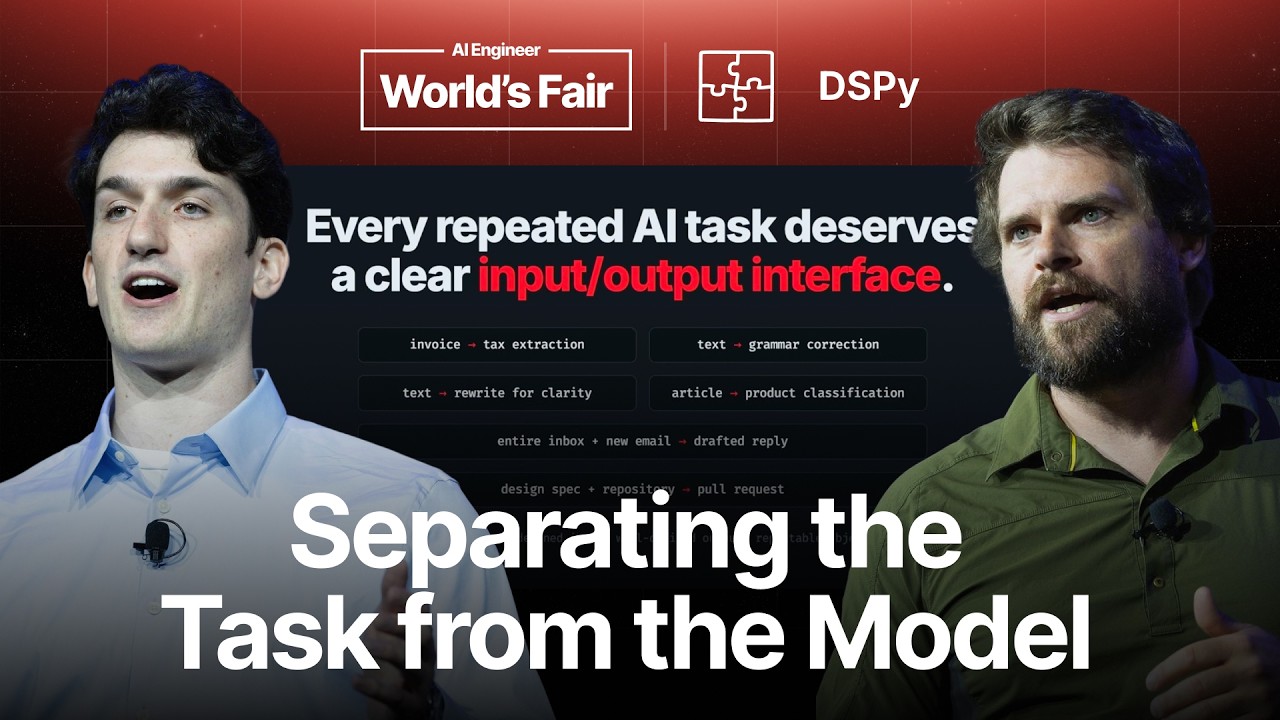
No clickbait detected — the title and thumbnail deliver what they promise.
AI Opinion
The episode most convincingly argues that structuring AI tasks as modular functions, as exemplified by DSPI, offers significant advantages in terms of reusability and experimentation—a compelling case for adopting programming-inspired practices within AI development. However, the discussion occasionally glosses over the practical challenges of precisely defining task boundaries and ensuring consistent specification across diverse applications; the presented examples primarily involve relatively contained scenarios. Listeners should critically evaluate how readily this methodology scales to significantly more complex or ambiguous real-world problems beyond those demonstrated in the episode’s case studies.
Avatars are AI rewrites of the same facts — style changes, not substance.
Summary
The speakers discuss a methodology for AI development inspired by traditional programming practices, emphasizing the benefits of modularity and reusability. They introduce DSPI, an open-source Python tool designed to treat repeated AI tasks as functions with defined inputs and outputs, enabling composability, testability, and optimization. This approach allows developers to isolate task specifications from implementation details, fostering agility and facilitating rapid experimentation with different models or techniques. Effective task specification involves defining instructions, constraints, and input/output signatures, which supports automated optimization and delegation. DSPI’s development has focused on specifications, code, and evaluations to ensure consistency and reproducibility, reflecting the field's evolution beyond basic prompting towards more adaptive AI systems capable of handling complex tasks like evolving emails.
Avatars are AI rewrites of the same facts — style changes, not substance.
Key Points
The Function Analogy in AI Programming
Drawing a parallel to traditional programming, the speakers advocate for treating repeated AI tasks as 'functions' – reusable, composable, testable, and optimizable units. This approach involves defining clear inputs and outputs, encapsulating implementation logic, and enabling broader program composition. The analogy emphasizes the benefits of modularity and abstraction in AI development.
DSPI Enables Modularity and Reusability
DSPI (Declarative Specification Programming Interface) is an open-source Python software designed to bring the benefits of functions – reusability, composability, testability, and optimizability – to AI programs. It provides tooling for defining clear interfaces and treating AI components as 'black boxes,' allowing developers to focus on task specifications rather than implementation details.
Defining Task Boundaries Enables Agility
By establishing clear input and output interfaces for repeated AI tasks, developers gain significant agility. This allows them to experiment with different internal implementations without affecting the overall task definition. The ability to isolate and modify internals fosters rapid prototyping and adaptation to new models or techniques.
Three Components of Task Specification
According to DSPI's creator, effectively specifying an AI task requires three key components: what should happen (instructions), what must happen (constraints enforced through code), and the signatures that define inputs and outputs. This structured approach facilitates automated optimization and delegation of implementation details, enabling more efficient development workflows.
DSPI's Core Principles (Specs, Code, and Evaluations)
Since 2022, DSPI has centered its efforts around three key principles: specifications, code, and evaluations. These are formalized as a programmatic interface to ensure consistency and reproducibility in AI development. This structured approach allows for easier collaboration and the integration of new techniques within the framework.
Evolving Techniques from Few-Shot to Harnessing Emails
The field has seen rapid advancement, moving beyond simple few-shot prompting. Current methods involve sophisticated techniques like harnessing and even evolving emails over time, demonstrating a shift towards more adaptive and personalized AI systems. This progression highlights the continuous innovation within the AI landscape.
Chapters
Claims & Fact Check
DSPI brings all properties of functions to AI programs.
Defining an input interface and output interface gives you a lot of agility.
You need three things to specify your task.
You should ask how any new technique helps you solve harder problems or your own problems better.
Was this digest good?
More from AI Engineer


Digest any single YouTube video — free.
3 free digests — no card, no sign-up wall.
Or just swap the domain of any YouTube link → instant digest