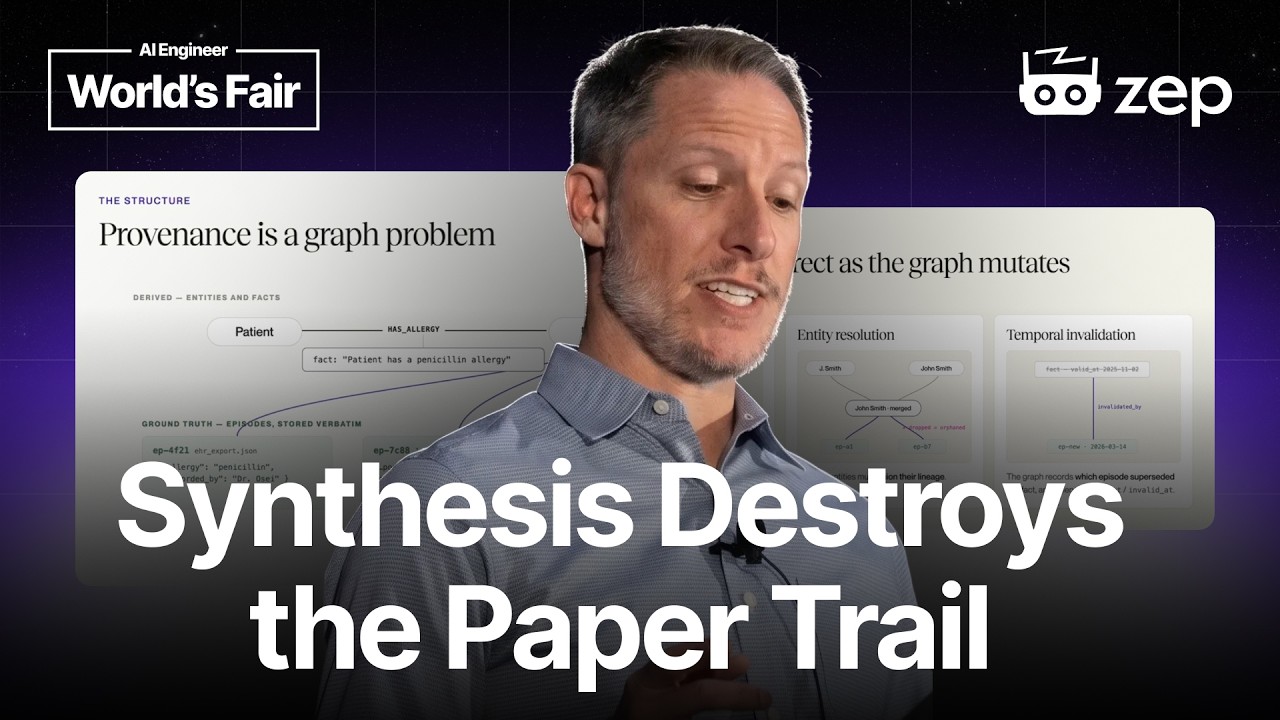
No clickbait detected — the title and thumbnail deliver what they promise.
AI Opinion
The episode convincingly argues that current LLM practices severely compromise provenance when constructing knowledge graphs, highlighting the necessity of systems like Graffiti to track data lineage and ensure reliability. While the discussion effectively demonstrates the technical approach Zep AI employs, the claim that a lack of source attribution could directly mislead medical professionals feels somewhat overstated without specific examples or context; it's reasonable but requires further substantiation. Listeners should consider how well Graffiti’s metadata tagging addresses biases inherent in the initial data sources and whether its reliance on single-shot LLM extraction might still introduce subtle, untraceable errors despite the reflection step.
Avatars are AI rewrites of the same facts — style changes, not substance.
Summary
The episode discusses the challenges of maintaining provenance when using Large Language Models (LLMs) to build knowledge graphs, particularly as LLM synthesis is non-deterministic and often obscures data origins. To address this, Daniel Chalef introduces Graffiti, an open-source temporal graph framework used by Zep AI to track relationships between source data and derived facts within a knowledge graph. This approach allows for tracing the lineage of information, filtering for verified sources through metadata tagging, and understanding how facts evolve over time. The system utilizes a single-shot LLM extraction process for efficient fact creation, supplemented by a "reflection step" that captures not only changes but also the reasoning behind them. While markdown files are suitable for smaller applications, graph-based solutions like Graffiti are necessary to manage provenance effectively at scale and ensure information reliability, especially in critical decision-making contexts where source attribution is essential.
Avatars are AI rewrites of the same facts — style changes, not substance.
Key Points
LLMs Synthesize Data Non-Deterministically, Destroying Provenance
Large Language Models (LLMs) synthesize data from multiple sources, but this process is non-deterministic and often destroys the original paper trail of how a fact was derived. This makes it difficult to trace the origin of generated facts and assess their veracity, which poses challenges for legal compliance, debugging, and trust assessment.
Graffiti Framework Enables Provenance Tracking Through Temporal Graphs
Daniel Chalef's team developed Graffiti, an open-source temporal graph framework, which serves as the foundation for Zep AI’s enterprise agent memory infrastructure. Graffiti allows for modeling relationships between source data and derived artifacts like facts within a knowledge graph, enabling provenance tracking and facilitating debugging.
Knowledge Graphs Model Provenance Relationships
Provenance in the context of agent memory is best represented as a knowledge graph. This allows for modeling relationships between source data and derived facts, enabling easy tracing of facts back to their origins through graph walks. The graph structure facilitates tracking how facts are generated and mutated over time.
Metadata Tags Enable Veracity Filtering
During ingestion, episodes (source data) are tagged with metadata like 'EHR' to indicate their origin. These tags are inherited by subsequent entities and facts derived from those episodes, allowing agents to filter for verified sources when retrieving context – a crucial feature for ensuring the reliability of information used in critical decision-making processes.
Zep Models Episodes as Graph Nodes with Lineage Tracking
Zep and Graffiti represent episodes, entities, and derived artifacts as nodes on a graph to track lineage. This allows for understanding how information was derived and enables the tracking of changes over time. The system employs a structured extraction process to identify entities, relationships, and candidate facts, materializing them into fact triples (subject-verb-object) that are then subject to deduplication and conflict resolution.
Markdown's Limitations in Provenance Management
While markdown files work well for desktop usage or single agent scenarios, they become problematic at scale due to challenges in tracking provenance. Modifying lines within a file makes it difficult to understand the history of changes and manage multiple users/sources effectively. This limitation highlights the need for graph-based solutions that inherently support lineage tracking.
Single-Shot LLM Extraction for Efficient Fact Creation
Zep utilizes a single-shot extraction method powered by an LLM to efficiently identify entities, relationships, and facts. This approach significantly reduces the cost of fact creation compared to other methods. A reflection step is also incorporated to ensure accuracy and enrich lineage information, explaining not only *what* changed but also *why*.
Reflection Step for Enhanced Lineage Information
Beyond simply tracking relationships between entities, Zep incorporates a 'reflection step' during the lineage process. This allows the system to capture not only *what* changes occurred but also *why* those changes happened, providing a more complete and nuanced understanding of information evolution within the knowledge graph.
Chapters
Claims & Fact Check
Synthesis often destroys the paper trail of how these outputs were originated.
If an agent presents a fact to a doctor without indicating the source, it may mislead them.
New data might invalidate old facts and lineage needs to be an evolving set.
New learned facts can mutate existing facts in the graph.
Zep tries to avoid using LLMs in the core pipeline due to cost and determinism concerns.
Single-shot extraction with an LLM allows for cheap fact creation.
Was this digest good?
More from AI Engineer
MCP Tasks (async): Why Aren't Any Agents Supporting Them? — Cornelia Davis, Temporal
Aug 2, 2026
When Will The Benchmaxxing Plague End? — Nick Heiner, Surge AI
Aug 2, 2026
Teaching AI to Find Real Vulnerabilities — David Brumley, Bugcrowd
Aug 1, 2026
Rethinking Environments for Long-Horizon Work — Rayan Garg, Theta Software
Aug 1, 2026
Digest any single YouTube video — free.
3 free digests — no card, no sign-up wall.
Or just swap the domain of any YouTube link → instant digest