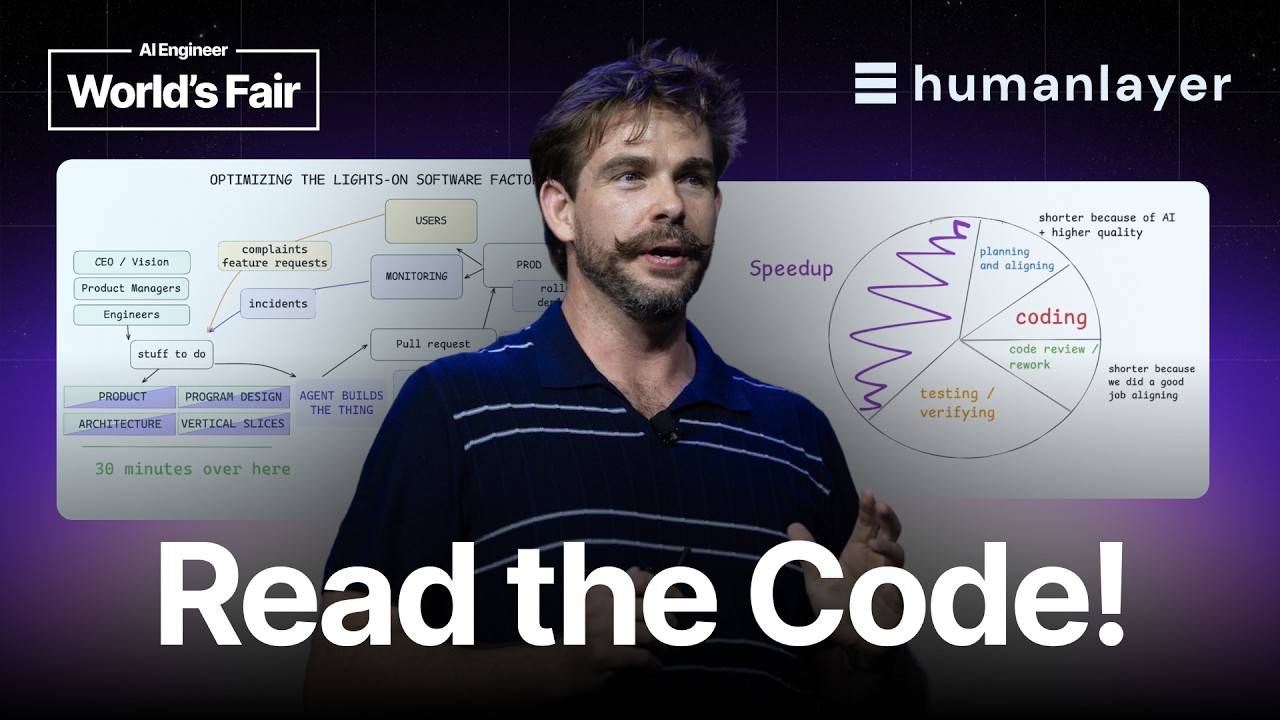
No clickbait detected — the title and thumbnail deliver what they promise.
AI Opinion
The episode convincingly argues that simply increasing AI coding agent usage—the "spend more tokens" approach—is insufficient for improving software development outcomes and echoes historical failures of overly ambitious “software factory” initiatives. The claim that fundamental limitations in AI model training are the root cause of issues like declining code review quality rests on observed trends but lacks direct evidence linking specific model deficiencies to these problems. Listeners should consider whether HumanLayer’s proposed solutions, while logically sound, represent a universally applicable fix or are tailored to their platform's particular implementation and design philosophy.
Avatars are AI rewrites of the same facts — style changes, not substance.
Summary
The episode examines the challenges facing modern software development practices, particularly in light of the increasing reliance on AI coding agents and the resurgence of "software factory" concepts. While initial enthusiasm for AI-assisted coding focused on simply increasing token usage, issues like codebase instability and declining code review quality—indicated by longer, more frequent pull request comments and a reduction in human oversight—suggest deeper limitations within the underlying AI models themselves. The discussion highlights historical context around software factories and identifies bottlenecks in traditional processes, particularly during code building and review, often addressed through extensive upfront planning. A key takeaway is the necessity of detailed program design, encompassing types, method signatures, and call stacks, to ensure clarity and reduce rework. Ultimately, the speaker advocates for proactive alignment and smaller, well-defined pull requests as crucial elements for improving software quality and developer productivity, introducing HumanLayer as a platform designed to facilitate these practices.
Avatars are AI rewrites of the same facts — style changes, not substance.
Key Points
Cracks in the AI Coding Agent Approach
Despite the prevailing narrative of simply increasing token usage to improve AI coding agent performance, cracks are beginning to appear. Companies are experiencing outages and codebase instability due to issues with these agents, highlighting a deeper problem than just engineering bottlenecks. Mario at AI Engineer Europe urged caution, emphasizing that current problems stem from underlying model training limitations rather than user error.
Decline in Code Review Quality
Data from Faros AI indicates a significant decline in code review quality since the widespread adoption of AI coding tools. Specifically, pull request comments have become longer and more frequent, with an alarming number of PRs being merged without any human review. This trend is contributing to increased incident rates and a higher bug count per developer.
Historical Context: The Software Factory
The concept of the 'software factory' was formally defined at a NATO conference in 1968, providing historical context for current development practices. A typical software factory involves engineers, product managers, and leadership teams who prioritize tasks and track progress through systems like Jira. This process includes building code, automated testing, human review via pull requests, and ultimately deployment to production where user feedback loops back into the system.
Bottlenecks in Traditional Software Factories
Traditional software factories face inherent bottlenecks, particularly in the 'someone builds the thing' and code review stages. These processes often consume hours or even days, leading teams to implement upfront planning, architectural proposals, and sprint planning to mitigate rework and reduce review time. The desire for automated monitoring systems that alert engineers to issues at inconvenient times (like 3:00 AM) underscores a reactive approach to software development.
The Necessity of Pre-Planning to Reduce Review Time
The speaker emphasizes that proactively planning and aligning before code review is crucial for reducing the time spent in the process. This involves a product review, architecture design (including component contracts and data models), and detailed program design—examining types, method signatures, and call stacks—to ensure clarity and reduce rework during reviews. The goal is to save hours of review time through upfront planning.
Program Design as a Critical Component
The speaker argues that program design, often overlooked in agentic coding, is essential. Simply having the architecture correct isn't enough; developers must delve into the specifics of types, method signatures, and call stacks to ensure a well-structured and understandable codebase. This level of detail helps prevent misunderstandings and simplifies the review process.
The Benefits of Smaller, Aligned Pull Requests
The speaker states that a large number of pull requests often indicates poorly aligned code. A 'good PR' is one that’s easy to review and reflects prior discussions. Even with AI assistance, rework can still be necessary (though ideally limited to 20%), but the emotional and intellectual burden on both reviewer and submitter increases significantly with larger, less-aligned changes.
HumanLayer as a Software Factory Platform
The speaker introduces HumanLayer as an AI IDE and collaboration platform designed to be the building blocks for software factories. It aims to provide a 'Figma for cloud code' with collaborative workspaces that guide users through workflows, ultimately improving software quality and developer productivity. They are actively seeking design partners and founding engineers in San Francisco.
Chapters
Claims & Fact Check
The prevailing narrative is we should just spend more tokens.
You're holding it wrong [referring to software development practices].
No amount of harness engineering or loops maxing can solve what is fundamentally a model training issue.
Pre-planning and alignment can save hours in the code review process.
A good pull request is a joy to review, reflecting clear alignment and understanding.
Even with AI assistance, rework on code can still be necessary.
Was this digest good?
More from AI Engineer


Digest any single YouTube video — free.
3 free digests — no card, no sign-up wall.
Or just swap the domain of any YouTube link → instant digest