No clickbait detected — the title and thumbnail deliver what they promise.
AI Opinion
Jason Liu convincingly argues that increasingly, effective work involves managing knowledge and possibilities rather than solely focusing on coding tasks, particularly as AI tools like Codex automate more routine processes. However, his claims about the near-term convergence of Codex's capabilities with advanced agent frameworks like Openclaw and Hermes, and the assertion that nearly everything in one’s life can be automated, rest on a degree of speculation regarding future development trajectories. Listeners should critically evaluate these projections alongside the demonstrated utility of Liu’s specific knowledge management techniques—such as appshots and proactive memory updates—and consider whether similar systems would be feasible or beneficial within their own workflows.
Avatars are AI rewrites of the same facts — style changes, not substance.
Summary
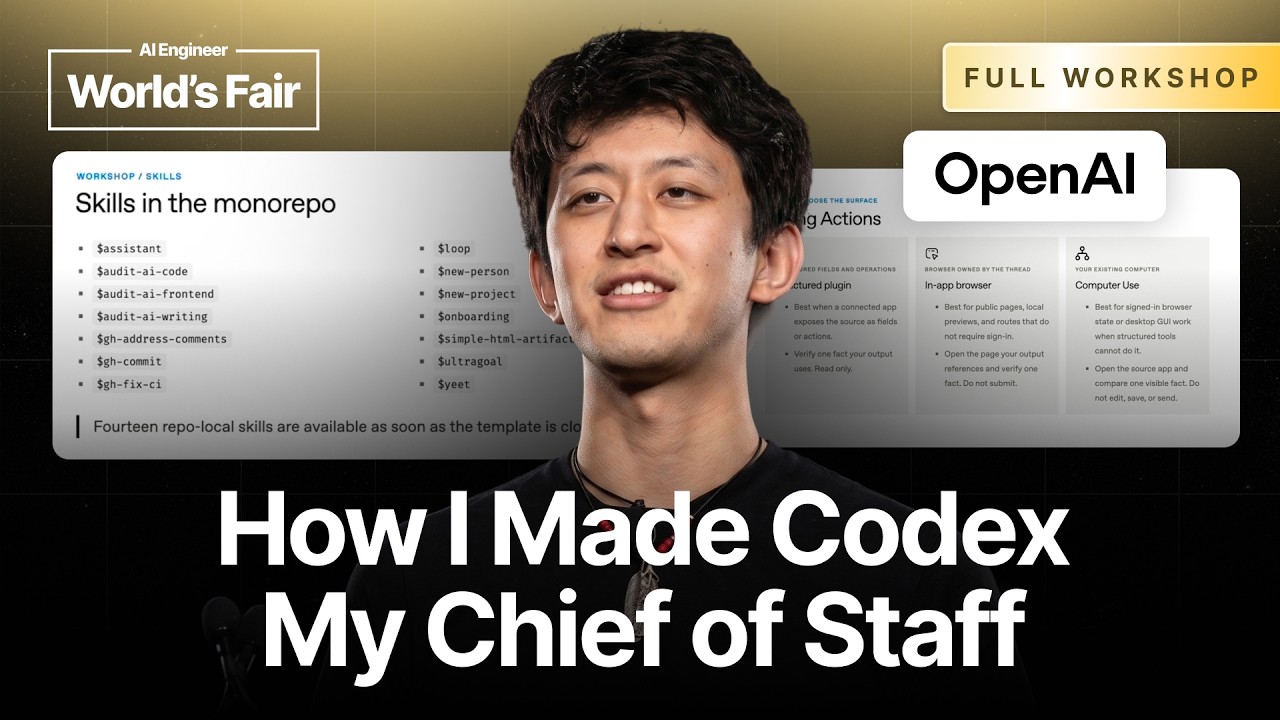
Jason Liu, from OpenAI Codex, presented a workshop detailing his personal knowledge management system and workflow, illustrating how AI tools like Codex are reshaping work practices. He emphasizes the value of daily summaries generated by agents to understand priorities and operations, along with proactive memory updates for optimal performance. A key theme is the shift in focus from coding itself to managing knowledge and understanding possibilities as automation increases. Jason’s system utilizes techniques such as 'appshots' for contextual data retrieval, a personal monorepo template, and “write like me” skills to mimic his communication style. He also highlighted organizational controls on Codex usage and demonstrated how features like automated thread management and proactive updates are crucial for efficiency and safety. Ultimately, Jason anticipates a future where voice commands replace text input and Codex’s capabilities converge with those of more complex agent frameworks, signifying an increasingly integrated human-computer interaction.
Avatars are AI rewrites of the same facts — style changes, not substance.
Key Points
Jason's Diverse Responsibilities at OpenAI
Jason Liu describes his multifaceted role at OpenAI, which includes prototyping, code writing, running evaluations and hill climbing algorithms, video editing with iMovies, managing partnerships and education initiatives, securing funding through foundations and programs. Notably, all of these tasks are performed within the Codex application, demonstrating its versatility for various operational needs.
The Shift in AI Work: From Coding to Knowledge Management
Jason explains that as coding tasks become increasingly automated with AI, the focus shifts towards knowledge management and understanding what actions are possible. He contrasts a traditional work environment where individuals manage distinct tasks with a modern landscape where everyone handles multiple projects, highlighting the need for tools like Codex to organize information and prioritize effectively.
The Value of Compaction in Thread Management
Jason emphasizes the effectiveness of 'compaction' within Codex, enabling the creation of long-running threads with numerous sub-agents that maintain clarity and purpose. He mentions having threads five weeks old with 400 sub-agents, illustrating how these systems can autonomously manage complex workflows over extended periods.
The Future of Human-Computer Interaction: Voice Commands
Jason predicts a future where voice commands replace text input as the primary mode of interaction with computers. He demonstrates his current setup using a foot pedal for transcription and command entry, allowing him to delegate tasks hands-free and focus on human interactions within OpenAI.
The Value of Appshots for Contextual Understanding
Jason Liu emphasizes the importance of 'appshots' as a key feature, explaining that screenshots alone lack sufficient information for Codex to effectively process them. Traditional screenshot processing requires OCR and analysis of Slack threads, involving numerous function calls. Appshots provide the entire accessibility tree of an application, including channel IDs and user identifiers, reducing context retrieval to a single function call – significantly improving efficiency. This allows Codex to quickly understand and respond to requests with greater accuracy.
Codex's Growing Intelligence and Automation Capabilities
Jason highlights that Codex is becoming increasingly intelligent, capable of automating tasks previously requiring manual intervention. He shares his personal experience of not having filled out a form in two weeks due to Codex’s ability to understand and populate fields automatically. This demonstrates the system's evolving capacity to handle complex workflows with minimal user input, effectively acting as an extension of the user's capabilities.
Personal Monorepo Template for Memory Management
Jason reveals that he uses a personal monorepo template on his computer, which is essentially a directory tree and collection of skills designed to expand his memory. This structure allows him to manage projects and code more efficiently within Codex. He encourages viewers to explore this template, emphasizing its utility in organizing and growing their AI-powered workflow.
Creating a 'Write Like Me' Skill
Jason introduces the concept of a 'write like me' skill, demonstrating Codex’s ability to mimic writing styles. The process involves instructing Codex to analyze past emails and Slack messages to generate a personalized style guide. This allows Codex to produce communications that closely resemble the user's own voice, showcasing its potential for highly customized AI assistance.
Codex's Reluctance to Destructive Actions
Jason Liu explains that the Codex models are generally cautious and reluctant to perform destructive actions, often requiring manual prompting like 'just send this message.' He notes that earlier versions were more eager to edit documents without explicit instruction. This highlights a deliberate design choice aimed at preventing unintended consequences and ensuring user control over automated processes.
Importance of Auto Review for Safety
Jason emphasizes the value of the 'auto review' feature, stating that it has been "really really great." He expresses frustration when models are too cautious and don’t perform actions as intended. This suggests a balance is needed between safety protocols and desired functionality, with auto-review serving as a crucial layer of oversight.
Organizational Controls on Codex Usage
Jason illustrates how organizations like OpenAI implement specific controls to limit the scope of Codex's actions. Examples include preventing email sending to external recipients via MCP servers and restricting Slack messages to external channels. These restrictions underscore the importance of establishing boundaries and mitigating risks when deploying AI models in enterprise environments.
Automated Thread Management with 'Keep an Eye On'
Jason introduces a powerful technique for automating tasks using the 'keep an eye on' command within Codex. This allows users to schedule recurring checks and actions, such as monitoring pull requests, ensuring CI passing status, and maintaining code consistency. The concept of 'loop skill' exemplifies how this automation can streamline workflows and prevent developers from falling behind.
Jason's Workflow Involves Organizing Work Products
Jason emphasizes his focus on organizing work products, specifically deciding how to structure output – whether as a set of gold files, new threads, or skills. He prefers directing the model to organize the work and then format it into HTML or Word documents, often sending very long messages containing detailed instructions for automation.
Integrating Slack Channel Data Improves Codex Results
Jason discovered that including relevant Slack channel IDs in project markdown files significantly improved the quality of Codex's output. He now proactively adds this information to front matter, highlighting how iterative improvements and incorporating contextual data enhance model performance.
Codex's Capabilities are Approaching Those of Agent Frameworks
Jason anticipates a convergence between Codex’s functionality and more complex agent frameworks like Openclaw and Hermes. He notes that his own workflows increasingly involve self-managing threads, suggesting that Codex is evolving towards the capabilities of sub-agents within broader automation systems.
Memory Management Requires Proactive Updates and Habit Formation
Jason explains that effective memory management in Codex requires users to proactively update skills and agents. He illustrates this by describing how including Slack channel IDs initially improved results, demonstrating the importance of establishing habits like updating documentation and agent configurations for consistent performance.
Jason's Personal Knowledge Management System
Jason utilizes a personal knowledge management system organized into directories for 'projects' and 'people.' The 'people' directory contains detailed information about individuals, including their current projects, concerns, and Slack channel participation. He also maintains daily summaries to test AI capabilities, primarily focusing on project and people data as the most valuable components.
The Value of Agent-Driven Daily Summaries
Jason emphasizes that daily summaries generated by an agent, particularly a 9:00 AM overview of the day and week's activities, are crucial for gaining significant insights. He suggests this practice is highly beneficial for understanding current operations and priorities, even if it consumes tokens.
The Role of 'Check Notes' Skill
Initially, Jason used a 'check notes' skill to prompt the AI to review its memory when he had doubts. This skill was frequently utilized during the initial onboarding phase but has become less necessary as the memory system matured and began proactively handling information.
Importance of Experiential Knowledge in Coding
Jason stresses the importance of consuming a wide range of applications and experiences to develop good taste in coding. He believes that understanding what constitutes a poor onboarding flow, experiencing frustration with software, and building a robust vocabulary for articulating these issues are vital skills for developers.
Chapters
Claims & Fact Check
The goal of this talk isn't just to waste tokens but to help you avoid wasting them.
A lot of the work in knowledge work now because the coding is solved, is really just understanding what you can do.
Text input isn't the thing that matters in the future.
Codex can fill out forms without user intervention.
The personal monorepo template is the only project on Jason's sidebar.
Codex can manage files outside of its designated project directory.
Models are getting smarter and better at not doing silly things.
You can effectively automate like about everything in your life at this point.
This is the equivalent of just saying keep an eye on this.
Jason sends very long messages as prompts to Codex.
Codex can read and incorporate information from Slack channels when prompted.
Jason believes Codex's capabilities will soon be very similar to those of Openclaw and Hermes agents.
Codex can draft emails and Slack updates, and even send them automatically.
It's almost like an AGI.
The memory system is doing a lot of the heavy lifting.
You can’t really describe things without a good vocabulary.
Was this digest good?
More from AI Engineer


Digest any single YouTube video — free.
3 free digests — no card, no sign-up wall.
Or just swap the domain of any YouTube link → instant digest