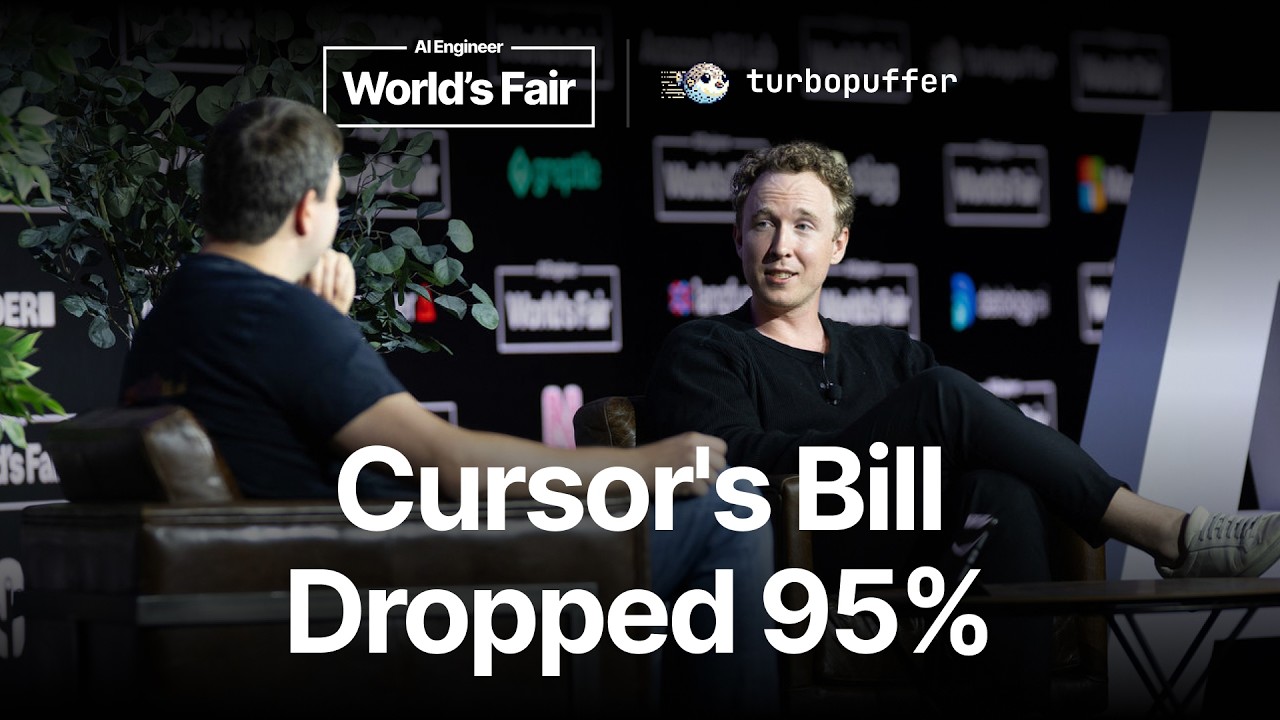
No clickbait detected — the title and thumbnail deliver what they promise.
AI Opinion
The episode most convincingly argues for the importance of disciplined financial management and transparency in early-stage startups, illustrated by Turbopuffer's aggressive pricing strategy and Gergely Orosz's investor interactions; this is supported by concrete examples of cost reduction and a willingness to forgo rapid growth. However, claims regarding the precise impact of individual optimizations like Justine’s file-based cache implementation on Cursor’s database bill rest on internal data not independently verified, and the assertion that one should "never bet your business" on a startup customer requires further scrutiny given varying risk tolerances. Listeners would benefit from researching alternative perspectives on early-stage investment strategies and critically evaluating claims regarding specific technical optimizations.
Avatars are AI rewrites of the same facts — style changes, not substance.
Summary
This episode explores the origins and development of Turbopuffer, focusing on the experiences of Gergely Orosz and Simon Eskildsen. Their backgrounds reveal unexpected influences: Simon’s English proficiency was honed through playing World of Warcraft, while his algorithmic thinking was fostered by participation in the International Olympiad in Informatics. Gergely's early career at Shopify provided valuable infrastructure experience, highlighted by a surge in traffic from celebrity product launches and leading to his creation of "Napkin Math," a tool for quantifying infrastructure costs and challenging flawed benchmarks. A key insight came from investigating MySQL write performance, which uncovered significant optimization potential. The team’s aggressive pricing strategy for their initial vector database—offering “a million vectors for a dollar”—and subsequent cost-saving measures, including Justine's implementation of a file-based cache, resulted in a 95% reduction in Cursor’s database bill. Throughout the discussion, Gergely emphasized financial discipline and transparency with investors, prioritizing sustainable growth over rapid expansion and even outlining conditions for funding to ensure product-market fit within a year.
Avatars are AI rewrites of the same facts — style changes, not substance.
Key Points
Gergely's Shopify Tenure & Motivation for Leaving
Gergely Orosz worked at Shopify from age 18 to 21, gaining extensive experience across various infrastructure components like caching, storefront development (alongside Justine), and database scaling. He left seeking new learning opportunities after feeling he'd maximized his growth within the company. A significant event during his time was the surge in traffic caused by celebrities like the Kardashians launching products on Shopify, which exposed scalability challenges.
The 'Napkin Math' Project: Quantifying Infrastructure Costs
While at Shopify, Gergely initiated a project called 'Napkin Math,' documented on GitHub. This involved creating a table detailing the bandwidth achievable with various hardware components (DRAMM, S3, NVME SSDs, EBS volumes) and their associated costs – including spot instances and committed usage. The goal was to have readily available data for quick calculations and to challenge assumptions in infrastructure decisions.
Challenging Benchmark Practices & the Importance of Calculation
Gergely frequently encountered situations where product teams made infrastructure choices based on what he considered flawed benchmarks. He felt these benchmarks often failed to account for distributed query complexities, leading to inaccurate performance expectations (e.g., a benchmark showing 10 seconds versus his calculated 10 milliseconds). He developed the 'Napkin Math' project as a tool to quickly perform calculations and challenge those assumptions.
Investigating MySQL Write Performance & Batching
After leaving Shopify, Gergely began exploring the performance of MySQL writes. He initially hypothesized that the number of writes per second should correlate with the frequency of f-sync operations to disk. This led him down a rabbit hole investigating batching and ultimately uncovering that MySQL could achieve significantly higher write rates than initially anticipated due to optimizations like larger f-sync sizes.
Early Vector Database Development and Pricing
Gergely Orosz initially developed a vector database as an internal SAS project, prioritizing reliability and high availability. He released it publicly with the claim of offering 'a million vectors for a dollar,' significantly undercutting existing solutions which cost around $100 per million vectors at the time. This aggressive pricing strategy demonstrated his confidence in the system's efficiency and scalability.
Cursor's Internal Discussion on Vector Database Economics
According to Gergely, Cursor’s founders had a dinner table discussion about the inefficiencies of their current vector database setup. They were grappling with the fact that all vectors resided in DRAM and explored the possibility of leveraging S3 for storage and caching, combined with active code bases in memory and other data in object stores. This highlighted an opportunity for a more cost-effective and scalable solution.
Justine's Contribution: File-Based Cache Implementation
After Gergely’s in-person visit to Cursor, Justine, his co-founder, quickly implemented a file-based cache, replacing the existing reverse proxy enginex cache. This optimization significantly improved performance by bringing data directly into RAM for faster query processing. Her ability to rapidly identify and address inefficiencies demonstrated her expertise and contributed to Turbopuffer's adoption.
Dramatic Cost Savings through Turbopuffer Adoption
Gergely and Justine’s work resulted in a remarkable 95% reduction in Cursor’s database bill. This substantial cost saving was achieved by optimizing the infrastructure and leveraging Turbopuffer's capabilities, showcasing its potential for significant economic benefits for businesses relying on vector databases.
Initial Skepticism about Billion-Dollar Potential
Gergely Orosz initially doubted if Turbopuffer could become a billion-dollar company, particularly in the early stages. He described it as feeling like a very niche product and a specialized search engine, which led to a cautious approach rather than immediate aggressive scaling. This initial assessment was based on his understanding of the market and the challenges involved.
Prioritizing Cost Optimization over Rapid Growth
The founders prioritized minimizing expenses, specifically focusing on reducing their Google Cloud Platform (GCP) bill. Gergely emphasized a pragmatic approach where the goal was to ensure one number (expenses) remained lower than another (revenue). This demonstrated an early commitment to financial discipline and sustainable growth rather than chasing rapid expansion.
Transparency with Investors: A Contrarian Approach
When seeking initial funding, Gergely openly communicated his intentions and limitations to potential investors. He explicitly stated the desired investment amount ($700K) for hiring two engineers and a small buffer, coupled with a clear condition: achieving product-market fit (PMF) within a year or shutting down without significant financial loss. This transparent approach was perceived as unconventional and even concerning by some West Coast VCs.
Reasons for Raising Capital - Beyond R&D
Gergely outlined three primary reasons companies seek venture capital funding. The first is to fund Research and Development (R&D), which was Turbopuffer's initial goal with the hiring of Buen and Morgan. He then contrasted this with less desirable motivations, such as fueling growth or satisfying founder ego, cautioning against the dilution of employee equity and potential for a status-driven approach.
The Power of PowerPoint in Early Programming Exploration
Simon recounts his early fascination with computers stemming from Microsoft PowerPoint's animation features. He discovered Front Page, a tool intended to simplify web development, which initially seemed promising but ultimately revealed the complexities of cross-browser compatibility issues prevalent in the early 2000s. This experience led him down a path of learning HTML, PHP, and eventually exploring more advanced programming concepts.
The Impact of World of Warcraft on Language Learning
Simon humorously attributes his proficiency in English to a four-year period spent playing World of Warcraft. He explains that the game necessitated understanding and communicating in English, significantly improving his language skills. This anecdote highlights an unexpected benefit derived from immersive gaming experiences.
The International Olympiad in Informatics as a Catalyst for Algorithmic Thinking
Simon describes his participation in the International Olympiad in Informatics, an experience that exposed him to algorithmic problem-solving. He explains that these problems differed significantly from typical web development tasks, requiring a more mathematical and logical approach – exemplified by challenges like optimizing package distribution across trucks. This competition broadened his programming skillset beyond front-end development.
Shopify Recruitment Through an Unexpected Article
Simon details how Shopify recruited him while he was still in high school, a surprising turn of events triggered by an article he wrote about the drawbacks of smartphones and his return to a Nokia brick phone. The article gained unexpected attention on Hacker News and was subsequently featured in The New York Times, leading to contact from a Shopify recruiter who was impressed by his insights.
Chapters
Claims & Fact Check
Microsoft Front Page aimed to eliminate the need for front-end developers.
The author's iPhone screen breaking led to a viral article and Shopify recruitment.
LLMs would have allowed the author to bypass language barriers he experienced as a child.
Shopify recruiters were unaware of Simon's age during his initial interview.
The Kardashians launching products on Shopify caused significant traffic spikes.
Benchmarks often fail to account for distributed query complexities, leading to inaccurate performance expectations.
MySQL can achieve significantly higher write rates than initially anticipated due to optimizations like larger f-sync sizes.
We could do a million vectors for a dollar.
I told them that I was going to reduce their bill by 95%.
You should never ever bet your business on a tiny startup where you are their only or biggest customer.
Gergely initially doubted if Turbopuffer could become a billion-dollar company.
The founders prioritized minimizing their Google Cloud Platform (GCP) bill.
He told some VCs that he would shut down the project if it didn’t achieve product-market fit within a year.
Was this digest good?
More from AI Engineer

MCP Apps: Extending the Frontier — Ido Salomon & Liad Yosef
Aug 2, 2026

MCP Tasks (async): Why Aren't Any Agents Supporting Them? — Cornelia Davis, Temporal
Aug 2, 2026

When Will The Benchmaxxing Plague End? — Nick Heiner, Surge AI
Aug 2, 2026

Teaching AI to Find Real Vulnerabilities — David Brumley, Bugcrowd
Aug 1, 2026
Digest any single YouTube video — free.
3 free digests — no card, no sign-up wall.
Or just swap the domain of any YouTube link → instant digest