Clickbait Checker
The video title says:
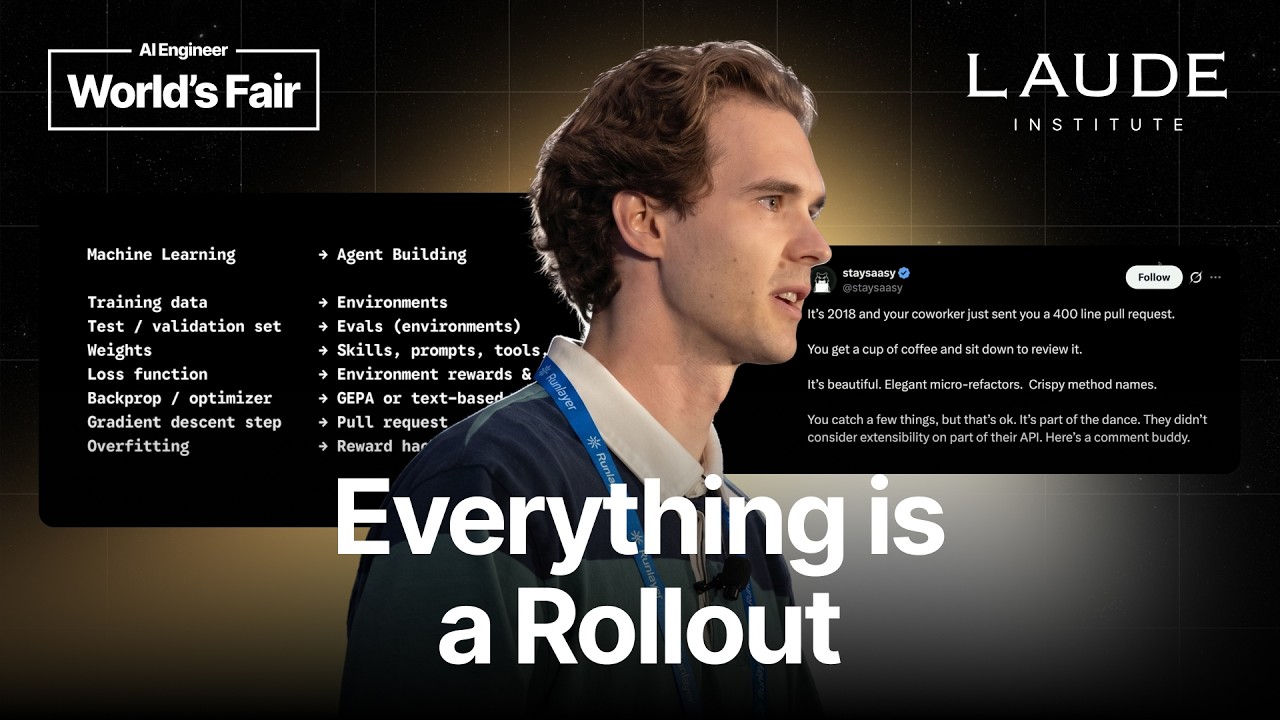
"Everything Is a Rollout — Alex Shaw + Ryan Marten, Terminal-Bench, Harbor, Laude Institute"
Reality:
The title 'Everything Is a Rollout' seems to refer metaphorically to the iterative development process discussed, particularly concerning agentic AI and platforms like Harbor, rather than a literal rollout of a product.
AI Opinion
The episode convincingly argues that the shift towards agentic AI necessitates a more empirical, iterative approach to development reminiscent of machine learning workflows, moving away from the predictability of earlier software engineering practices. However, the claim regarding a multibillion-dollar market for data creation and task selling appears speculative and lacks concrete supporting evidence; further investigation into market size and activity would be warranted. Listeners should also critically assess Harbor’s capabilities as presented, remembering that vendor discussions often highlight ideal scenarios rather than comprehensively detailing limitations or potential challenges in broader applications.
Avatars are AI rewrites of the same facts — style changes, not substance.
Summary
This discussion explores the evolution of software engineering practices, contrasting a predictable coding style prevalent in 2018 with the increasing complexity and uncertainty introduced by modern agentic AI and large language models. The speakers draw parallels between machine learning workflows and agent building, highlighting that agent performance should be treated as a "black box" requiring empirical evaluation. A key emergent use case is “agentic map reduce,” facilitated by the Harbor platform, which enables parallel execution of numerous agents across distributed environments to aggregate results and optimize AI models—a process already adopted by organizations like Poolside. The rapid growth of Harbor’s ecosystem, evidenced by integrations with tools for software engineering, finance, and gaming, underscores its rising importance in the agent-based AI landscape, alongside active team expansion and community engagement.
Avatars are AI rewrites of the same facts — style changes, not substance.
Key Points
The Nostalgia of 2018 Software Engineering
Alex Shaw references a tweet from 2018 describing a common software engineering experience: receiving a large pull request and reviewing it, finding beauty in the code but noting a lack of consideration for extensibility. This evokes a sense of nostalgia, highlighting how quickly practices evolve even within relatively short timeframes – only six to eighteen months had passed since this described scenario was commonplace.
The Transition from Regex-Based Code to Model-Driven Code
Shaw contrasts a 2018 program using regular expressions (regex) for phone number extraction with a 2026 version utilizing a large language model (LLM). While the LLM-powered code is potentially more powerful and adaptable, it introduces uncertainty; running it multiple times may not yield identical results due to the inherent stochasticity of these models.
Agent Performance as a Black Box
Building on Francois Chalet's original tweet, Alex Shaw expands the concept that agentic coding is a form of machine learning. He argues that agent performance itself should be treated as a 'black box artifact', meaning its behavior and generalization are best managed through empirical evaluation – similar to how we approach evaluating ML models.
Parallels Between Machine Learning and Agent Building
Alex Shaw outlines a direct comparison between machine learning workflows and agent building processes. Training data becomes environments, test/validation sets become evaluations (environments), model weights transform into skills, prompts & tools, loss functions equate to environment rewards, backpropagation is analogous to context-based optimization or pull requests, and overfitting manifests as reward hacking.
Emergent Use Case: Agentic Map Reduce with Harbor Exec
A significant emergent use case for Harbor is what the speakers call 'agentic map reduce,' which involves running a large number of agents on distributed compute sandboxes in parallel and aggregating the results. This process leverages Harbor Exec, a feature built specifically to address this need, allowing users to process numerous agent runs and extract insights like recurring mistakes or failure categories. The process utilizes tools such as Cursor CLI for fast processing and Fable 5 for accurate summarization.
Harbor's Role in Model Training and Optimization
Several organizations are utilizing Harbor to enhance their model training processes. Poolside uses Harbor for all of its model evaluations, while others leverage it for reinforcement learning by extracting reward signals from agent trajectories. This demonstrates Harbor's versatility beyond simple evaluation and its integration into the full lifecycle of AI model development.
Rapid Adoption and Ecosystem Growth Around Harbor
The presentation highlights a rapidly growing ecosystem built around Harbor, with numerous benchmarks and tools integrating with it. Examples include Frontier Suite for software engineering, Banker for investment banking, Rune Bench for Runescape gameplay, and Scale's Sweet Atlas suite. This widespread adoption indicates Harbor’s increasing importance in the agent-based AI landscape.
Harbor Team Growth and Community Engagement
The speaker emphasizes that the Harbor team is actively seeking new members, indicating a period of rapid growth and development for the platform. To facilitate this recruitment effort, they direct interested individuals to their Twitter account, highlighting the community's role in shaping Harbor’s future.
Chapters
Claims & Fact Check
Software engineering in 2018 was characterized by knowing what code would do before running it.
The uncertainty in model-driven code increases with the complexity of the task.
Agentic coding is a form of machine learning, and agent performance should be treated as a black box artifact.
There is a multibillion-dollar market around data creation and selling tasks for AI training.
Harbor can be used to run any agent with any model in any sandbox on any task.
Senior Sweet Bench measures how well agents function under ambiguity with behavioral feedback.
Was this digest good?
More from AI Engineer

Digest any single YouTube video — free.
3 free digests — no card, no sign-up wall.
Or just swap the domain of any YouTube link → instant digest