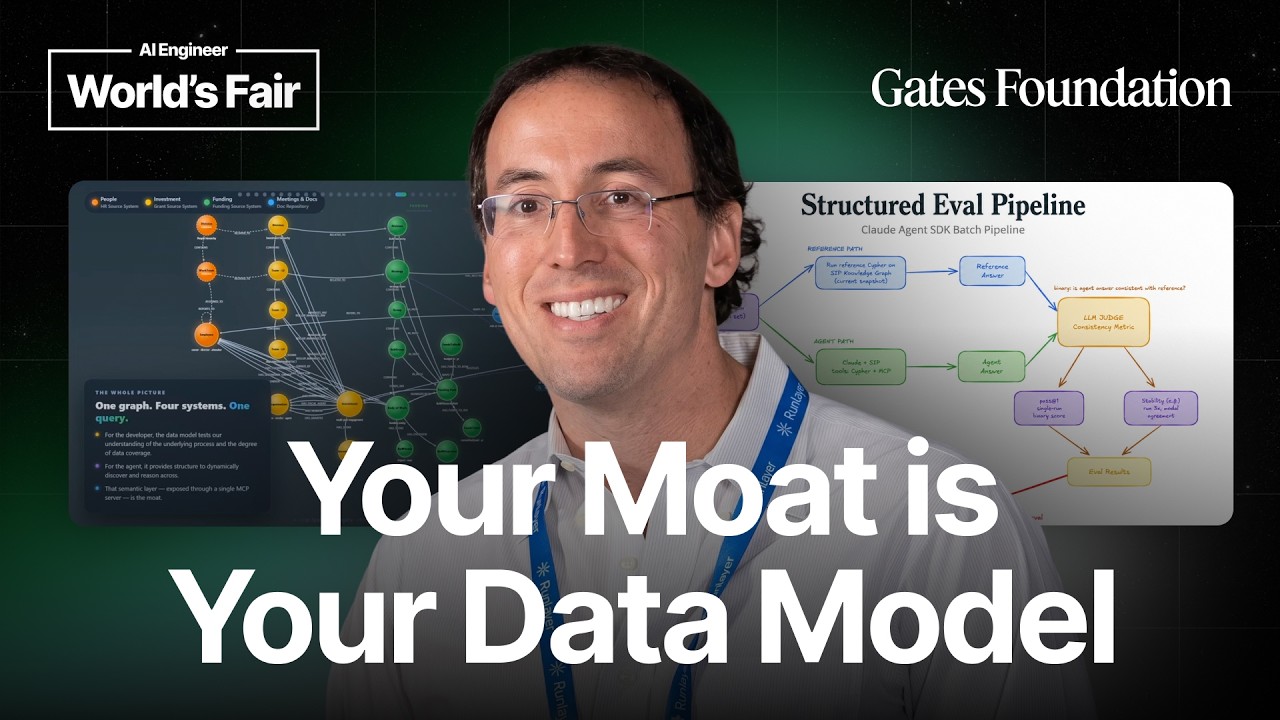
No clickbait detected — the title and thumbnail deliver what they promise.
AI Opinion
The episode persuasively argues that a robust data model, reflecting deep institutional knowledge, offers a sustainable competitive advantage for organizations like the Gates Foundation—a compelling counterpoint to hype surrounding large language models alone. While the description of SIP’s architecture and its impact on identifying knowledge gaps feels grounded in practical experience, the assertion that constrained workflows are inherently “more desirable” than freeform chat interactions relies on a specific operational context and may not be universally applicable. Listeners should consider how this design choice might affect user adoption and innovation across different teams within such a large organization, and whether it truly maximizes utility.
Avatars are AI rewrites of the same facts — style changes, not substance.
Summary
The Gates Foundation views its competitive advantage, or "moat," not as residing in AI models themselves but in a deep understanding of its internal processes and the tacit knowledge required to effectively utilize AI at scale. The Strategic Intelligence Platform (SIP), recently rolled out to 4,000 employees, is a key initiative designed to consolidate data from diverse sources into a unified data lakehouse, enabling agentic retrieval and analysis across the foundation’s vast operations—which include over 2,000 grants annually spanning numerous countries. The development of SIP involves significant customization of existing technologies like Neoforj's MCP servers, and emphasizes iterative refinement through evaluation pipelines that identify knowledge gaps and inconsistencies in data models. Future development will focus on federated graph experiences to connect team-specific datasets and enhance agentic interactions, reflecting a shift towards more constrained workflows rather than purely freeform chat interfaces.
Avatars are AI rewrites of the same facts — style changes, not substance.
Key Points
The Moat is Understanding Internal Processes
Mike Phipps emphasizes that the Gates Foundation's defensible advantage, or 'moat,' isn’t in flashy AI models themselves but in their deep understanding of internal processes and tacit knowledge required to run successful AI initiatives. He argues that even with rapid advancements in AI like Claude or Mythos, this foundational understanding will remain crucial for long-term durability and success.
Scale of Gates Foundation Operations
The presentation highlights the immense scale of the Gates Foundation's operations, emphasizing the vast amount of structured data generated over 25 years. With over 2,000 grants annually, targeting hundreds of countries and involving thousands of employees, extracting meaningful insights at scale presents a significant challenge that SIP aims to address.
SIP: A Data Lakehouse for Agentic Retrieval
The Strategic Intelligence Platform (SIP) is described as a key component of the Gates Foundation's approach to leveraging data. It functions as a data lakehouse, consolidating previously siloed structured and unstructured data from various systems of record and programmatic investments into a unified platform. This allows for agentic retrieval, enabling users to interact with the data through an agent-driven workflow.
SIP Architecture: From Data Sources to Agentic UX
The architecture of the Strategic Intelligence Platform (SIP) is presented as an end-to-end system. It begins with various systems of record and unstructured data sources, which are then consolidated into a data lakehouse. A data curation layer processes this data before it’s fed into SIP, culminating in an agentic chat interface that provides users with access to the platform.
Data Modeling Reveals Knowledge Gaps
The process of modeling data often reveals gaps in understanding or incomplete datasets. Developers quickly discover areas where their model doesn't fully capture the reality they are trying to represent, prompting them to refine and expand their models. This iterative discovery is a valuable aspect of the development cycle.
Neoforj MCP Modifications for Enhanced Functionality
The Gates Foundation has significantly modified off-the-shelf MCP (Message Channel Protocol) servers from Neoforj, including forking the code and updating schemas. These modifications enable state to be passed back to their system through conversation IDs and message numbers, demonstrating a customized approach to integrating AI workflows.
Eval Pipelines Improve Data Model Accuracy
Evaluation (eval) processes highlight ambiguities and inconsistencies in data models. By working with data owners, targeted eval questions aligned with reporting standards are created and tiered by complexity. This feedback loop allows for continuous refinement of the data model through updates to domain rules and schema descriptions.
Future SIP Focus on Federated Graph Experiences
The Gates Foundation's SIP (Semantic Information Platform) is expanding its capabilities, with a focus on federated graph experiences. This involves connecting specific team data sets to the main enterprise system and enabling more agentic interactions, catering to increasing demand for broader data integration.
Chapters
Claims & Fact Check
The Gates Foundation's moat is their understanding of internal processes.
Even advanced AI models like Claude and Mythos won't diminish the importance of understanding internal processes.
SIP is an enterprisewide platform rolled out this past month for 4,000 Gates Foundation employees.
The chat interface and general agent interaction were not defensible components.
Constrained workflow experiences are more desirable than freeform chat interactions.
Ambiguous questions often lead to incorrect responses from the system.
Was this digest good?
More from AI Engineer
MCP Tasks (async): Why Aren't Any Agents Supporting Them? — Cornelia Davis, Temporal
Aug 2, 2026
When Will The Benchmaxxing Plague End? — Nick Heiner, Surge AI
Aug 2, 2026
Teaching AI to Find Real Vulnerabilities — David Brumley, Bugcrowd
Aug 1, 2026
Rethinking Environments for Long-Horizon Work — Rayan Garg, Theta Software
Aug 1, 2026
Digest any single YouTube video — free.
3 free digests — no card, no sign-up wall.
Or just swap the domain of any YouTube link → instant digest