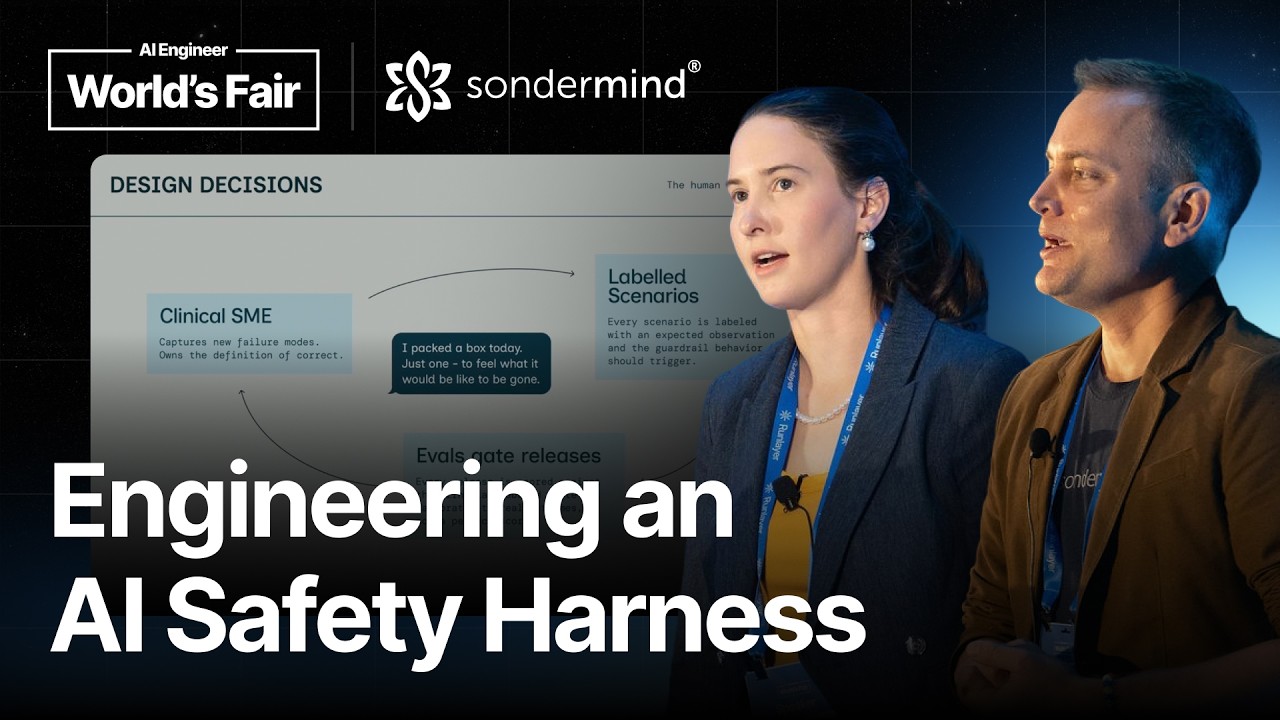
No clickbait detected — the title and thumbnail deliver what they promise.
AI Opinion
SonderMind’s discussion effectively argues for the necessity of a highly structured, clinically informed approach to AI in mental health care, particularly highlighting the risks posed by unmodified large language models and the importance of user experience alongside safety. While they convincingly present their modular architecture and open-sourced datasets as crucial safeguards, the claim that separating guardrail language models inherently makes them more robust against circumvention requires further scrutiny—it’s plausible but not definitively demonstrated here. Listeners should also consider that SonderMind's experiences represent a specific implementation and may not be universally applicable to all mental health AI development efforts.
Avatars are AI rewrites of the same facts — style changes, not substance.
Summary
SonderMind is developing a clinically grounded AI coach for mental health support, recognizing the limitations and potential dangers of general-purpose large language models in this sensitive area. Their approach prioritizes user safety through a modular architecture and separate language models for input and output guardrails, balancing robust safeguards with an empathetic user experience to avoid alienating vulnerable individuals. SonderMind emphasizes human-centered AI design, rigorous testing by subject matter experts, and the importance of clinically reviewed data sets—which they have open-sourced—to promote shared safety standards and facilitate learning loops within the mental health AI space. The company’s experiences highlight challenges in adapting general language models, including overcoming overly restrictive default guardrails and the need for custom systems to prevent circumvention of safety measures. They've verified that psychologists are seeing increased patient use of AI tools and acknowledge tragic events stemming from unsuitable LLMs being used for mental health care.
Avatars are AI rewrites of the same facts — style changes, not substance.
Key Points
Sonder's Focus on Clinically Grounded AI for Mental Health
Sonder is a clinically grounded AI coach specifically designed for mental health support, distinguishing it from general-purpose LLMs that have proven inadequate and even dangerous in this domain. It aims to bridge the gap between needing care and being ready for therapy or providing support between sessions, acting as a front door to SonderMind's provider network when appropriate.
The Architecture of Sonder Prioritizes Safety Through Modular Design
Sonder’s architecture emphasizes modularity, allowing for iteration on the core AI without compromising user safety. This design choice recognizes the complexity and vastness of mental health issues, enabling adjustments to the system while maintaining a robust safety net. The team understood that designing for the unknown requires flexibility.
Separate Language Models for Input and Output Guardrails Enhance Robustness
To prevent users from circumventing safety measures, Sonder utilizes separate language models for input and output guardrails. While this approach introduces a trade-off in latency and cost, the team believes that the sensitivity of mental health use cases justifies the increased robustness against prompt engineering attempts to bypass safeguards.
Balancing Safety with User Experience: Avoiding Overly Conservative Guardrails
Recognizing that users often seek support during vulnerable moments, Sonder aims to avoid overly conservative guardrails that can feel dismissive and isolating. The team acknowledges the importance of providing a supportive experience while maintaining safety protocols, understanding that an inappropriate guardrail response can be detrimental.
The Need for Human-Centered AI Safety in Mental Health
SonderMind emphasizes designing AI with the human at the center, recognizing that capability is rapidly advancing. They advocate for rigorous safety systems reviewed and tested by subject matter experts, moving beyond simple promises of safety. This approach is particularly crucial in mental health applications where potential harm from inaccurate or inappropriate responses can be significant.
Open Sourcing Data Sets to Promote Shared Standards
To address the challenges faced by organizations working with AI in mental health, SonderMind has open-sourced their data sets. These include 200 input guardrail scenarios and 100 output guardrail scenarios, all clinically reviewed and calibrated against real conversation patterns across various mental health conditions. This initiative aims to establish a shared baseline for safety and learning.
The Significance of Data Sets in AI Safety
SonderMind highlights the importance of clinically reviewed data sets, emphasizing that they are intended to support the creation of robust learning loops. They acknowledge that these resources may not replace custom development but underscore their value in mitigating potential harm to individuals who might be relying on AI during vulnerable moments and experiencing loneliness, depression, or anxiety.
Circumventing Default LLM Guardrails
SonderMind found that general-purpose large language models (LLMs) were overcalibrated and overly restrictive, often blocking legitimate interactions. To enable the use of their data sets for training and evaluation, they had to disable these default guardrails and build their own custom guardrail system. This highlights a common challenge when adapting LLMs for specialized applications.
Chapters
Claims & Fact Check
General purpose LLMs have resulted in tragic events due to their unsuitability for mental health care.
77% of psychologists report their patients are using AI for mental health support.
Keeping guardrails as separate LM's makes them more robust and harder to circumvent.
We need to deliver the most rigorous systems we can, especially in mental health.
Anyone working in this space is going to face some version of these [challenges].
This is not meant to replace creating your own learning loops.
General purpose LLMs are overc calibrated.
Was this digest good?
More from AI Engineer



Digest any single YouTube video — free.
3 free digests — no card, no sign-up wall.
Or just swap the domain of any YouTube link → instant digest