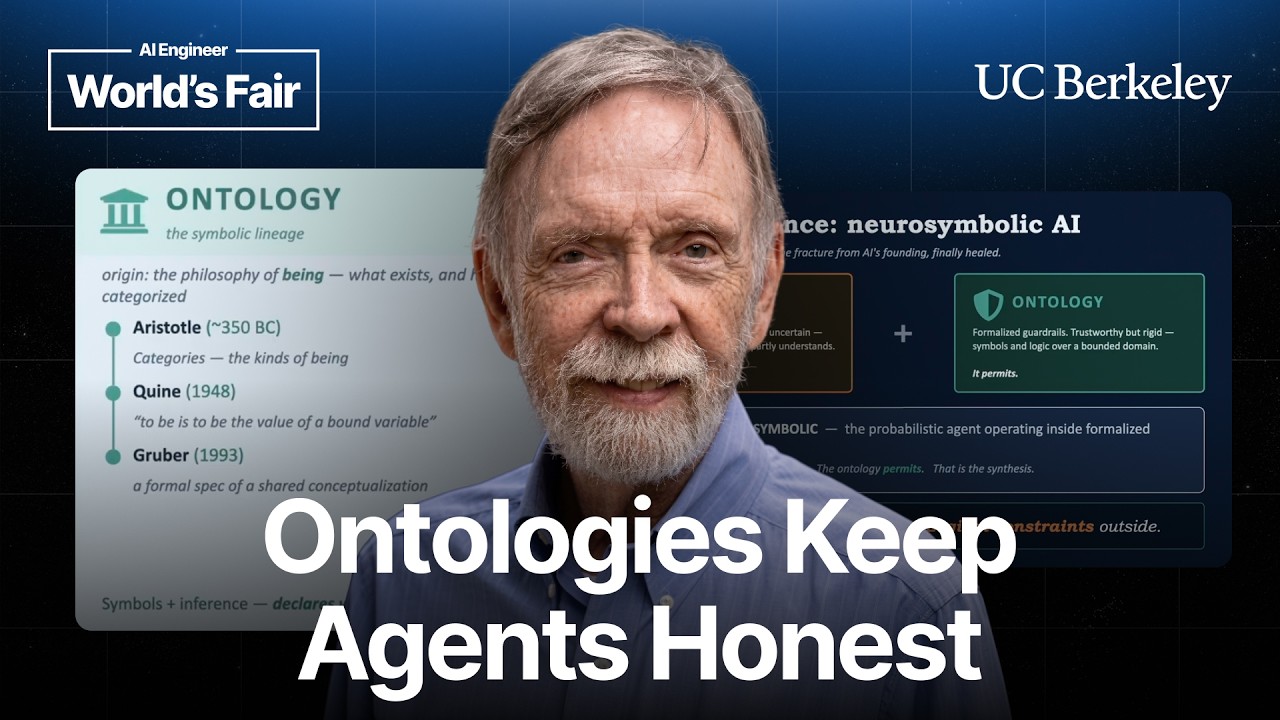
No clickbait detected — the title and thumbnail deliver what they promise.
AI Opinion
Coyle convincingly demonstrates how ontologies offer a vital corrective for the inherent unpredictability of large language models by providing structured knowledge against which their outputs can be validated, particularly within neuro-symbolic AI systems. The argument that LLMs function primarily as parameter generators, necessitating external tools and ontological validation, is well supported through concrete examples of workflow limitations. However, the presentation’s assertion regarding the universality of graph databases' superiority over relational models for all complex data relationships would benefit from more nuanced consideration of specific use cases and performance trade-offs; listeners should consider whether a particular application truly demands the flexibility of a graph structure. Finally, while Coyle highlights tools like OWL and Pydantic, understanding their practical implementation and scaling challenges within real-world applications remains an area for further investigation.
Avatars are AI rewrites of the same facts — style changes, not substance.
Summary
Frank Coyle’s presentation explores the intersection of agentic systems, large language models (LLMs), and ontologies. He argues for a learning philosophy centered on active creation and experimentation, drawing parallels to artistic practices that embrace mistakes as opportunities. Ontologies, defined as formal specifications of shared knowledge, are presented as crucial for structuring information and enabling more reliable reasoning in AI agents, particularly when combined with probabilistic models like LLMs—a trend known as neuro-symbolic AI. Coyle explains that LLMs function primarily by predicting the next word and require external tools and parameter generation to interact meaningfully with systems; ontologies then serve a vital role in validating these tool outputs against established domain knowledge. The discussion highlights the limitations of relational databases compared to graph databases for representing complex relationships, and introduces tools like Pydantic and OWL to improve code reliability and provide error detection guardrails within LLM-driven workflows.
Avatars are AI rewrites of the same facts — style changes, not substance.
Key Points
The Importance of 'Making' in Learning
Frank Coyle emphasizes the importance of active creation and experimentation over passive reading, drawing inspiration from Sister Corita Kent and John Cage. He advocates for a philosophy where mistakes are not failures but opportunities to learn through 'making,' encouraging students to engage in hands-on activities like writing and drawing rather than solely relying on typing.
Ontologies as Formal Specifications
Coyle defines ontologies as 'a formal specification of a shared conceptualization,' emphasizing their role in providing agents with structured knowledge about the world. He explains that this concept, initially explored by Gruber in 1993, is crucial for representing entities, their properties, and relationships within a domain, enabling more effective agent reasoning.
The Convergence of Probabilistic Agents and Formal Ontologies
Coyle highlights the significant trend of neuro-symbolic AI, which involves integrating probabilistic agents (like LLMs) with formal representations like ontologies. This convergence aims to leverage the creativity of LLMs while grounding them in structured knowledge and mitigating issues such as hallucinations that arise from purely probabilistic models.
Graph Databases vs. Relational Databases
Coyle contrasts graph databases with relational databases to explain the rise of ontologies. He notes that traditional relational databases, which store data in tables, are restrictive and require significant restructuring when new information is added. Graph databases offer more flexibility by allowing for easy attachment of properties and relationships, making them well-suited for representing complex knowledge structures.
LLMs as Parameter Generators
The speaker explains that Large Language Models (LLMs) fundamentally operate by predicting the next word with a given probability, and therefore cannot inherently 'do' anything. To enable them to interact with external systems, they are used as generators of parameters for tools. The LLM is prompted to determine how a tool can help achieve a desired outcome, then sets up the necessary parameters and returns those to an external executor.
The Role of Ontologies in Validating LLM Responses
Following tool execution, ontologies are introduced as a mechanism for validating the LLM's output. The speaker emphasizes that after a tool is called and provides information, this data needs to be formatted in a way that can be understood by a validator operating within an ontological framework. This allows for reasoning about whether the response from the LLM aligns with established domain knowledge.
Pydantic for Type Specification
To address the lack of type safety in Python, Pydantic is presented as a solution. Pydantic allows developers to specify and enforce data types for parameters, preventing unexpected behavior and improving code reliability. The speaker recommends using Pydantic to check parameter types and then employing ontologies to validate the overall results.
OWL for Error Detection and Guardrails
The speaker introduces OWL (Web Ontology Language) as a tool for creating logical constructs that can detect errors and provide guardrails for LLMs. Examples are given, such as identifying duplicate refunds or ensuring payout destinations are correct, demonstrating how ontologies can catch inconsistencies that might be difficult to identify using natural language alone.
Chapters
Claims & Fact Check
Large language models (LLMs) 'hallucinate' as a feature, not a bug.
Relational databases are too restrictive for representing complex data relationships.
Expert systems were once considered the primary path to AI.
LLMs can only give us the next word with a high probability and cannot 'do' anything.
Ontologies are crucial for validating LLM responses after tool execution.
Pydantic adds typing to Python, improving code reliability.
OWL can be used to create logical constructs that detect errors in LLM outputs.
Was this digest good?
More from AI Engineer
MCP Tasks (async): Why Aren't Any Agents Supporting Them? — Cornelia Davis, Temporal
Aug 2, 2026

When Will The Benchmaxxing Plague End? — Nick Heiner, Surge AI
Aug 2, 2026
Teaching AI to Find Real Vulnerabilities — David Brumley, Bugcrowd
Aug 1, 2026
Rethinking Environments for Long-Horizon Work — Rayan Garg, Theta Software
Aug 1, 2026
Digest any single YouTube video — free.
3 free digests — no card, no sign-up wall.
Or just swap the domain of any YouTube link → instant digest