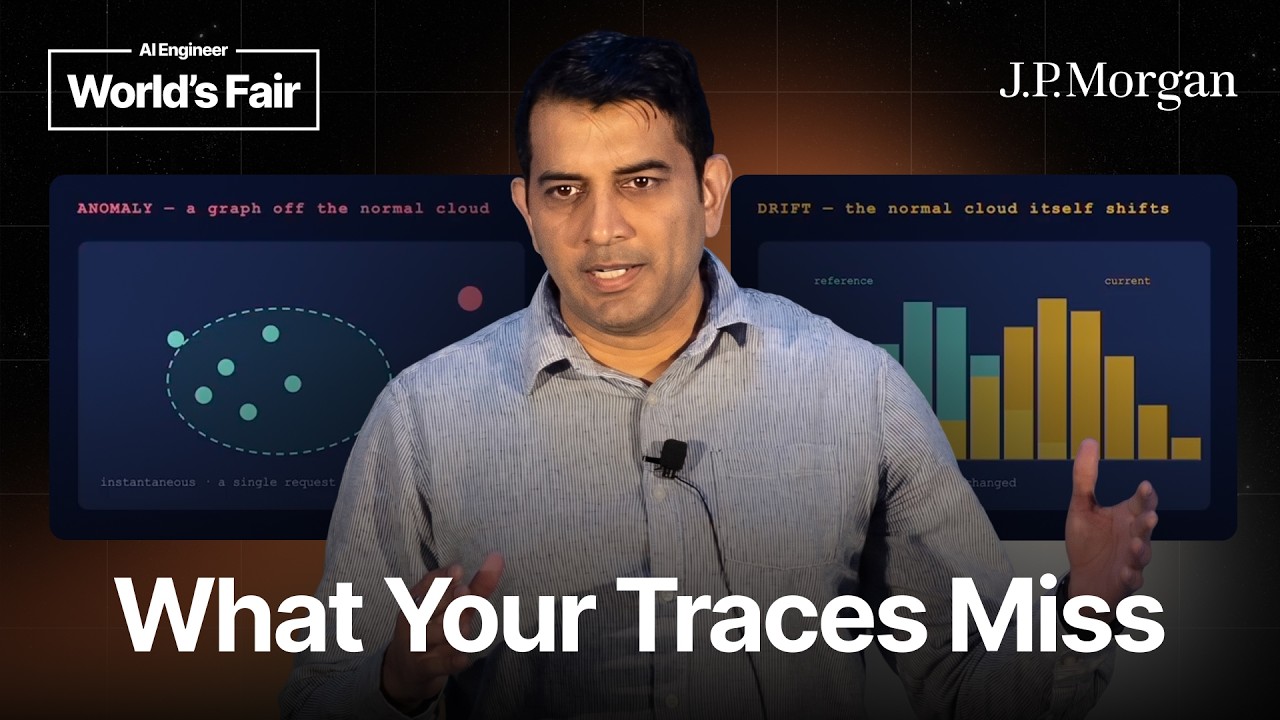
No clickbait detected — the title and thumbnail deliver what they promise.
AI Opinion
The presentation convincingly demonstrates how Learned Execution Graphs, combined with synthetic data and tailored baselines, offer a practical approach to API anomaly detection and drift management, particularly the distinction between transient anomalies and gradual shifts in behavior. However, the claim that a tail-based system is *optimal* for real-time tracking feels less substantiated without comparison to alternative methodologies, and the discussion of exponential moving averages lacks sufficient detail regarding implementation and validation. Listeners should investigate whether the presented architecture’s complexity justifies its benefits compared to more established monitoring solutions, and consider how easily these graphs can be adapted when API structures evolve significantly.
Avatars are AI rewrites of the same facts — style changes, not substance.
Summary
JP Morgan Chase utilizes Learned Execution Graphs to monitor APIs and detect anomalies and drift, employing a tiered system of checks analogous to airport security to manage processing intensity. To train these systems effectively, synthetic trace data simulating both normal operation and anomalies is generated and injected into the environment before production deployment. The presentation distinguishes between anomalies—isolated unexpected events—and drift, which represents gradual shifts in patterns over time, necessitating different response strategies. A key challenge involves identifying how to classify delays originating from specific system nodes, while a tail-based system is recommended for real-time tracking applications. To improve accuracy and reduce false positives, the team advocates for customized baselines tailored to specific use cases rather than applying generic rules across all requests. Crucially, they emphasize the need for explainable data—providing context alongside anomaly scores—to build user trust and facilitate effective problem resolution through detailed insights into request processing flows represented as Directed Acyclic Graphs (DAGs).
Avatars are AI rewrites of the same facts — style changes, not substance.
Key Points
Tiered Checks Based on Baseline
The presentation uses an analogy of airport security to explain tiered checks. If a request's execution aligns with the established baseline, it bypasses more intensive checks (like tier two). However, if delays or deviations are detected, further investigation is triggered to pinpoint the source of the issue and understand the underlying cause.
Training with Synthetic Traces
To build robust anomaly detection systems, the team utilizes synthetic trace data. Over a period of seven days, millions of traces are injected into the system, including simulated anomalies. This allows them to train their models and refine thresholds before deploying changes to production environments, ensuring minimal disruption.
Distinguishing Anomalies from Drift
Ritvik clarifies the difference between anomalies and drift using a driving analogy. An anomaly is a single, unexpected event (e.g., traffic delay), while drift represents a gradual change in patterns over time (e.g., consistently longer commute times). Recognizing this distinction helps prioritize responses – immediate action for anomalies, and proactive adjustments for drift.
Addressing Delayed Events in System Nodes
The speaker discusses a challenge where one system node delays event data, creating discrepancies. He poses the question of whether this delay should be considered a structural change, as it effectively reduces the number of nodes contributing data. Fine-tuning is needed to determine when such delays warrant classification as structural changes and avoid misinterpretations.
Tail-Based System for Real-Time Tracking
For use cases requiring real-time tracking, a tail-based system is recommended. This approach focuses on the start and end times of service requests for each node. The speaker emphasizes that when introducing new endpoints, establishing a fresh baseline is crucial to prevent overly generic anomaly detection.
Customized Baselines Based on Use Cases
Instead of applying uniform baselines for all post requests (e.g., across payment types), the speaker advocates for creating use-case specific baselines. This allows for more accurate anomaly detection tailored to different scenarios like payments, real-time transactions, or wire transfers. Such customization significantly improves accuracy and reduces false positives.
The Need for Explainable Data
The speaker stresses the importance of data explainability, drawing an analogy to a doctor providing a health score without context. He argues that users need more than just numerical scores; they require detailed explanations and informative data to make informed decisions. This transparency builds trust and facilitates effective problem-solving.
Execution Graphs for API Monitoring
Ritvik introduces the concept of execution graphs, which are short-lived representations of request processing flows. Unlike traditional graph databases used for querying relationships, execution graphs focus on identifying deviations from expected behavior within a single request's lifecycle. They simplify complex systems by representing them as Directed Acyclic Graphs (DAGs), enabling easier anomaly detection and automated troubleshooting.
Chapters
Claims & Fact Check
Exponential moving averages are used for analyzing scale deviations and divergence.
Client A's requests may take less time than Client B's due to geographic location.
Execution graphs represent request processing as a DAG.
A delayed event from a system node should be considered a structural change.
A tail-based system is optimal for real-time tracking of service requests.
Generic baselines for post requests are not effective; use case specific ones are better.
Was this digest good?
More from AI Engineer
MCP Tasks (async): Why Aren't Any Agents Supporting Them? — Cornelia Davis, Temporal
Aug 2, 2026
When Will The Benchmaxxing Plague End? — Nick Heiner, Surge AI
Aug 2, 2026
Teaching AI to Find Real Vulnerabilities — David Brumley, Bugcrowd
Aug 1, 2026
Rethinking Environments for Long-Horizon Work — Rayan Garg, Theta Software
Aug 1, 2026
Digest any single YouTube video — free.
3 free digests — no card, no sign-up wall.
Or just swap the domain of any YouTube link → instant digest