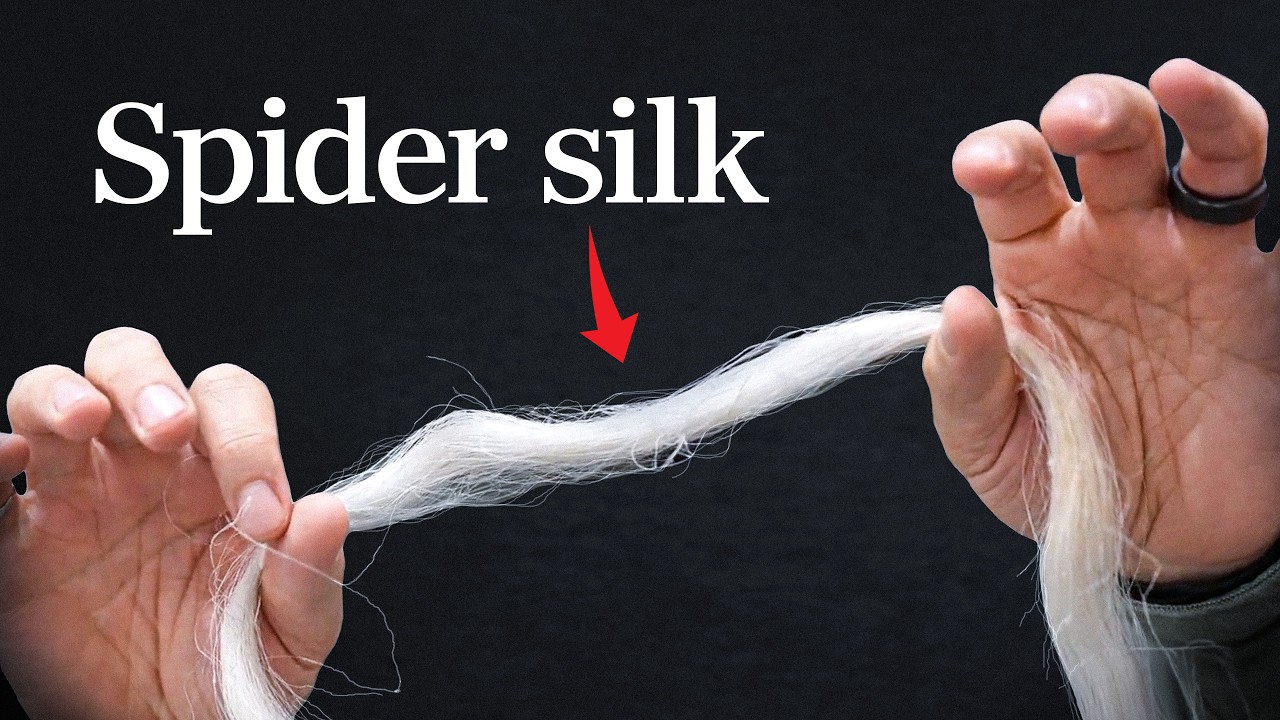
No clickbait detected — the title and thumbnail deliver what they promise.
AI Opinion
The episode makes its most persuasive case by reframing the "stronger than steel" claim around density, showing convincingly that spider silk’s advantage is real but only in strength-to-weight terms, not absolute tensile strength—a distinction that clarifies why the myth persists. Its verified figures for Darwin’s bark spider silk and the equal-mass comparison are solid, but the episode leans on weaker evidence for the "first industrial espionage" label and for the moth’s 500-egg-per-30-day claim, both of which are presented as fact without sourcing. A thoughtful viewer should double-check the industrial espionage framing (historical records are ambiguous) and note that the transgenic silkworm segment, while interesting, glosses over how imprecise gene placement actually undermines the commercial viability it implies.
Avatars are AI rewrites of the same facts — style changes, not substance.
Summary
The episode examines the common claim that spider silk is stronger than steel, clarifying that this depends on how strength is measured. Spiderwebs contain multiple silk types, with dragline silk being the strongest and most comparable to steel. Tensile strength tests on a garden spider's dragline silk measured around 600 megapascals, while the Darwin's bark spider's silk reached roughly 1,600 megapascals. However, ultra-high-strength steels can reach nearly 3,000 megapascals, making them absolutely stronger. The key distinction is density: steel is about six times denser than spider silk, so for ropes of equal mass and length, spider silk has a much larger cross-sectional area and can withstand roughly twice the force before breaking. This means the choice between materials depends on whether absolute strength or strength-to-weight ratio matters for the application. The episode also covers the history of silk production, including the legend of the Chinese empress discovering silk, nearly 5,000 years of silkworm farming, and the Byzantine Empire's smuggling of silkworm eggs in the sixth century, considered the first recorded industrial espionage. Finally, it discusses current research at Kraig BioCraft Laboratories, where scientists are creating transgenic silkworms by injecting spider DNA into silkworm eggs using a piggyBac jumping gene system. This gene insertion is imprecise, as the gene may not land in the silk gland, limiting the effectiveness of producing spider silk from farmed silkworms.
Avatars are AI rewrites of the same facts — style changes, not substance.
Key Points
Spider silk has multiple types, with dragline silk being the strongest
A spiderweb is not made of a single type of silk. There are seven different types, each serving a specific function: anchoring, forming the stretchy spiral, catching prey, and wrapping trapped insects. The strongest is the dragline silk, also called major ampullate silk, which forms the structural spokes and outer framework of the web. It is this dragline silk that is commonly compared to steel because it bears most of the load when a bug hits the web.
Measuring tensile strength: stress, strain, and ultimate tensile strength
To test spider silk, researchers pull a single strand in a machine that measures two key properties: stress and strain. Stress is the force divided by the cross-sectional area, while strain is the change in length divided by the original length. Initially, stress and strain increase proportionally, and the silk springs back if released. But beyond a certain point, stretching becomes permanent, and eventually the silk breaks. The force at break divided by the cross-sectional area is the ultimate tensile strength. The tested sample reached about 600 megapascals, which would support the weight of a fully grown African elephant if scaled to a one-square-centimeter rope.
Darwin's bark spider silk is stronger, but steel is denser
The Darwin's bark spider, found in Madagascar, spins giant webs up to 25 meters over rivers to catch flying insects. Its dragline silk has an ultimate tensile strength of around 1,600 megapascals, more than twice the strength of the garden spider sample. However, experimental ultra-high-strength steels can reach nearly 3,000 megapascals, about three times that of typical dragline silk. But steel is about six times denser, so for ropes of the same mass and length, the silk rope has six times the cross-sectional area. This gives spider silk a specific strength that can withstand roughly twice the force of ultra-high-strength steel before breaking.
Application matters: strength vs. weight
The comparison between spider silk and steel depends on the application. If weight is not a concern and you need maximum strength, steel is perfectly fine. But if weight matters, spider silk is the champion for tensile strength. This is because specific strength—strength relative to mass—is what determines performance in weight-sensitive applications. The choice between materials should be based on whether you prioritize absolute strength or strength-to-weight ratio.
Silkworm farming and the legend of silk discovery
According to legend, a Chinese empress discovered silk when a cocoon fell into her teacup and unraveled into a long thread. Silkworms, the caterpillars of the domesticated silk moth, have been farmed for nearly 5,000 years. Silk became so valuable that it dressed emperors and spurred trade between East Asia and Europe, giving the trade route its name, the Silk Road. For nearly 2,000 years, China guarded the secret of silk production.
The Byzantine Empire's silk espionage
By the mid-sixth century, the Byzantine Empire was devastated by plague and its gold was being drained by silk purchases from Persia, its enemy. Emperor Justinian made a secret deal with two monks who traveled east and smuggled silkworm eggs back hidden inside their hollow canes. This is considered the first recorded case of industrial espionage in history. With the eggs, Byzantium could finally produce its own silk.
Transgenic silkworms: combining spider and silkworm genetics
Researchers at Kraig BioCraft Laboratories in Michigan are creating transgenic silkworms by combining the genetics of silkworms and spiders. They inject spider DNA into silkworm eggs using a microinjection station with needles half a micron in diameter. The process uses a 'jumping gene' called piggyBac, which acts as a natural cut-and-paste system to insert the spider silk gene into the silkworm's genome. A green fluorescent protein is used to mark successful transgenics, making cocoons glow green under specific light.
The challenge of gene placement in silkworms
Even if the spider silk gene is successfully inserted into the silkworm's DNA, it might not end up in the right place. The piggyBac system only recognizes a four-letter DNA sequence (TTAA), which appears many times in the genome, so the gene's location is not controlled. If the gene doesn't land in the silk gland, the silkworm won't spin pure spider silk. Researchers compare this to putting a chocolate chip cookie recipe in the pasta section of a cookbook—it won't be used effectively.
Chapters
Claims & Fact Check
Spider silk is reportedly stronger than steel and 10 times tougher than Kevlar.
The Darwin's bark spider's silk has an ultimate tensile strength of around 1,600 megapascals.
For the same mass and length, spiderwebs can withstand roughly twice the force of ultra-high-strength steel before breaking.
Silkworms have been farmed for nearly 5,000 years.
The smuggling of silkworm eggs by monks is the first recorded case of industrial espionage in history.
One moth lays 500 eggs and does it every 30 days.
Was this digest good?
More from Veritasium

Digest any single YouTube video — free.
3 free digests — no card, no sign-up wall.
Or just swap the domain of any YouTube link → instant digest