No clickbait detected — the title and thumbnail deliver what they promise.
AI Opinion
Mistele makes a compelling case that unconstrained AI coding loops, while promising, risk creating unsustainable development workflows due to escalating costs and complexity; his argument regarding the need for structured loops guided by control theory principles is particularly insightful. The episode’s assertion that entire roles are now dedicated solely to loop design (“Boris Churnney writing prompts for Claude”) feels anecdotal and requires further substantiation, as does the precise extent of existing control loop implementations within current software systems. Listeners should consider how these theoretical engineering practices translate into specific tooling or workflows beyond HumanLayer's own experience, and critically evaluate claims regarding migration velocity improvements.
Avatars are AI rewrites of the same facts — style changes, not substance.
Summary
Kyle Mistele’s discussion explores the practical application of AI coding loops, moving beyond prevalent hype to address challenges in software development. He argues that simply automating loops with coding agents can lead to unmanageable codebases and escalating costs, emphasizing the need for careful engineering based on control theory principles – a process of measuring system state, comparing it to desired outcomes, and iteratively adjusting accordingly. While control loops are not new and exist within various existing software systems, their application in AI-driven development requires strategies like flow control to prevent excessive pull requests and parallel review processes to accelerate migration velocity. The focus shifts from prompting agents directly to designing structured loops that guide agent behavior, ultimately aiming for incremental code improvements while maintaining human oversight and system stability.
Avatars are AI rewrites of the same facts — style changes, not substance.
Key Points
The Hype Around AI Coding Loops
Kyle critiques the prevalent hype surrounding AI coding loops, arguing that much of the discourse lacks practical value and overlooks critical considerations. He points out the industry's assumption that simply piping prompts and loops to coding agents will enable software development, which often results in massive pull requests (PRs) that are difficult to review and maintain. This approach is unsuitable for teams or systems requiring high reliability.
The Cost of Poorly Designed Loops
Kyle highlights that while AI-powered loops offer potential benefits, they can be significantly expensive if not implemented carefully. He references Matt PCO's observation that 'bad code is much more expensive in the age of agents than it has ever been.' This underscores the importance of engineering robust and well-designed loops to avoid escalating costs associated with maintenance, debugging, and overall system stability.
Control Theory as a Foundation for Loops
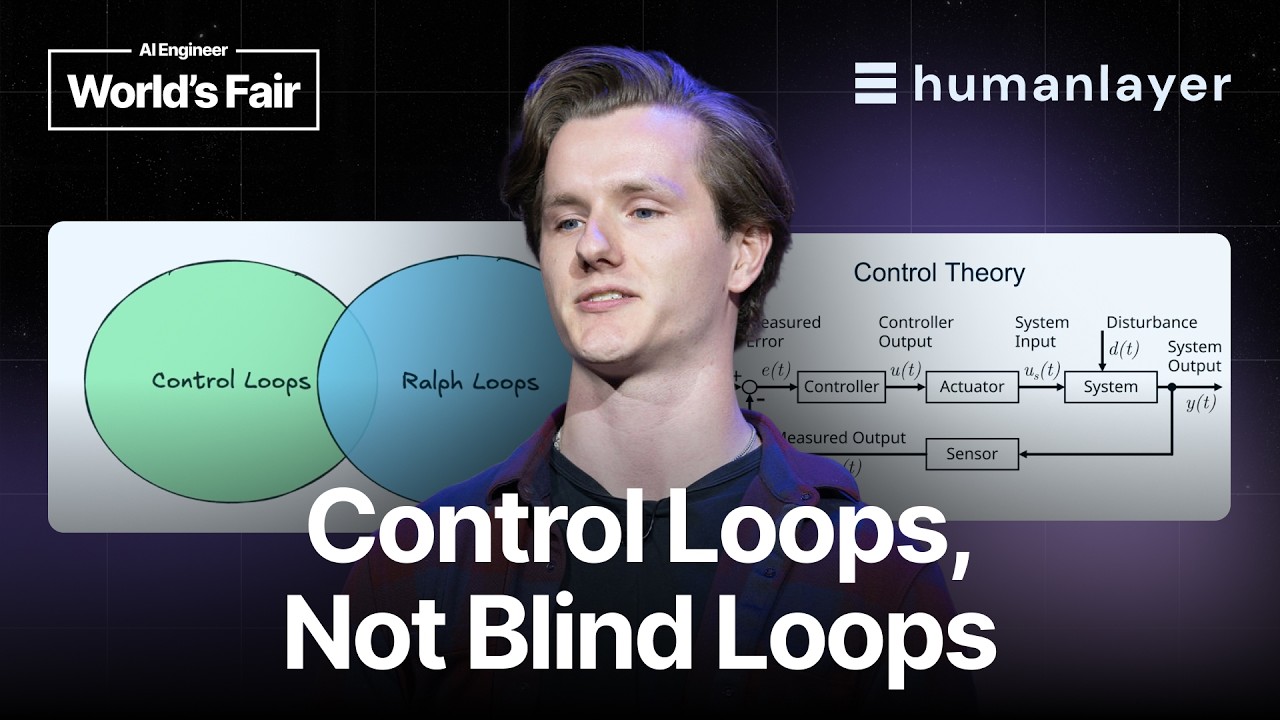
Kyle introduces control theory as the underlying principle behind effective looping mechanisms. He explains that it involves measuring the current state of a system, comparing it to a desired state (set point), calculating an error, and using a controller to generate adjustments. This iterative process, similar to how thermostats regulate temperature or fighter jets maintain stability, allows for incremental changes towards a stable or optimal outcome.
Ubiquity of Control Loops in Software
Kyle emphasizes that control loops are not novel concepts and are already integrated into numerous software systems. Examples include thermostats, Kubernetes autoscaling, Infrastructure as Code tools, PostgreSQL's autovacuum, and React’s virtual DOM. This widespread adoption demonstrates the practical utility of this approach for managing complex systems and achieving desired states.
Addressing PR Stack-up with Flow Control
The team encountered a problem where loops generated numerous pull requests (PRs) when engineers were away or focused on other tasks, leading to duplicated work and conflicts. To resolve this, they implemented flow control by attaching labels to each loop's PRs. Before running the workflow, the system checks if an open PR already exists with that label; if so, it halts further execution, preventing unnecessary accumulation of reviewable code.
Strategies for Increasing Loop Migration Velocity
Recognizing the need to accelerate loop migration, Kyle suggests several strategies. These include having the controller migrate multiple procedures concurrently (e.g., three or five at a time), implementing separate implementation phases for each migrated procedure to enhance reliability and context windows, or distributing PRs across team members for parallel review. The goal is to significantly reduce the overall migration timeline.
Chapters
Claims & Fact Check
Simply piping prompts and loops to coding agents will enable software development.
We shouldn't be prompting coding agents anymore; we should be designing loops that prompt our agents.
Boris Churnney's entire job is now writing loops to prompt Claude.
The loops work is not that important.
We built a control loop that improves our code incrementally and we're actually reading the code.
Was this digest good?
More from AI Engineer



Digest any single YouTube video — free.
3 free digests — no card, no sign-up wall.
Or just swap the domain of any YouTube link → instant digest