No clickbait detected — the title and thumbnail deliver what they promise.
AI Opinion
The episode convincingly argues that specialized, process-based data—what Cai labels "type one"—is crucial for advancing AI models beyond what can be achieved with simpler annotation or expert-generated datasets, a point supported by observed limitations in current large language models. However, the claim that fragmentation in the data market is permanent rests on an assumption of continued complexity in real-world workflows and may not fully account for potential consolidation or standardization over time. Listeners should critically evaluate Cai’s projections regarding the "ticket through mechanism" and its impact on Reinforcement Learning as a Service, given the inherent challenges in implementing such complex feedback loops at scale.
Avatars are AI rewrites of the same facts — style changes, not substance.
Summary
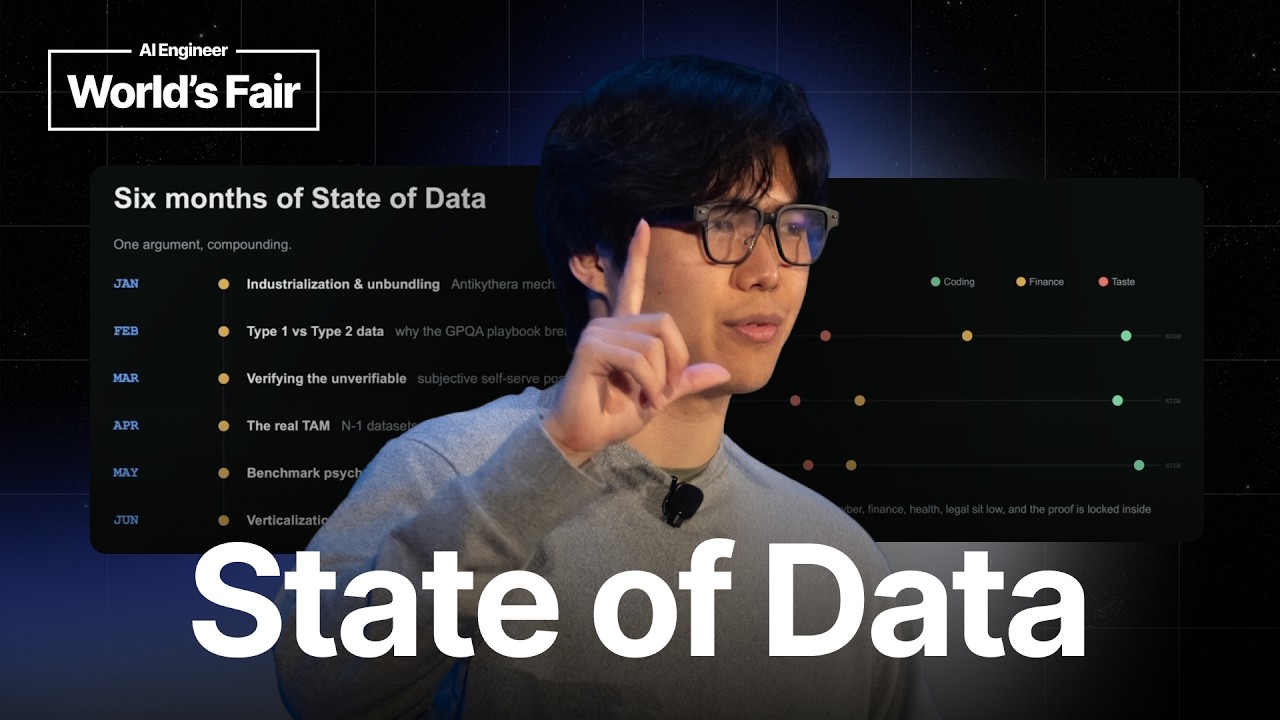
The video explores a broader view of data markets beyond simple annotation tasks, arguing that the real opportunity lies in specialized data crucial for advancing AI models. Drawing parallels to historical industrial revolutions, the speaker positions data as a foundational element driving economic transformation and highlights its significant Total Addressable Market. A shift is underway from large, integrated data providers to specialist firms who excel at sourcing talent and designing effective workflows. The video distinguishes between "type one" (real-world workflow data) and "type two" (contrived expert data), emphasizing the importance of type one for substantial model improvement. Furthermore, application companies are increasingly decoupling from specific foundational models, and data businesses are evolving into “neo labs” offering sophisticated, integrated solutions rather than just raw data. Ultimately, a company’s competitive advantage isn't simply owning data but possessing robust pipelines connecting them to real-world work and enabling continuous model retraining, with the speaker currently developing "ticket through mechanisms" to facilitate Reinforcement Learning as a Service.
Avatars are AI rewrites of the same facts — style changes, not substance.
Key Points
Data Markets Beyond Annotation
The speaker clarifies that the common image of data markets – rooms full of annotators labeling images for around $10-15 billion annually – represents only a small, relatively uninteresting portion of the overall landscape. The real value lies in the data that transforms generalist competence into specialized expertise, which is currently underpriced and crucial for model advancement.
Data's Role in the White Collar Revolution
The speaker draws a parallel between data and coal/iron during the Victorian age, framing data as a foundational element of the current white-collar revolution. He emphasizes that the Total Addressable Market (TAM) for data encompasses all labor, highlighting its significance in driving economic transformation.
The Shift to Specialist Data Providers
Historically, large vertically integrated companies like Remarque and Scale AI handled all aspects of data acquisition. However, the speaker argues that this model is increasingly unsustainable as specialist providers are outcompeting these giants in sourcing talent, building environments, designing rewards, and conducting evaluations. This fragmentation is considered permanent.
Type 1 vs Type 2 Data
The speaker introduces a distinction between 'type one' and 'type two' data, crucial for AI model improvement. Type one data captures real workflows (e.g., GitHub commits) with minimal manipulation, while type two is contrived data generated by experts in artificial settings. While type two data is useful initially, type one data is essential for achieving significant performance gains (20-80%) due to its inherent realism.
Decoupling of Application and Model Layers
Sean Cai argues that application layer companies are increasingly able to decouple themselves from the underlying model layer. He cites GLM 5.2 surpassing GPT on several real-world benchmarks as evidence, highlighting that models aren't fungible like electricity due to differences in efficiency and modality. This decoupling suggests a shift away from durable lock-in with specific foundational models.
Data Companies are Becoming 'Neo Labs'
Cai states that data businesses need to evolve into what he calls 'neo labs' because the long-term value accrues to the services and application layer. This implies a transition from simply providing raw data to offering more sophisticated, integrated solutions built on top of that data—essentially moving up the value chain.
The Importance of Real-World Work Pipelines
Cai emphasizes that a builder's moat isn’t their data itself, but rather the pipeline connecting them to real-world work. This pipeline includes infrastructure for continuous retraining as models improve underneath, suggesting that adaptability and integration are key competitive advantages in the evolving landscape of AI.
Introducing a New Ticket Through Mechanism
Sean Cai announces he is working on a new project involving 'ticket through mechanisms' designed to monetize data assets and implement Reinforcement Learning as a Service (RLaaS). This initiative aims to assist enterprises in leveraging RL while avoiding common pitfalls, signaling a move towards providing specialized AI services.
Chapters
Claims & Fact Check
Data markets are currently underpriced and represent a significant opportunity.
Fragmentation in the data market is permanent, not transitional.
Data is the underfunded leg in AI model improvement and a source of inefficiency.
Process-based data (trajectory, reasoning trace) is more valuable than state-based data (saved files).
GLM 5.2 is surpassing GPT on many real-world benchmarks.
Successful data companies are pivoting to enterprise solutions.
Data businesses do not stay data businesses because durable value accrues to the services and app layer of actual work.
Was this digest good?
More from AI Engineer



Digest any single YouTube video — free.
3 free digests — no card, no sign-up wall.
Or just swap the domain of any YouTube link → instant digest