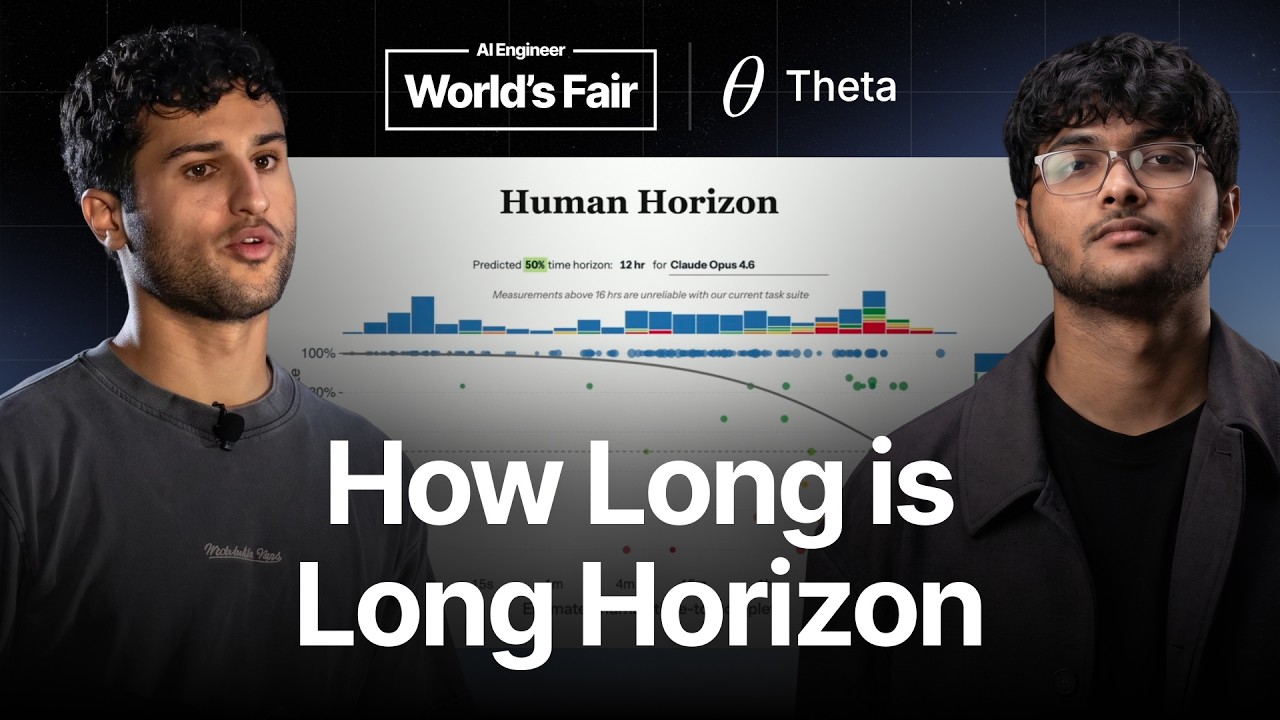
No clickbait detected — the title and thumbnail deliver what they promise.
AI Opinion
Rayan Garg makes a compelling case that current AI benchmarks fail to adequately capture the challenges of increasingly complex, long-horizon tasks, particularly by relying on artificially low baselines derived from human time. The argument for incorporating agent-based judges and detailed trajectory analysis is well-reasoned, though the feasibility of consistently applying such evaluations at scale remains unaddressed. While Garg’s critique of GDP Valer and Apex Agents raises valid concerns about metric accuracy, his assertions regarding their specific reported values require independent verification against published data to fully assess their validity. Listeners should consider that defining "long horizon" inherently involves subjective choices about what constitutes a meaningful task and acceptable performance.
Avatars are AI rewrites of the same facts — style changes, not substance.
Summary
Rayan Garg of Theta Software discusses the evolving definition of "long-horizon" work for AI agents, noting that benchmarks and performance expectations are rapidly changing. The Meter benchmark uses human time as a reference point to define long horizons, establishing thresholds based on how long it takes a human to complete a task. While token consumption is a useful metric for gauging task difficulty, Garg emphasizes the need to combine multiple metrics—including human-based comparisons and model-specific data—for a comprehensive assessment. As AI agents tackle increasingly complex tasks with longer trajectories, simple language model evaluations become inadequate, necessitating "agent-based judges" capable of analyzing trajectory data in detail, including parsing phases and enabling targeted searches for failure points. The learnability of an environment is tied to reward density and judge consistency, requiring careful rubric design and quality assurance. Finally, Garg critiques existing benchmarks like GDP Valer and Apex Agents, suggesting their reported metrics may not accurately reflect true long-horizon performance due to artificially low human time baselines.
Avatars are AI rewrites of the same facts — style changes, not substance.
Key Points
Defining Long Horizon is Evolving
Rayan Garg explains that the definition of 'long horizon' for AI agents changes over time. What was considered a long horizon a year ago may not be so today, and this will continue to evolve as models improve. This highlights the importance of understanding how rapidly the capabilities of AI are progressing.
Meter Benchmark Uses Human Time as a Threshold
The Meter benchmark uses human time as a reference point for defining long horizon tasks. It establishes thresholds, such as a 16-hour threshold where an AI agent can achieve the same success rate as a human taking 16 hours to complete a task. This approach provides a tangible metric by comparing AI performance against established human benchmarks.
Token Consumption is a Noisy but Useful Metric
While token consumption (number of tokens used in a trajectory) can be a noisy metric due to variations in models and harnesses, it remains valuable for understanding task difficulty. A higher token count generally indicates a more challenging task for an AI agent, providing insights into the technical frontier of model capabilities.
Combining Metrics Provides a More Complete Picture
Rayan emphasizes that relying on any single metric (human time or token consumption) is insufficient for accurately assessing long horizon performance. A holistic approach, considering both human-based benchmarks and model-specific metrics like tokens and steps, provides a more comprehensive understanding of an AI agent's capabilities.
The Need for Agent-Based Judges
As environments become more complex and agent trajectories lengthen, relying on basic language model calls to evaluate those trajectories becomes insufficient. The sheer length and complexity of these trajectories necessitate a more sophisticated approach, such as using another agent (a 'judge') to analyze them. This allows for richer processing, including database storage, sub-agent enrichment, and parsing specific phases within the trajectory.
Importance of Queryable Trajectories
To effectively analyze long agent trajectories, they need to be 'queryable,' meaning that information can be extracted and examined. This involves enriching the trajectory data with metadata, parsing specific phases (like logging, coding, or verification), and enabling targeted searches for critical steps like failure points. This allows for a more granular understanding of the agent's process.
Reward Density and Judge Consistency
The learnability of an environment is heavily influenced by the density of the reward signal, which is largely determined by the rubric used and how the judge defines it. Overloading a rubric with excessive detail can overwhelm judges, especially when dealing with complex or frontier problems where models struggle. Careful consideration and rigorous quality assurance (QA) are crucial to ensure consistent application of the rubric.
Critique of Existing Benchmarks
The speaker critiques popular benchmarks like GDP Valer, Toolbench, and Apex Agents, highlighting issues with their reported metrics. Specifically, the average human hours per task often fall below what would be considered 'long horizon,' leading to artificially saturated results and a narrow scope of tasks. This suggests that current evaluation practices may not accurately reflect true long-horizon performance.
Chapters
Claims & Fact Check
The horizon at which AI agents can work autonomously is accelerating rapidly.
Long horizon is a scalar metric, useful for comparing tasks but difficult to define as binary.
Meter uses a 50% success rate threshold when comparing AI agent performance to human time.
The only way we can really verify correctness is to actually look at the state itself.
These trajectories can get really really long and really really complex.
The average human hours per task fall far below what would be considered 'long horizon'.
Was this digest good?
More from AI Engineer

Teaching AI to Find Real Vulnerabilities — David Brumley, Bugcrowd
Aug 1, 2026

Agents at Scale: Inside MiniMax's Model and the Infrastructure Behind It — Olive Song
Jul 31, 2026
fighting slop with slop — Vaibhav Gupta, Boundary
Jul 31, 2026
First Steps Toward Automated AI Research — Richard Socher, CEO Recursive AI
Jul 30, 2026
Digest any single YouTube video — free.
3 free digests — no card, no sign-up wall.
Or just swap the domain of any YouTube link → instant digest