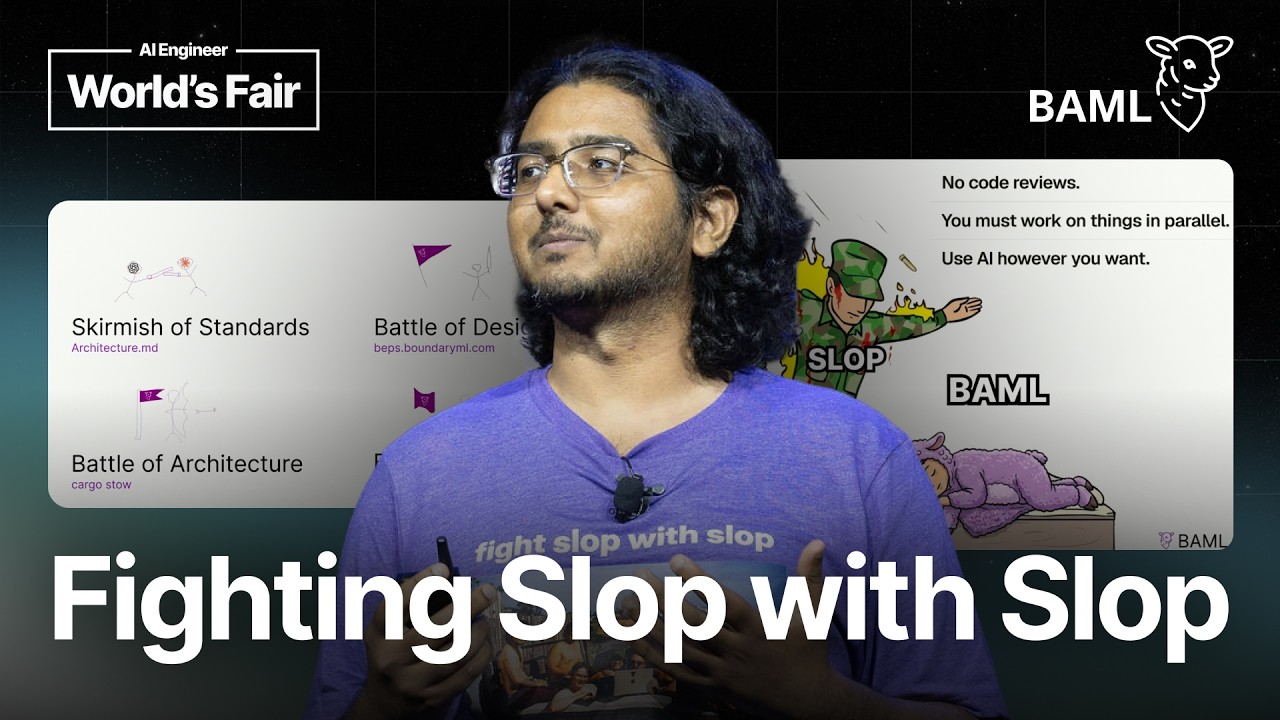
No clickbait detected — the title and thumbnail deliver what they promise.
AI Opinion
Gupta’s argument for proactively managing code inconsistencies—rather than eliminating them entirely—and the practical implementation of Boundary's "architecture.md" file offer a compelling case for adapting engineering workflows in an age of rapidly evolving AI tools. However, claims regarding the elimination of code reviews and guarantees about error handling, particularly in relation to JavaScript, require further scrutiny as they appear to overstate current capabilities; the assertion that Python’s long-standing bugs are relevant to this discussion also feels somewhat disconnected. Listeners should consider how Boundary's specific context and scale might influence the generalizability of these strategies before applying them elsewhere.
Avatars are AI rewrites of the same facts — style changes, not substance.
Summary
Vaibhav Gupta of Boundary discusses a philosophy centered around managing "slop"—inevitable inconsistencies in code—rather than striving for its complete elimination. To address the challenges arising from disparate AI tooling, Boundary implemented an “architecture.md” file to establish centralized standards and prioritized high-quality design documentation with dedicated tools and Slack integration to foster shared knowledge. A key process involves automated generation of BAML programs for continuous validation, ensuring code quality and identifying deviations. The system also automatically infers error types, allowing the compiler to provide guarantees about error handling and enabling APIs that avoid errors. Looking ahead, Boundary envisions seamless integration of machine language functions across various programming languages like Python and Rust. Ultimately, Gupta argues that complex systems can be built without traditional code reviews through parallel work streams and thoughtful interaction with AI tools, emphasizing the need for evolving engineering processes to maintain efficiency and proactively address "slop."
Avatars are AI rewrites of the same facts — style changes, not substance.
Key Points
The 'Slop' Philosophy - Embracing Controlled Chaos
Vaibhav introduces the concept of 'slop,' defining it as any code that isn’t consistently reviewed. He emphasizes that a codebase will inevitably contain some level of slop, and the goal is to manage it rather than eliminate it entirely. This philosophy stems from their experience building a programming language where consistency and reliability are paramount, requiring them to actively combat 'slop' in their processes.
Architecture.md: A Centralized Standard for AI Tooling
To address the issue of engineers using disparate AI tools, Boundary implemented an 'architecture.md' file. This document serves as a central repository for agreed-upon standards and guidelines, ensuring that all agents can understand and work with the same foundational elements, particularly layers within their compiler. The file is intentionally kept small and stable to minimize disruption.
Design Docs as a Priority: A Shift in Focus
Recognizing that code can be 'slop' but design documentation cannot, Boundary prioritized the quality of written design documents. This led to the creation of a dedicated design doc tool with versioning and commenting features, coupled with a Slack integration to promote visibility and engagement. The resulting channel became highly active, demonstrating the power of shared knowledge and accountability.
Automated BAML Program Generation for Continuous Validation
To ensure code quality and catch potential issues, Boundary implemented a system where agents automatically generate BAML programs. These programs are then used to test the codebase from scratch, allowing them to analyze tool usage and identify any deviations or inconsistencies in the development process. This continuous validation loop helps maintain stability and prevent regressions.
Inferred Error Types and Compiler Guarantees
The speaker demonstrates how the system automatically infers error types, eliminating guesswork for developers. This allows the compiler to provide exhaustive guarantees regarding error handling – proving whether an error has been handled or not. This capability enables the design of APIs that guarantee they never throw errors by leveraging these inferred types and compiler-verified handling.
Bridging Language Boundaries with ML
The speaker proposes a future where Machine Language (ML) functions are directly accessible from any programming language, including Python, TypeScript, Rust, Go, Ruby, and Java. This seamless integration allows for the passing of lambdas, generics, and closures across these languages, streamlining development workflows and ensuring type safety without requiring engineers to manually manage complexities.
The Power of Abstracting Away Code Review
The speaker argues that incredibly complex systems can be built without traditional processes like code reviews. This is enabled by parallel work streams and the freedom to utilize AI tools as desired, but crucially depends on a thoughtful approach to how engineering teams interact with underlying systems. This shift allows for greater flexibility and speed in software development.
Embracing Evolution of Engineering Processes
The speaker emphasizes that engineering processes must evolve to match the pace of modern software development, particularly when aiming for 'agent speed.' He draws a parallel to the initial resistance towards CI/CD pipelines, highlighting how short-term slowdowns are outweighed by long-term gains in efficiency. This underscores the importance of proactively addressing and mitigating slop within codebases.
Chapters
Claims & Fact Check
We do no code reviews.
Everyone here knows that you have to write perfect design docs.
We haven't changed our architecture in the last three or four months.
Python has bugs 25 years later.
Error handling in JavaScript often involves deeply nested try/catch blocks, leading to developers giving up and using console.log for error management.
The system can guarantee that errors are handled or not handled, eliminating guesswork and enabling APIs that never throw errors.
Integrating ML with existing languages can be achieved by making ML functions directly accessible from any language, ensuring type safety and seamless interoperability.
Was this digest good?
More from AI Engineer
Agents at Scale: Inside MiniMax's Model and the Infrastructure Behind It — Olive Song
Jul 31, 2026
First Steps Toward Automated AI Research — Richard Socher, CEO Recursive AI
Jul 30, 2026
How Forward Deployed Engineering is done at Kepler — Vinoo Ganesh
Jul 28, 2026

Serving 2 Million Models Without Melting: Scaling the Hugging Face Hub — Arek Borucki, Hugging Face
Jul 28, 2026
Digest any single YouTube video — free.
3 free digests — no card, no sign-up wall.
Or just swap the domain of any YouTube link → instant digest