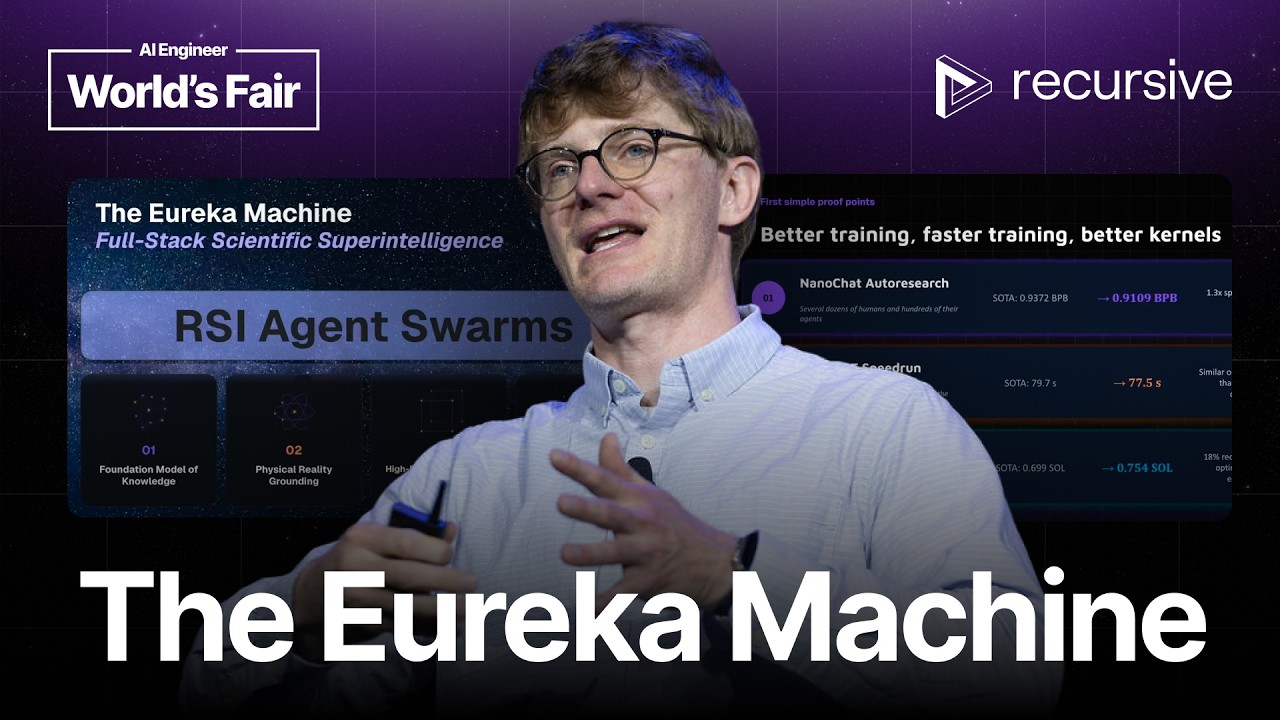
No clickbait detected — the title and thumbnail deliver what they promise.
AI Opinion
Socher convincingly argues that automated systems like Recursive Search Initiative (RSI) can drastically accelerate AI research, demonstrated by their rapid NanoChat training and CUDA kernel optimization achievements. However, claims regarding the “Eureka machine” and its potential to broadly solve global challenges rest on a speculative extrapolation of current capabilities and lack concrete timelines or measurable outcomes. Listeners should critically evaluate assertions about outperforming human teams – while RSI's results are impressive, independent verification of these benchmarks would strengthen the argument—and consider whether automation’s benefits will be distributed equitably given Socher’s techno-optimist framing.
Avatars are AI rewrites of the same facts — style changes, not substance.
Summary
Richard Socher, CEO of Recursive AI, discusses his company’s efforts to automate AI research and development, drawing parallels between current technological progress and historical advancements like the rapid transition from early flight to lunar travel. He demonstrates how their automated system, Recursive Search Initiative (RSI), can quickly train AI models – exemplified by a NanoChat model trained in under five minutes – and optimize specialized areas like CUDA kernels, often surpassing existing benchmarks. Socher highlights inefficiencies within current AI infrastructure, particularly with Mixture of Experts models, suggesting that automation can significantly improve resource utilization and reduce costs. He introduces the concept of a “Eureka machine,” an AI system designed to mimic evolutionary processes and accelerate scientific discovery, ultimately envisioning its potential to drive broader technological and economic growth, aligning with a techno-optimist perspective on innovation's ability to solve global challenges and generate widespread benefits.
Avatars are AI rewrites of the same facts — style changes, not substance.
Key Points
Rapid NanoChat Model Training
Richard Socher demonstrates Recursive AI's automated research system's ability to rapidly train a small chat model, achieving significant improvements in 'bits per byte' within a short timeframe. The system trained the model in less than 5 minutes and achieved a score of 0.91, surpassing the community’s previous best of 0.93 after extensive work. This showcases the potential for automated systems to accelerate AI development.
Automated CUDA Kernel Discovery
The system was used to optimize CUDA kernels, which are crucial for efficient GPU utilization in training and testing large AI models. After a few days of automated research, the system discovered kernels that outperformed those on Nvidia's benchmark website by a significant margin. This highlights the ability of RSI to identify improvements even in specialized areas where human expertise is typically required.
Limitations of Current AI Efficiency
Richard Socher points out the surprising inefficiency of many Mixture of Experts (MoE) models, noting that even large clusters costing billions of dollars often have only 30% utilization. This highlights a significant area for improvement and suggests that automated research can play a crucial role in optimizing resource usage and reducing costs within AI infrastructure.
Exponential Growth and Future Potential
Socher argues that Recursive AI's automated research system (RSI) represents a potential 'S-curve' or exponential growth phase layered on top of existing advancements in AI. He emphasizes the vast remaining potential for improvement across various dimensions of intelligence, suggesting RSI could ultimately benefit not only AI but also science and technology as a whole.
The Eureka Machine Concept
Richard Socher introduces the 'Eureka machine,' a concept for an AI system designed to automate research and invent future technologies. He frames this as his personal equivalent of going to Mars, signifying a monumental undertaking. The goal is to mimic evolution's inventive capacity by automating scientific discovery and pushing the boundaries of human knowledge.
Evolutionary Inspiration for AI Development
Socher emphasizes that evolution, a process spanning billions of years, has yielded remarkable advancements in biology and is now inspiring the development of AI. He suggests drawing parallels between evolutionary processes and AI design to create more effective systems, highlighting the potential for AI to mimic nature's iterative problem-solving approach.
Technological Progress Drives Economic Growth
Drawing from Marc Andreessen’s techno-optimist manifesto, Socher asserts that technology is the primary driver of economic growth. He counters concerns about AI displacing jobs by arguing that technological advancements will ultimately lead to massive economic expansion and widespread benefits for humanity, emphasizing a positive outlook on innovation's impact.
Rapid Technological Advancements within a Lifetime
Socher illustrates the rapid pace of technological progress by contrasting advancements made between 1900 and 1969, highlighting humanity's transition from rudimentary flight to lunar travel. This example underscores how quickly technology evolves and suggests that current AI development may be on a similar trajectory, potentially leading to transformative changes within a single generation.
Chapters
Claims & Fact Check
We should fire all the AI engineers and have them manage an actual AI.
The only perpetual source of growth for the entire economy is technology.
No material problems cannot be solved with even more technology.
The system outperformed many different teams using other AI research methods.
After a day or two of training, the NanoChat model achieved a bits per byte score of 0.91.
The system discovered better kernels than the leaderboards best on the Nvidia benchmark website.
Was this digest good?
More from AI Engineer

Agents at Scale: Inside MiniMax's Model and the Infrastructure Behind It — Olive Song
Jul 31, 2026

fighting slop with slop — Vaibhav Gupta, Boundary
Jul 31, 2026
How Forward Deployed Engineering is done at Kepler — Vinoo Ganesh
Jul 28, 2026

Serving 2 Million Models Without Melting: Scaling the Hugging Face Hub — Arek Borucki, Hugging Face
Jul 28, 2026
Digest any single YouTube video — free.
3 free digests — no card, no sign-up wall.
Or just swap the domain of any YouTube link → instant digest