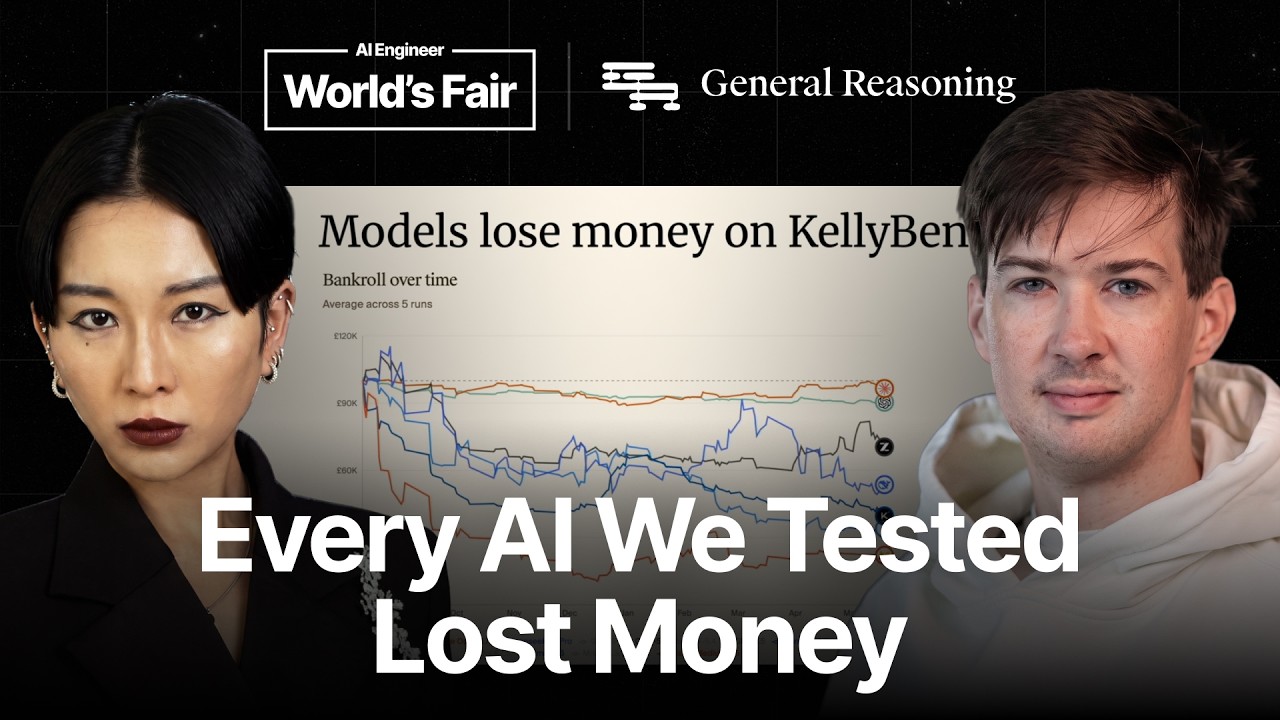
No clickbait detected — the title and thumbnail deliver what they promise.
AI Opinion
The episode most convincingly argues that Reinforcement Learning from Human Feedback (RLHF) is essential for translating advanced base models into practical, widely-adopted tools, citing Meta’s Llama development as a compelling example. However, the discussion of "value model bootstrapping" to mitigate long-horizon inference challenges rests on an unverified assumption about its potential to introduce bias without adequately addressing how that risk would be managed. Listeners should critically evaluate claims regarding Galactica's performance relative to larger models, considering its controversial public release and subsequent limitations. Finally, the speakers’ emphasis on a "long horizon mindset" could benefit from more concrete examples of how this translates into specific methodological changes beyond simply extending policy constraints.
Avatars are AI rewrites of the same facts — style changes, not substance.
Summary
The discussion centered on scaling AI development, particularly focusing on long-horizon challenges and the critical role of Reinforcement Learning from Human Feedback (RLHF). Speakers highlighted that small, aligned teams can drive significant innovation, exemplified by Meta’s work on Llama models, but even advanced base models like Galactica – which demonstrated superior performance in scientific domains compared to larger counterparts – require RLHF to become widely adopted and useful. A key challenge arises with long-horizon tasks, where inference times extend considerably, leading to GPU idle time; a proposed solution involves “value model bootstrapping” to generate expectations during training, though this introduces potential bias. General Reasoning’s Open Review platform, hosting over 350 environments via a unified API, provides crucial infrastructure for research in this area. Ultimately, the speakers emphasized that addressing complex problems necessitates a shift towards a long-horizon mindset, requiring adjustments to algorithms, environments, and computational approaches beyond typical eight-step policy constraints used in off-policy learning.
Avatars are AI rewrites of the same facts — style changes, not substance.
Key Points
Long Horizon Inference Time and GPU Idle Time
When dealing with long horizon tasks, inference times can extend to weeks or even longer. This significantly exceeds the typical eight-step policy constraint used for off-policy learning. Consequently, GPUs are forced to remain idle while waiting for these lengthy inferences to complete, representing a major inefficiency.
Value Model Bootstrapping as a Solution
To mitigate the GPU idling issue during long horizon inference, a value model can be employed for bootstrapping. This involves generating expectations before the episode's end, acting like dopamine in the human brain to facilitate model training. However, this approach introduces a trade-off by potentially introducing bias from the value model itself.
Open Review Platform: A Unified Environment Hub
General Reasoning has developed Open Review, a platform hosting over 350 environments accessible through a single API endpoint. This infrastructure is crucial for long horizon tasks and is currently utilized internally by General Reasoning as well as several frontier and new labs for reinforcement learning research.
Long Horizon as a Mindset Shift
The speakers emphasize that tackling long horizon challenges is not merely an engineering problem but requires a fundamental shift in mindset. To address humanity's most significant problems, embracing this long-horizon perspective and adapting algorithms, environments, and computational approaches becomes essential for progress.
Small, Aligned Teams Can Achieve Significant Results
Ross highlights that small, focused teams with aligned goals can achieve remarkable results, even within the context of scaling AI development. He points to his experience at Meta where a relatively small team was responsible for significant advancements in open-weight models like Llama 2 and Llama 3. This suggests that concentrated effort and shared vision are vital ingredients for innovation.
The Importance of RLHF in LLM Development
Ross emphasizes that Reinforcement Learning from Human Feedback (RLHF) was the crucial element transforming Large Language Models (LLMs) into usable products. He contrasts Galactica, a model lacking RLHF, with ChatGPT, highlighting how the feedback pipeline enabled LLMs to cross what he calls the 'Rubicon' and become widely adopted by billions of users. This demonstrates that even advanced base models are insufficient without RLHF.
Galactica's Performance Despite its Public Backlash
Despite the negative public reaction and association with Meta, Galactica demonstrated superior performance compared to models like Palm and GPT-3.5 in scientific domains. It achieved 68% accuracy on research paper tasks versus GPT-3.5's 49%, and outperformed Palm (540 billion parameters) on chain-of-thought reasoning tasks. This underscores the potential of well-designed base models, even when overshadowed by other factors.
The Paradox of Base Model Performance
Ross notes the paradox that Galactica was a state-of-the-art model despite its public downfall. It outperformed larger models like Palm and Chinchilla with significantly less compute in scientific domains, demonstrating the power of base models. However, this also reinforces his earlier point that even exceptional base models require RLHF to reach their full potential.
Chapters
Claims & Fact Check
ChatGPT's emergence shocked the world and marked the beginning of the modern AI wave.
Galactica was in some respects quite similar to ChatGPT.
RLHF provides value and is the key thing that made LLMs products for the first time.
Off-policy learning is generally acceptable up to eight steps.
Applying a value model allows for bootstrapping during long horizon inference.
Open Review hosts over 350 environments with a single API endpoint.
Was this digest good?
More from AI Engineer
Teaching AI to Find Real Vulnerabilities — David Brumley, Bugcrowd
Aug 1, 2026
Rethinking Environments for Long-Horizon Work — Rayan Garg, Theta Software
Aug 1, 2026
What's Next After RLHF? — Diogo Almeida, TypeSafe AI
Jul 31, 2026

Data Quality Is the Compute Multiplier — Ari Morcos, DatologyAI
Jul 31, 2026
Digest any single YouTube video — free.
3 free digests — no card, no sign-up wall.
Or just swap the domain of any YouTube link → instant digest