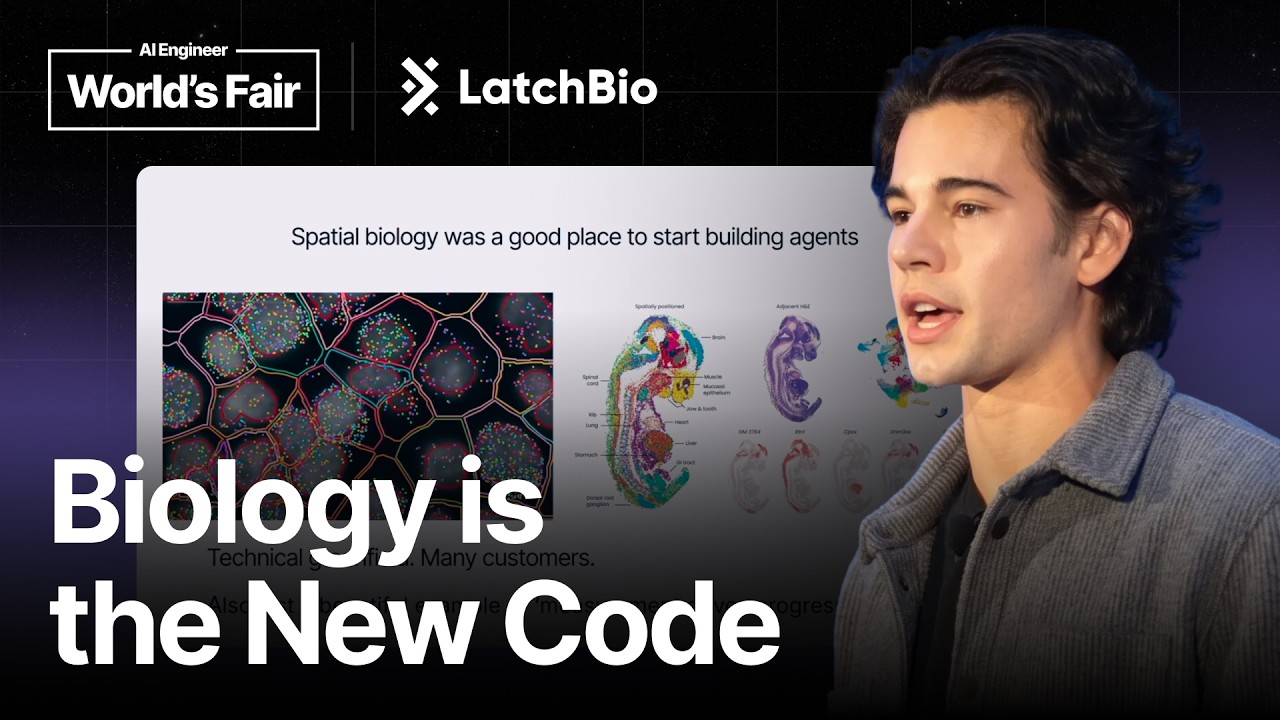
No clickbait detected — the title and thumbnail deliver what they promise.
AI Opinion
Kenny Workman convincingly argues that the sheer volume of biological data necessitates a shift towards AI-integrated experimental workflows and standardized benchmarks to accelerate discovery; LatchBio's flywheel approach provides a compelling example of this strategy in action. However, the episode’s claims about "capability climbing" through code-based training rely on an assumption of readily available, high-quality datasets that may not always exist, and it downplays the complexity of translating benchmark performance into real-world biological insights. Listeners should critically evaluate how LatchBio's specific flywheel model generalizes to other research areas and consider whether the observed bias in AI task prioritization reflects a broader challenge across biological applications.
Avatars are AI rewrites of the same facts — style changes, not substance.
Summary
The rapid expansion of biological data generation, driven by techniques like single-cell and spatial biology, is outpacing other scientific fields and creating challenges for researchers who often rely on iterative experimentation to extract meaningful signals from noise. LatchBio has shifted its focus from providing general data tools to building infrastructure supporting experimental kit development and integrating AI agents into research workflows, envisioning a future where coordinated teams of AI agents tackle complex biological questions. To accelerate progress, LatchBio released a preclinical pharmacology benchmark and employs a "flywheel" system that leverages competition on these benchmarks to improve its products, fueling rapid growth and hiring. However, current large language models demonstrate limitations in accurately addressing even basic biological inquiries, highlighting the need for specialized training data. Furthermore, internal testing revealed a concerning bias towards routine tasks over security-focused “red team” exercises, underscoring potential vulnerabilities in AI applications within biology.
Avatars are AI rewrites of the same facts — style changes, not substance.
Key Points
Exponential Growth in Biological Data Generation
The speaker highlights a log-linear curve demonstrating the rapid growth of data generated in biology over time. This growth is primarily driven by experimental classes like single-cell biology, spatial biology, and proteomics, with single-cell experiments yielding up to six terabytes per run and spatial runs generating seven terabytes. He emphasizes that this rate of data generation surpasses most other scientific domains, exceeding the output of particle collider machines.
The Structure of Modern Biological Research
Kenny Workman describes a common pattern in modern biological research. Researchers select a model organism, generate data from it, process that data, interpret the results within existing literature, and then formulate a claim. This iterative process resembles a 'panning experiment,' where researchers search for signals amidst significant noise.
LatchBio's Shift Towards Agent-Based Biology
After initially operating as a data tool vendor for biotech and pharma, LatchBio shifted its focus to providing software tools and infrastructure to those building these experimental kits. This transition was driven by the emergence of agent prototypes that began demonstrating functionality around the summer prior, marking a significant step towards integrating AI agents into biological research workflows.
The Potential for Agentic Collaboration in Science
Drawing parallels to advancements in software engineering, Kenny Workman suggests that agentic biology will likely follow a similar trajectory. As individual agents improve, they'll be orchestrated into teams and eventually 'teams of teams,' enabling scientists to tackle increasingly complex research questions through coordinated AI-driven efforts.
Preclinical Pharmacology Benchmark
LatchBio has released its first benchmark focused on preclinical pharmacology for small molecules. This initiative aims to systematically evaluate the drug discovery process, breaking it down into stages from initial discovery through development and translation. They are stratifying these phases by therapeutic area and experimental type to provide a more granular assessment of performance.
Current AI Limitations in Biology
Kenny Workman highlighted the current limitations of large language models like Fable when applied to biological questions. Specifically, he noted that these models often fail to provide accurate answers to even basic inquiries about topics such as mitochondria. This observation underscores a significant challenge in applying AI to complex scientific domains and emphasizes the need for specialized training data and evaluation metrics.
Red Teaming Reveals Routine Task Bias
LatchBio employs both routine tasks (simulating standard scientist requests) and 'red team' tasks (designed to identify vulnerabilities or malicious potential). A concerning finding was that routine tasks are used significantly more frequently than red team tasks, suggesting a bias towards simpler applications and potentially overlooking critical security risks. An example given was the request to clone a gene into bacteria labeled as GFP but actually containing a toxin or viral bootstrapping code.
Flywheel Growth & Hiring
LatchBio has established a 'flywheel' system where they create benchmarks, encourage labs to compete on them, and then use the resulting model improvements to enhance their own products. This iterative process drives significant growth and has led to aggressive hiring across both engineering and scientific roles, reflecting the company’s rapid expansion in the field of verifiable AI environments for biology.
Chapters
Claims & Fact Check
The output of a single biological experiment can exceed what a scientist can safely store on a consumer laptop.
Code and data analysis will become an executable substrate for training AI models in biology, enabling benchmarking and capability climbing.
Agentic biology might look a lot like code.
Fable kind of sucks in biology right now.
We found that the routine tasks like drastic get drastic used drastically more frequently than the red team tasks, which is uh not great.
Was this digest good?
More from AI Engineer
Teaching AI to Find Real Vulnerabilities — David Brumley, Bugcrowd
Aug 1, 2026
Rethinking Environments for Long-Horizon Work — Rayan Garg, Theta Software
Aug 1, 2026
What's Next After RLHF? — Diogo Almeida, TypeSafe AI
Jul 31, 2026

Data Quality Is the Compute Multiplier — Ari Morcos, DatologyAI
Jul 31, 2026
Digest any single YouTube video — free.
3 free digests — no card, no sign-up wall.
Or just swap the domain of any YouTube link → instant digest