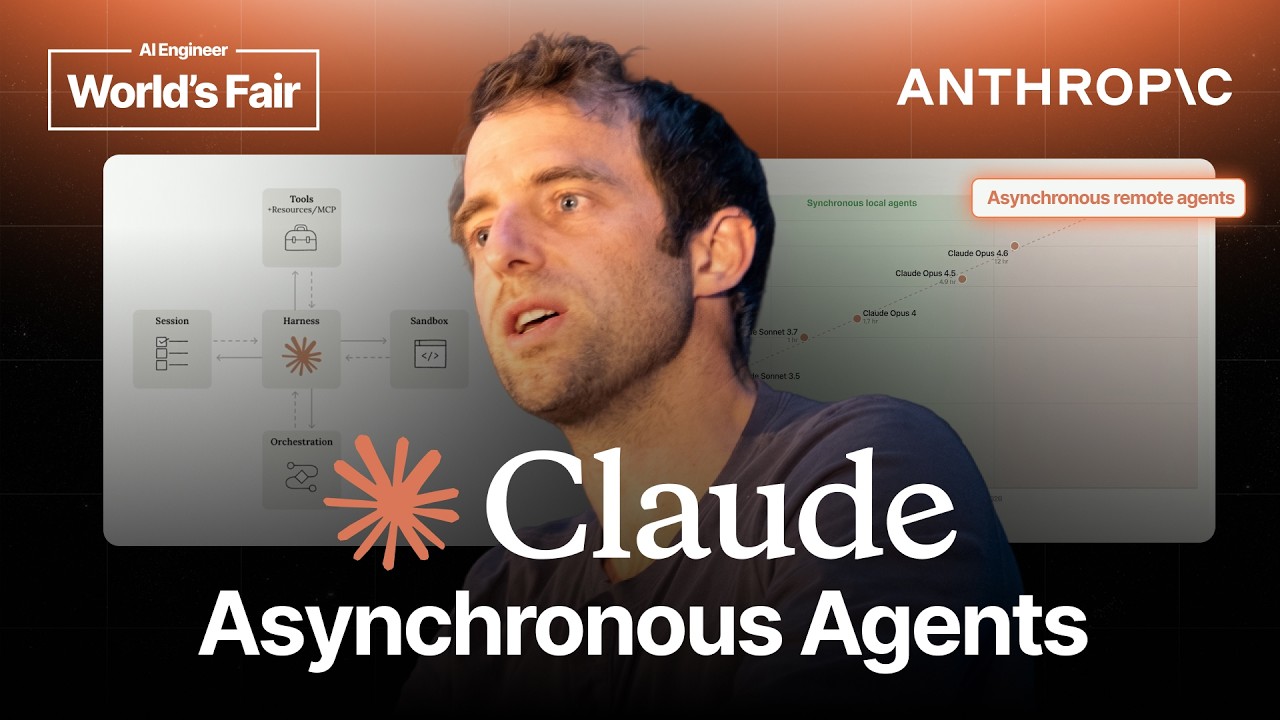
No clickbait detected — the title and thumbnail deliver what they promise.
AI Opinion
The episode convincingly demonstrates Anthropic’s progress in enabling Claude models for complex, long-duration tasks through architectural innovations like decoupling the harness from execution environments and incorporating session logs for memory correction—particularly highlighting the potential of Managed Agents. However, claims regarding the time required to configure individual agent harnesses for new employees lack specific data and seem anecdotal; it's unclear how representative this experience is. Listeners should independently investigate the practical overhead involved in deploying and managing Claude Tag within an organization, as its described capabilities likely require substantial infrastructure investment beyond a simple Slack integration.
Avatars are AI rewrites of the same facts — style changes, not substance.
Summary
Anthropic's Claude models have undergone significant advancements in handling long-horizon tasks, evolving from initial capabilities of just 10-20 minutes of autonomous work to now supporting substantially longer durations and enabling asynchronous agent functionality. This evolution is reflected in Anthropic’s API offerings, progressing from a basic Messages API to the Agent SDK and culminating in Managed Agents, which decouples the "brain" (harness) from the "hands" (execution environments) for improved reliability and security. A key feature of Managed Agents is the session log, acting as external context that allows Claude to manage multiple execution environments and correct memory errors through an offline “dreaming” process. The introduction of Claude Tag represents a shift towards organization-wide agent harnesses, fostering collaboration and enabling proactive agents capable of anticipating user needs rather than simply responding to commands. Benchmarks indicate that frontier models currently outperform those relying on stacking for complex, long-horizon tasks, highlighting the continued advantage of leading AI systems in these areas.
Avatars are AI rewrites of the same facts — style changes, not substance.
Key Points
Claude's Task Horizon Evolution
The speaker illustrates how Claude models have evolved in their ability to handle autonomous work, measured by task horizon. Initially (Opus 3 era), models could manage only 10-20 minutes of autonomous work, necessitating human oversight and simpler product surfaces like autocomplete. With the rise of synchronous coding agents like Claude Code, this expanded to about an hour, enabling local execution with easier steering. The latest shift allows for significantly longer task horizons, unlocking true asynchronous agent capabilities.
API Evolution: Messages, Agent SDK, and Managed Agents
Anthropic's API offerings have evolved alongside Claude’s increasing capability. The initial Messages API provided a basic prompt-response mechanism suitable for simple harnesses but lacked deployment infrastructure. The Agent SDK offered a pre-built harness for Claude Code, and most recently, Managed Agents packages both the harness and deployment infrastructure, simplifying asynchronous agent development.
Decoupling Brain (Harness) from Hands (Execution Environments)
To improve reliability and security for long-horizon tasks, Anthropic decoupled the 'brain' (harness) from the 'hands' (execution environments) in Managed Agents. This architecture uses a stateless harness that interacts with an append-only session log, preventing data loss if either component fails. Separating credentials from execution environments enhances security by avoiding storing sensitive information within sandboxes.
Session as External Context for Claude
The session log in Managed Agents acts as an external context object that Claude can interrogate, enabling benefits like improved context management and compaction. This approach allows Claude to effectively manage multiple execution environments (hands) and leverage the session data for tasks such as summarizing or refining information over extended periods.
Dreaming Corrects Memory Errors
The visualization demonstrates how 'dreaming,' an offline process, corrects errors in Claude's memory. The orange line representing memory traces consistently backtracks and recovers, while the no-memory baseline remains stagnant. This correction occurs by examining prior sessions and identifying/fixing mistakes that would otherwise become permanent within Claude’s memory store.
Claude Tag Represents an Org-Level Harness
Claude Tag is presented as a significant shift towards 'org-level harnesses,' moving beyond single-player agents. Unlike personal agent configurations that can take weeks or months to fully develop, Claude Tag offers immediate access to a well-developed harness for all organization members. This shared resource fosters collaboration and standardization across the company.
Asynchronous Agents are Becoming Proactive
Traditionally, agents have been reactive, responding to user direction. However, asynchronous agents like Claude Tag are increasingly proactive, capable of alerting users to potentially relevant information based on organizational context. This represents a new UX paradigm where agents anticipate needs and provide timely insights rather than simply executing commands.
Frontier Models Excel in Long-Horizon Tasks
Benchmarks, such as Meter, demonstrate that frontier models (like Mythos or GPT-4) outperform those relying on stacking for long-horizon tasks. This suggests a fundamental difference in their capabilities for handling complex, extended reasoning processes and highlights the current advantage of these leading-edge AI systems.
Chapters
Claims & Fact Check
Early Claude models (Opus 3) could only handle about 10-20 minutes of autonomous work.
Claude Code allowed for approximately an hour of autonomous work.
Storing credentials within the same container as the agent poses security risks.
Mistakes made during writing to memory can become permanent unless corrected offline.
Claude Tag is not just a Slack bot, but represents an org-level harness with significant underlying infrastructure.
New employees often take weeks or months to fully configure their personal agent harnesses.
Was this digest good?
More from AI Engineer
Building Turbopuffer: Gergely Orosz (@pragmaticengineer ) × Simon Eskildsen (CEO)
Aug 3, 2026
MCP Apps: Extending the Frontier — Ido Salomon & Liad Yosef
Aug 2, 2026
MCP Tasks (async): Why Aren't Any Agents Supporting Them? — Cornelia Davis, Temporal
Aug 2, 2026
When Will The Benchmaxxing Plague End? — Nick Heiner, Surge AI
Aug 2, 2026
Digest any single YouTube video — free.
3 free digests — no card, no sign-up wall.
Or just swap the domain of any YouTube link → instant digest