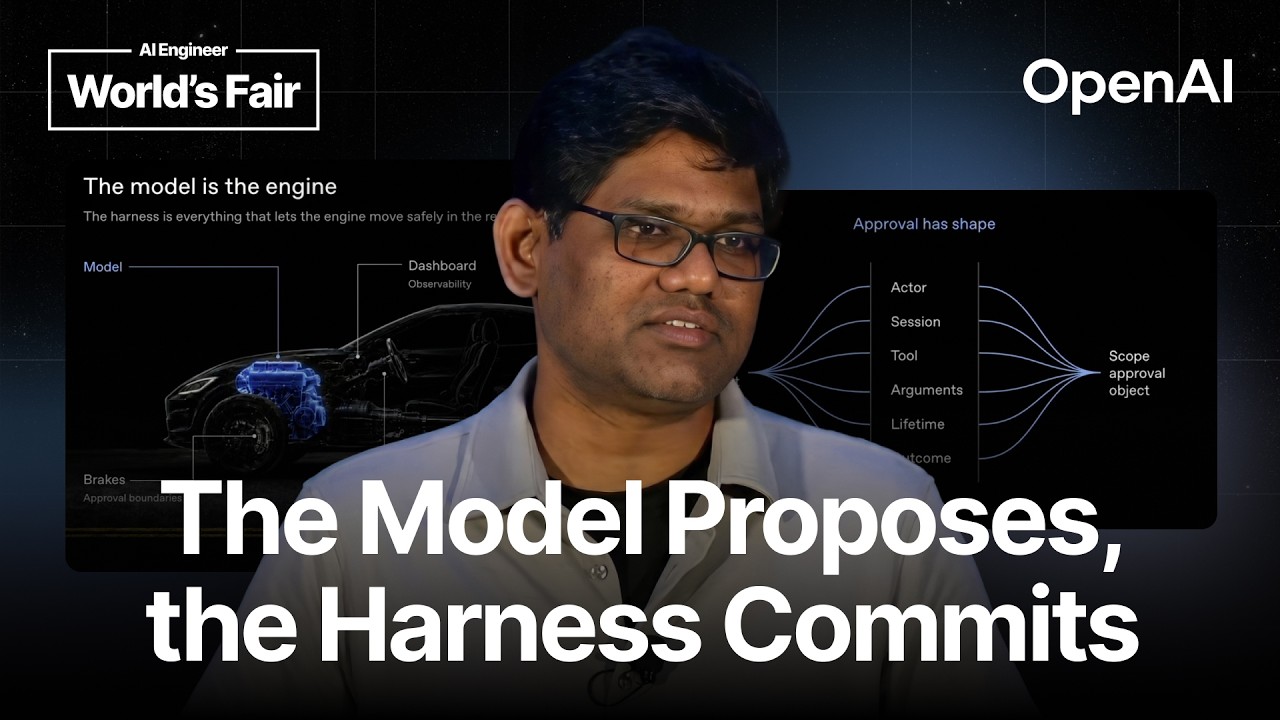
No clickbait detected — the title and thumbnail deliver what they promise.
AI Opinion
Govindarajan’s argument that production failures frequently arise from inadequate harness infrastructure rather than inherent model limitations is convincingly presented, particularly through the clear "propose, commit, prove" framework and emphasis on detailed receipts. However, the discussion of how a “better model” contributes to performance within each turn feels less substantiated, relying more on intuitive reasoning than concrete examples—it’s plausible but not definitively demonstrated. Listeners should consider that while harness design is undoubtedly critical, the episode's focus may slightly downplay the ongoing need for improvements in underlying language model capabilities alongside robust infrastructure.
Avatars are AI rewrites of the same facts — style changes, not substance.
Summary
The discussion centers on a critical shift in how we approach agent system failures, arguing that issues often stem from problems within the "harness"—the infrastructure managing and controlling an agent's actions—rather than shortcomings of the underlying language model itself. A proposed framework outlines a core contract: the model proposes, the harness commits, and a detailed receipt proves the action. The architecture of a robust harness includes event management, session tracking, tool utilization with approvals, and a comprehensive audit trail to ensure state ownership and accountability. Crucially, complete receipts—detailed records of actions, including tool calls and results—are essential for debugging and verifying system behavior, as a summary of intent is insufficient. Ultimately, the focus should move from evaluating model reasoning capabilities to assessing the system's ability to reliably manage state, order actions, control authority, and preserve evidence, ensuring overall integrity and dependable performance.
Avatars are AI rewrites of the same facts — style changes, not substance.
Key Points
Production Failures are Often Harness Issues, Not Model Failures
The speaker emphasizes that many production failures aren't due to the underlying model’s performance but rather issues within the 'harness,' which manages and controls the agent's interactions. He illustrates this with an example where a user sees a successful reply, but the system forgets it happened, creating an inconsistent record despite appearing functional.
The Model-Harness Contract: Propose, Commit, Prove
Ben outlines a core contract for agent systems: the model proposes an action, the harness commits it (ensuring order and authority), and a receipt serves as verifiable evidence of that action. This framework highlights the harness's critical role in ensuring reliability beyond just the model’s output.
Agent Harness Blueprint - Events, Sessions, Tools, Audit
Ben details the architecture of a typical agent harness. It begins with events from various sources (chat, webhooks), maps them to sessions using keys, and then utilizes a control plane to manage state boundaries. The runtime calls models and tools, with approvals and policies governing actions, all recorded in an audit rail.
State Ownership is Crucial for Reliability
Ben clarifies that 'ownership' refers to the system of record responsible for maintaining persistent state. He uses examples like calendar events and support statuses, emphasizing that a failure occurs when delivery appears successful but isn’t reliably recorded or replayed, leading to inconsistencies in subsequent interactions.
Five Key Elements of Harness Design
Vinoth outlines five critical elements for a robust harness: identifying the trigger, understanding inherited state, defining authority, recording execution details, and preserving evidence. He emphasizes that these elements are crucial to avoid duplication, maintain order, control authorization, and accurately track actions taken by an agent. Without meticulous tracking of each element, it's impossible to diagnose issues effectively.
The Distinction Between Model Reasoning and System Capability
Vinoth argues that improving the underlying language model or prompt engineering is not always the solution when an agent fails. Instead, he posits that the problem often lies within the 'harness' – the system responsible for managing state, ordering actions, and ensuring accountability. This highlights a shift in focus from solely optimizing the AI model to building a reliable infrastructure around it.
The Importance of Complete Receipts
A 'complete receipt' is essential for understanding what an agent actually did and whether that aligns with the intended outcome. Vinoth stresses that a summary of intent isn’t sufficient; instead, detailed records of tool calls, arguments, results, and evidence are needed to accurately trace actions and identify points of failure within the system. This allows for precise debugging and improvement.
Shifting Focus from Model Reasoning to System Integrity
The crucial question shifts from 'Can the model reason?' to 'Can the system own the state, order mutations, bound work, constrain authority, and preserve evidence?'. This represents a fundamental change in how we evaluate agent systems – moving beyond assessing the model's capabilities to ensuring the overall integrity and reliability of the entire process.
Chapters
Claims & Fact Check
Most production failures are not model failures, but harness failures.
The model proposes, the harness commits, and the receipt proves it.
A successful send proves transcript but not future context.
The system needed a better harness with complete receipt.
A better model helps inside the turn.
Once text can become an action, the useful question changes.
Was this digest good?
More from AI Engineer
Teaching AI to Find Real Vulnerabilities — David Brumley, Bugcrowd
Aug 1, 2026

Rethinking Environments for Long-Horizon Work — Rayan Garg, Theta Software
Aug 1, 2026
What's Next After RLHF? — Diogo Almeida, TypeSafe AI
Jul 31, 2026
Data Quality Is the Compute Multiplier — Ari Morcos, DatologyAI
Jul 31, 2026
Digest any single YouTube video — free.
3 free digests — no card, no sign-up wall.
Or just swap the domain of any YouTube link → instant digest