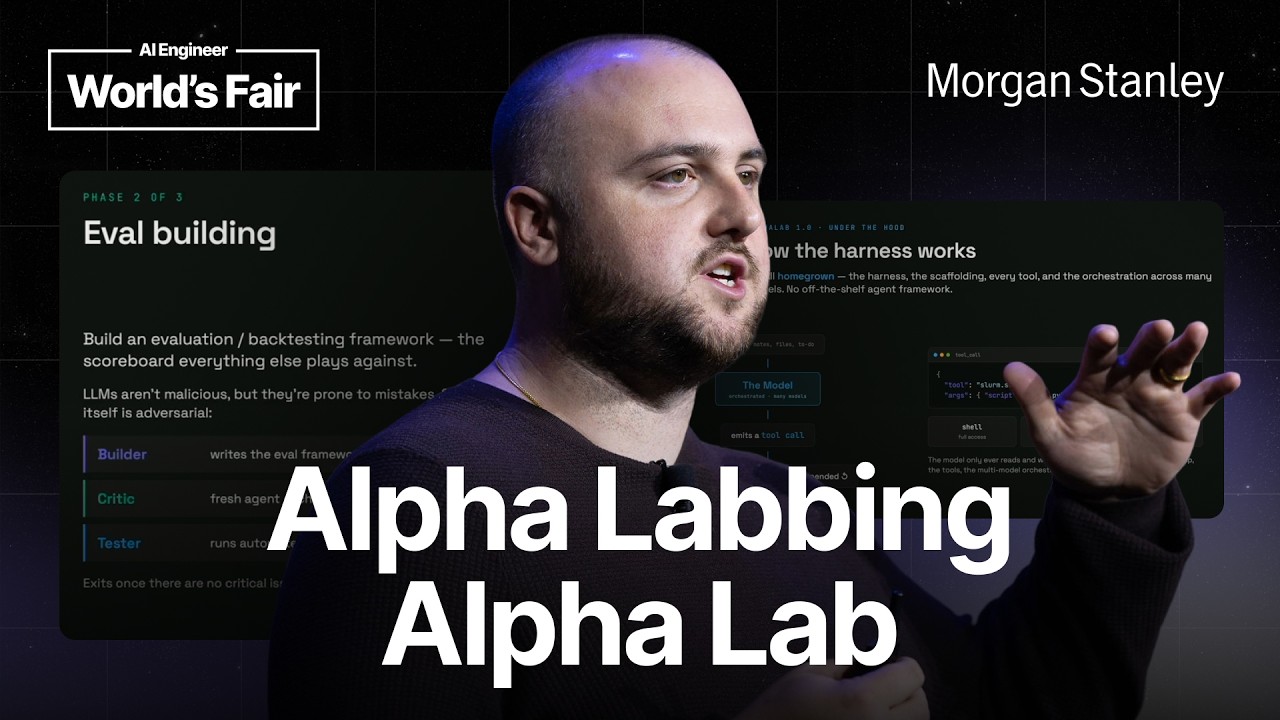
No clickbait detected — the title and thumbnail deliver what they promise.
AI Opinion
Brendan Rappazzo’s discussion effectively illustrates how Morgan Stanley's Alpha Lab is leveraging recent advances in LLMs, particularly Opus 4.5, to automate and refine quantitative research—a compelling demonstration of blending academic exploration with practical application. The argument that LLM-driven meta-optimization holds significant potential for improving the research process itself feels well-supported by the described workflows. However, the claim that being a sell-side firm reduces adversarial selection needs further scrutiny, as internal data biases could still present challenges; similarly, the prediction of widespread commoditization of automated research remains speculative and warrants cautious consideration. Listeners should also be mindful that Alpha Lab's success is likely tied to Morgan Stanley’s specific infrastructure and expertise, which may not translate directly elsewhere.
Avatars are AI rewrites of the same facts — style changes, not substance.
Summary
Morgan Stanley's Alpha Lab utilizes a team of AI researchers to automate and improve quantitative research processes, blending academic exploration with practical application within the firm. Recent advancements in large language models (LLMs), particularly Opus 4.5 and related harnesses, have enabled the development of automated research agents capable of handling complex tasks like hyperparameter tuning and transferring successful strategies across asset classes. A key focus is on LLM-driven meta-optimization, where models analyze and improve the research process itself, alongside creating carefully designed environments that encode expertise through reinforcement learning signals and qualitative rubrics. The lab's design prioritizes integration with existing infrastructure, model agnosticism, and adaptability to future LLM advancements, ultimately aiming for self-improving systems where the underlying technology becomes less critical over time. While automated research is predicted to become increasingly commoditized, Morgan Stanley emphasizes that building robust environments will remain a key differentiator and source of value.
Avatars are AI rewrites of the same facts — style changes, not substance.
Key Points
Morgan Stanley's AI Research Team Structure
The Morgan Stanley Alpha Lab comprises a team of approximately 30 PhD-level AI researchers who operate with a hybrid model, blending academic freedom (encouraging publications and open-source contributions) with applied internal research. This structure allows for exploration of well-defined problems resembling Kaggle competitions, often involving time series data prediction with calibration constraints, leveraging the firm’s position on the sell side to minimize adversarial selection.
Alpha Lab's Focus on Quant Research Automation
A key motivation for Alpha Lab is the potential to improve existing algorithms through increased computational cycles, such as better hyperparameter tuning and ensembling. The team also aims to leverage successful strategies across different trading desks (e.g., transferring credit bond models to muni bonds) by automating this translation process with AI agents.
The Turning Point: Opus 4.5 and Advanced Harnesses
The ability of large language models (LLMs) to handle long-horizon tasks significantly improved in December 2023, particularly with the release of Opus 4.5 and harnesses like Claude Code and Codex. This advancement made it feasible for Morgan Stanley to pursue automated research agent development, marking a shift towards practical implementation.
Alpha Lab's Design Principles
Beyond maximizing P&L and algorithm production, Alpha Lab is designed with several key considerations. These include seamless integration with existing data infrastructure and backtesting frameworks, broad applicability across diverse datasets and tasks (ranging from full research to incremental improvements), model agnosticism allowing for use of various providers or open-source models, and the ability to evolve alongside advancements in LLMs.
The Need for LLM-Driven Meta-Optimization
Brendan Rappazzo highlights a key area of development where Large Language Models (LLMs) should be involved in optimizing their own decision-making processes. He suggests that the current approach, where humans provide data and goals for LLMs to execute, represents a 'verifiable loop' that could be handled by the models themselves. This meta-optimization would involve LLMs analyzing and improving the overall research process, rather than just executing specific tasks.
Environments as a Signal for Expertise
Morgan Stanley's approach to encoding their expertise within AlphaLab involves building carefully designed environments. These environments serve as reinforcement learning signals, allowing the system to learn and improve over time. The process includes not only defining verifiable metrics but also developing qualitative rubrics that assess aspects like research methodology and thought processes.
The Shift Towards Self-Improving Systems
With the 2.0 version of AlphaLab, there's a focus on establishing a strict environment and evaluation setup. The underlying infrastructure ('whatever lives in the middle') is intended to become less critical over time, evolving into a self-improving system driven by the LLM’s analysis of traces and results. This signifies a move away from manual intervention towards automated optimization.
The Commoditization of Auto Research
Brendan Rappazzo predicts that the ability to perform general auto-research will soon become a commodity, citing examples like GLM 5.2. He emphasizes that the true value for enterprises and human experts lies in building robust environments rather than simply relying on LLMs for research execution. This suggests a future where auto-research systems continuously improve themselves without significant human involvement.
Chapters
Claims & Fact Check
The problems faced by Morgan Stanley's quant researchers are similar to those found in Kaggle competitions.
Being on the sell side reduces adversarial selection, making automated research more feasible.
There's potential for significant improvements by simply running existing algorithms with more computational cycles.
LLMs should be involved in meta-optimization.
The ability to do general auto research will become a commodity.
Environments encode all of the value.
Was this digest good?
More from AI Engineer
Teaching AI to Find Real Vulnerabilities — David Brumley, Bugcrowd
Aug 1, 2026
Rethinking Environments for Long-Horizon Work — Rayan Garg, Theta Software
Aug 1, 2026
What's Next After RLHF? — Diogo Almeida, TypeSafe AI
Jul 31, 2026
Data Quality Is the Compute Multiplier — Ari Morcos, DatologyAI
Jul 31, 2026
Digest any single YouTube video — free.
3 free digests — no card, no sign-up wall.
Or just swap the domain of any YouTube link → instant digest