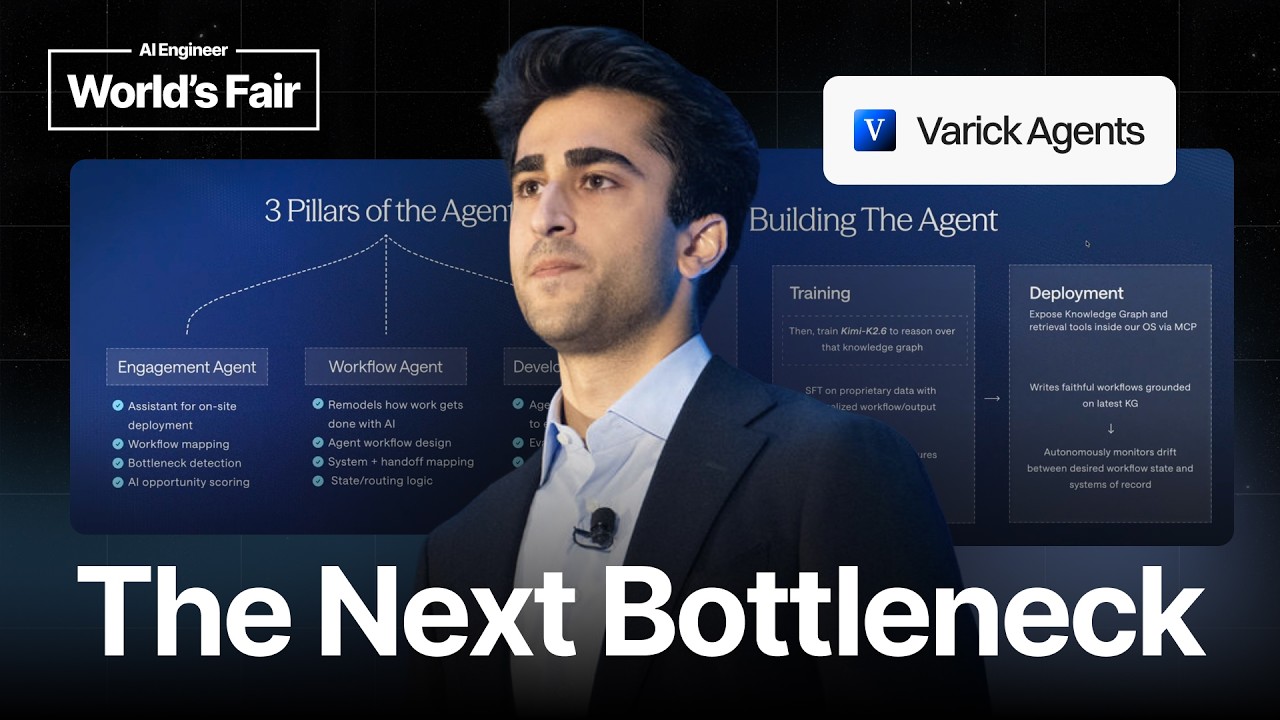
No clickbait detected — the title and thumbnail deliver what they promise.
AI Opinion
The episode’s strongest argument lies in highlighting that successful AI integration hinges on a thorough comprehension of existing business processes, not just technological prowess—a point supported by numerous anecdotes and the observed failures of applying AI to flawed workflows. While the discussion convincingly portrays FDEs as essential for this process mapping, the assertion that Claude is "surprisingly ineffective" feels overstated without comparative benchmarks against other models; similarly, claims about frontier model limitations regarding client priorities are presented as observations rather than rigorously tested hypotheses. Listeners should consider whether Varick Agents’ dependency graph approach represents a universally applicable solution or a strategy best suited to specific types of workflows and organizational structures.
Avatars are AI rewrites of the same facts — style changes, not substance.
Summary
This discussion centers on the challenges and strategies for effectively implementing AI within organizations, particularly through the role of forward-deployed engineers (FDEs). The speakers argue that the primary obstacle to successful AI adoption isn't technological execution but rather a company’s limited understanding of its own business processes – how work actually gets done, often deviating from documented procedures. FDEs are crucial for bridging this gap by embedding themselves within departments, mapping workflows through observation and interviews, and identifying areas ripe for improvement. Simply applying AI to existing, flawed processes is cautioned against as a common cause of failed AI initiatives; instead, the focus should be on re-engineering processes *around* AI capabilities. Varick Agents utilizes dependency graphs to represent these workflows and post-trains open-source models like Kimiko 26 to produce more focused outputs, addressing limitations observed in frontier models such as Claude. Ultimately, Verica’s approach prioritizes deep business understanding through FDEs to ensure tailored AI solutions that deliver tangible value.
Avatars are AI rewrites of the same facts — style changes, not substance.
Key Points
Dependency Graphs for Workflow Representation
The speakers emphasize the use of dependency graphs to represent enterprise workflows, noting that while various graph database solutions exist (mentioning Postgres and several vendors), the specific technology is less important than the concept. They explain that process owners prefer a dependency-driven approach where approvals are sequential, preventing individuals from proceeding without necessary sign-offs. This structured representation facilitates AI automation.
Limitations of Frontier Models & Custom Model Post-Training
The discussion highlights a surprising limitation of frontier models like Claude: they often produce verbose and unfocused outputs. To address this, Varick agents post-train their own models on top of open-source foundations (specifically mentioning Kimiko 26). This custom training aims to achieve a balance between detailed analysis and clarity, mirroring the ability of experienced consultants to prioritize client concerns.
RL Environment for Knowledge Graph Traversal
To effectively utilize knowledge graphs, Varick agents create a reinforcement learning (RL) environment. This environment is used to train custom tools designed to navigate the graph and extract relevant context. These tools address specific challenges like resolving ambiguity around names (e.g., multiple 'Mikes' in a company) and identifying redundancies or violations within the workflow.
Verica’s Focus on Forward Deployed Engineers (FDEs)
Varick believes that the biggest bottleneck in AI implementation isn't technology, but a lack of deep understanding of how businesses operate. They address this by employing forward deployed engineers and strategists who conduct audits within client companies to learn their processes from the inside out. This foundational knowledge informs subsequent agent building and ensures solutions are tailored to specific business needs.
The New Bottleneck: Business Understanding
Varick argues the primary bottleneck isn't AI execution anymore, but rather a company’s ability to understand its own business processes. He highlights that every business and consumer operates differently; for example, sales departments in healthcare versus SaaS companies function uniquely. Extracting this context from employees and feeding it into AI models remains challenging due to the difficulty of translating nuanced knowledge into API calls.
The Role of Forward Deployed Engineers (FDEs)
Forward-deployed engineers are crucial for bridging the gap between current operations and future AI-driven processes. Their role involves understanding existing workflows, identifying pain points, and re-envisioning how AI can transform them. This goes beyond simply applying AI tools; it requires fundamentally changing operational processes to leverage AI effectively.
Mapping Human Workflows: The First Step for FDEs
The initial step for forward-deployed engineers is meticulously mapping how humans currently perform their work. This involves embedding engineers within specific departments, such as finance, and interviewing process leads to understand both standard procedures and the often undocumented ways things actually get done when issues arise. For instance, an FDE might discover that Sarah in AP handles a workflow one way but relies on Chris for reconciliation, adding significant cycle time.
Avoiding AI on Broken Processes
Varick cautions against simply applying AI to existing, flawed processes. He points out that this is a key reason for the lack of widespread ROI in AI adoption. Instead, he emphasizes the need to re-engineer processes *around* AI, which requires understanding the underlying issues and designing workflows that leverage AI's strengths effectively.
Chapters
Claims & Fact Check
The next bottleneck is how deep can you go into a customer without scaling head count exponentially.
AI is solving the execution of work.
Slapping AI onto broken processes is why you don't see ROI across the industry today.
Claude is surprisingly ineffective at providing high-quality analysis.
Frontier models lack the ability to discern what details a client truly cares about.
The biggest bottleneck in AI implementation is a lack of understanding of how businesses operate.
Was this digest good?
More from AI Engineer
Teaching AI to Find Real Vulnerabilities — David Brumley, Bugcrowd
Aug 1, 2026

Rethinking Environments for Long-Horizon Work — Rayan Garg, Theta Software
Aug 1, 2026
What's Next After RLHF? — Diogo Almeida, TypeSafe AI
Jul 31, 2026
Data Quality Is the Compute Multiplier — Ari Morcos, DatologyAI
Jul 31, 2026
Digest any single YouTube video — free.
3 free digests — no card, no sign-up wall.
Or just swap the domain of any YouTube link → instant digest