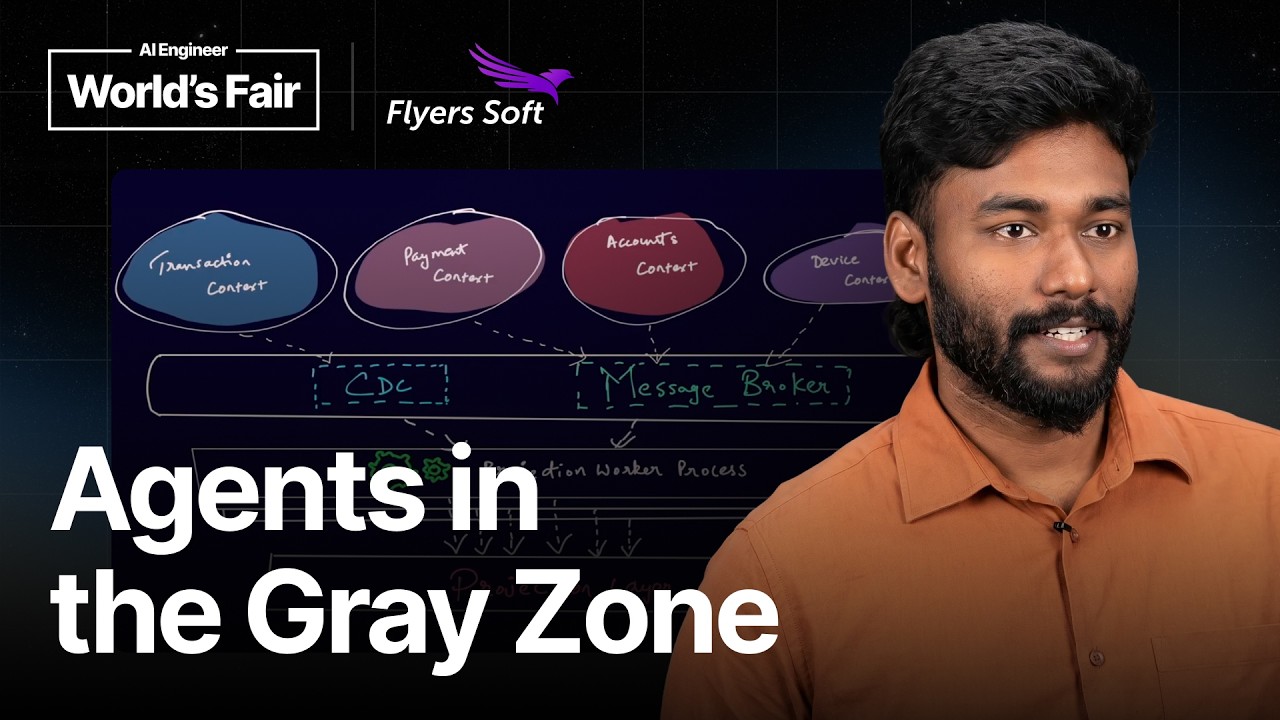
No clickbait detected — the title and thumbnail deliver what they promise.
AI Opinion
The episode convincingly demonstrates how AI agents can move beyond simple automation by addressing fraud detection’s “gray zone” challenges through a tiered architecture and multi-agent consensus, offering a potential improvement over existing rule-based systems. However, the discussion lacks specifics regarding the training data used for these agents and the metrics employed to measure their performance relative to current solutions; claims of reduced false positives would benefit from quantifiable evidence. Listeners should investigate the scalability of FlyersSoft’s architecture given real-world transaction volumes and consider how agent biases might impact fairness in fraud determinations.
Avatars are AI rewrites of the same facts — style changes, not substance.
Summary
The discussion centers on integrating AI agents into event-sourced systems, specifically focusing on improving fraud detection beyond traditional methods. The speaker argues that AI agents offer greater value when applied to business workflows rather than solely for tasks like coding assistance. Current rule-based and machine learning approaches struggle with transactions in a "gray zone" – ambiguous cases difficult to classify definitively as fraudulent or legitimate. FlyersSoft’s solution proposes a tiered architecture, leveraging existing systems while employing agentic AI to handle these complex situations. A key element is a multi-agent verdict layer where three agents collaborate to analyze data and reach conclusions, reducing false positives. The system utilizes a semantic layer aggregating transaction, account, and device information to provide comprehensive context for the agents' decision-making process, enhanced by short-term memory within the agentic layer. Finally, a Change Data Capture (CDC) mechanism ensures real-time data synchronization between layers, enabling continuous analysis and facilitating event propagation throughout the system.
Avatars are AI rewrites of the same facts — style changes, not substance.
Key Points
AI Agents Beyond Chatbots and Coding Assistance
The speaker emphasizes that the true value of AI agents lies in their application to business workflows, not just chatbots or coding assistance. He believes integrating them into processes like fraud detection can significantly improve efficiency and decision-making within organizations. This shift moves beyond simple automation towards intelligent process optimization.
Limitations of Rule-Based and ML Fraud Detection Systems
The speaker explains that while rule-based systems were initially effective, they require constant updates to combat evolving fraud techniques. Machine learning models, though an improvement, still struggle with transactions falling within a 'gray zone' where it’s difficult to definitively classify them as fraudulent or legitimate. This necessitates a more nuanced approach.
The Concept of the 'Gray Zone' in Fraud Detection
A significant portion of transactions fall into a 'gray zone,' where rule-based and traditional machine learning models are unable to confidently determine whether a transaction is fraudulent or legitimate. This uncertainty highlights the need for more sophisticated AI agents capable of analyzing context and making nuanced judgments in ambiguous situations, improving accuracy and reducing false positives/negatives.
Tiered Architecture: Combining Existing Systems with Agentic AI
The proposed solution involves a tiered architecture where existing rule-based and machine learning systems handle the majority of transactions. A second tier, utilizing agentic AI, is then employed to address the 'gray zone' cases that are difficult for the initial systems to resolve. This approach aims to augment rather than replace current infrastructure.
Multi-Agent Verdict Layer for Enhanced Accuracy
To mitigate false positives arising from rule-based mechanisms, FlyersSoft implemented a three-agent system within their verdict layer. The first two agents analyze transaction data and generate responses which are then evaluated by a third agent. This final agent synthesizes the information and emits an event to a message broker, integrating seamlessly into the saga flow for payment approval and subsequent updates to the transaction context. The entire process occurs within the orchestration layer.
Semantic Layer Integration of Transaction Contexts
The system leverages a semantic layer that aggregates data from various contexts, including transaction, account, and device information. Transaction context denormalizes average amounts and recent transactions, while the device context stores trust scores, location histories, and IP addresses. Account context provides statuses like KYC compliance and customer tenure, all contributing to a comprehensive view for agent-driven decision making.
Agentic Layer Architecture with Short-Term Memory
The orchestration layer incorporates an agentic layer featuring a verdict tool and short-term memory. This allows agents to retain context from previous interactions, improving the accuracy and consistency of their decisions. The results generated by this agentic layer are then passed on to the saga orchestration layer for further processing and event emission.
CDC Mechanism for Event Propagation
A Change Data Capture (CDC) mechanism is crucial for propagating events from the projection layer to the semantic layer. This ensures that AI agents have access to up-to-date information, enabling real-time analysis and decision making. The CDC process facilitates continuous data synchronization between different system components, supporting a dynamic and responsive event-sourced architecture.
Chapters
Claims & Fact Check
AI agents offer more value when applied to business workflows.
Fraudsters are constantly evolving their techniques, requiring frequent updates to fraud detection rules.
Traditional ML models struggle with transactions in the 'gray zone'.
A third agent analyzes responses from two other agents to reach a final conclusion.
The semantic layer aggregates data from transaction, account and device contexts.
A CDC mechanism propagates events to the semantic layer for agent consumption.
Was this digest good?
More from AI Engineer
Teaching AI to Find Real Vulnerabilities — David Brumley, Bugcrowd
Aug 1, 2026
Rethinking Environments for Long-Horizon Work — Rayan Garg, Theta Software
Aug 1, 2026
What's Next After RLHF? — Diogo Almeida, TypeSafe AI
Jul 31, 2026
Data Quality Is the Compute Multiplier — Ari Morcos, DatologyAI
Jul 31, 2026
Digest any single YouTube video — free.
3 free digests — no card, no sign-up wall.
Or just swap the domain of any YouTube link → instant digest