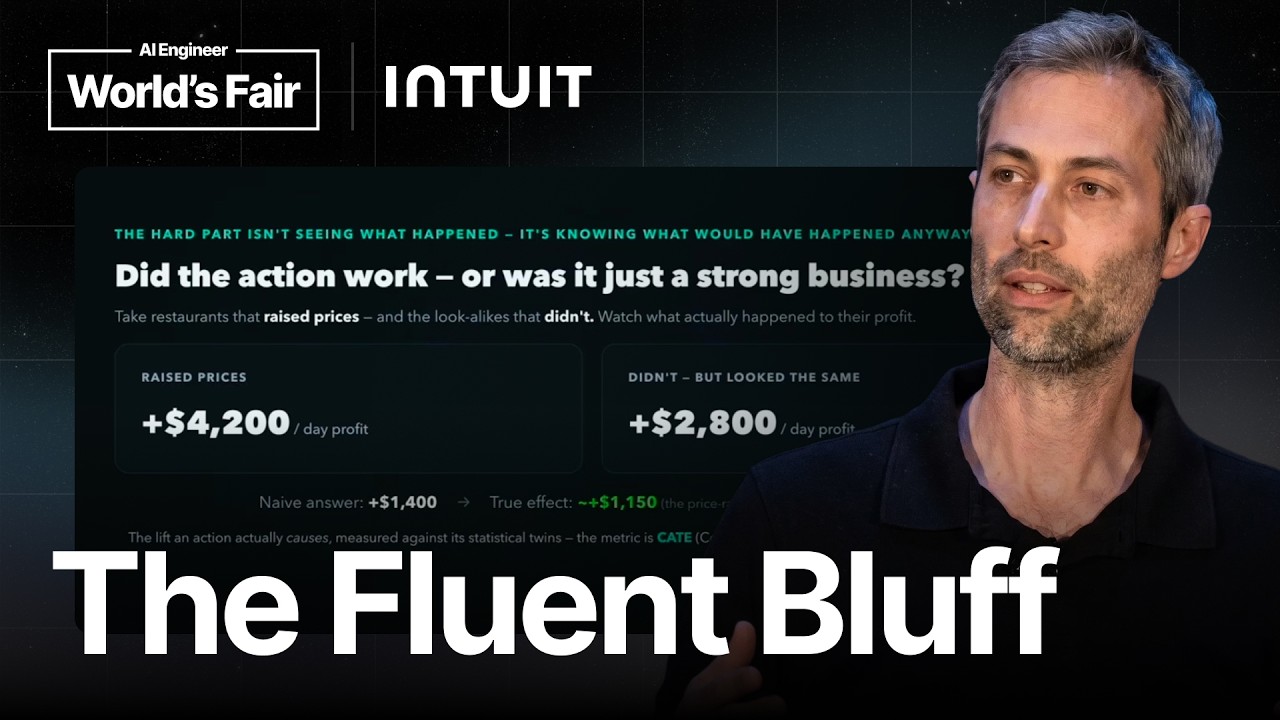
No clickbait detected — the title and thumbnail deliver what they promise.
AI Opinion
The episode convincingly argues that current LLMs, despite their size, fail to reliably handle financial reasoning due to a lack of grounding in real-world outcomes—a point supported by Intuit and Princeton research demonstrating simulated business failures. While the claim that "almost every answer related to money and finances from LLMs is based on learned information rather than actual outcomes" seems broad and would benefit from further clarification, the demonstrated advantage of “grounded” models focused on verified strategies offers a compelling alternative approach. Listeners should consider whether Intuit’s specific implementation of an AI Business Advisor represents a universally applicable solution or a product of their unique data and business context.
Avatars are AI rewrites of the same facts — style changes, not substance.
Summary
Current large language models (LLMs) struggle to provide reliable financial advice, despite their apparent sophistication. Unlike young children who grasp basic monetary concepts, these AI systems often generate conflicting recommendations based on minor input changes and lack nuanced perspectives. Research from Intuit and Princeton University demonstrates that LLMs frequently lead to poor business decisions, even driving simulated companies into bankruptcy, significantly underperforming simpler rule-based approaches. The key takeaway is that model size isn't the determining factor in success; instead, "grounded" models—those trained on real-world data and verified outcomes—outperform larger, less contextualized ones. Intuit’s development of an “AI Business Advisor,” which proactively suggests actions based on successful strategies employed by similar businesses, exemplifies this shift toward outcome-driven AI. Ultimately, organizations that can leverage robust datasets and train models to achieve specific results will be best positioned for success in the evolving landscape of artificial intelligence.
Avatars are AI rewrites of the same facts — style changes, not substance.
Key Points
Children's Understanding of Money vs. AI Complexity
The speaker begins by illustrating how even a three-year-old can develop a rudimentary understanding of money, contrasting this with the sophisticated but flawed reasoning of current Large Language Models (LLMs). He uses an anecdote about his daughter suggesting buying another car after it was scratched to highlight the simplicity and lack of nuanced perspective often found in AI financial advice. This sets the stage for exploring why off-the-shelf LLMs struggle with financial concepts.
LLMs Provide Conflicting Financial Advice Based on Minor Input Changes
The speaker recounts a personal experience where he used an AI model to evaluate investment options (real estate vs. stock market). He found that even slight alterations in the input assumptions led to drastically different recommendations, demonstrating the instability and lack of robust reasoning within these models. This highlights a core problem: LLMs can generate seemingly logical advice that is highly sensitive to minor changes in context.
Grounded Models Recommend Price Increases for Rental Properties
A study by Intuit examined the financial advice given to small businesses. Frontier models, lacking real-world grounding, advised a struggling landlord to acquire another rental property, which is risky in a negative cash flow situation. In contrast, a 'grounded' model – one trained on actual business outcomes – recommended a more practical solution: raising prices by 5-10% on the existing tenant before renewal.
Princeton Research Shows LLMs Often Lead to Business Bankruptcy
Recent research from Princeton simulated business decisions using leading LLMs, providing them with tools and data for a 500-day period. The study found that most of these models drove the simulated company bankrupt within that timeframe, significantly underperforming even a simple rules-based system. This starkly demonstrates the potential for AI to make disastrous financial decisions when not properly constrained.
Smaller, Grounded Models Can Outperform Larger Ones
Intuit's testing revealed that smaller, less expensive AI models could outperform larger 'frontier' models. This wasn’t due to model size but because of the grounding—the ability to connect the model's understanding to real-world data and specific business contexts. The speaker emphasizes that access to a large model isn't inherently better; it's about having relevant, grounded data.
The AI Business Advisor Proactively Suggests Actions
Intuit has developed an 'AI Business Advisor' currently in beta. This tool proactively identifies opportunities for businesses by leveraging a custom LLM. It provides specific recommendations (“Here’s what you should do. Here is why.”) and bases these suggestions on the actions taken by similar businesses, creating personalized action plans to drive business growth.
The Era of Outcome-Driven AI Has Begun
The focus in AI is shifting from simply evaluating which model is 'better' to determining how to direct AI to achieve specific, desired outcomes. This applies across various domains, including fraud prevention, healthcare, and logistics. The speaker posits that the organizations who can best steer AI toward these outcomes will be the winners.
Data and Verified Outcomes are Key to Success
The speaker argues that success in outcome-driven AI hinges on having a robust system of records, creating unique datasets from those records, and training models using verified outcomes. He draws an analogy to trusted mentors who understand individual preferences and emphasizes the importance of grounding AI in real-world results rather than simply relying on larger model sizes.
Chapters
Claims & Fact Check
Almost every answer related to money and finances from LLMs is based on learned information rather than actual outcomes.
More than half of the advice given by frontier models involves acquiring new customers or increasing revenue.
Leading LLMs often drive simulated businesses bankrupt within a short timeframe.
Smaller, cheaper AI models can outperform larger 'frontier' models.
The moat in AI isn’t model access but the data itself.
Off-the-shelf models don't understand money.
Was this digest good?
More from AI Engineer

Teaching AI to Find Real Vulnerabilities — David Brumley, Bugcrowd
Aug 1, 2026

Rethinking Environments for Long-Horizon Work — Rayan Garg, Theta Software
Aug 1, 2026

What's Next After RLHF? — Diogo Almeida, TypeSafe AI
Jul 31, 2026

Data Quality Is the Compute Multiplier — Ari Morcos, DatologyAI
Jul 31, 2026
Digest any single YouTube video — free.
3 free digests — no card, no sign-up wall.
Or just swap the domain of any YouTube link → instant digest