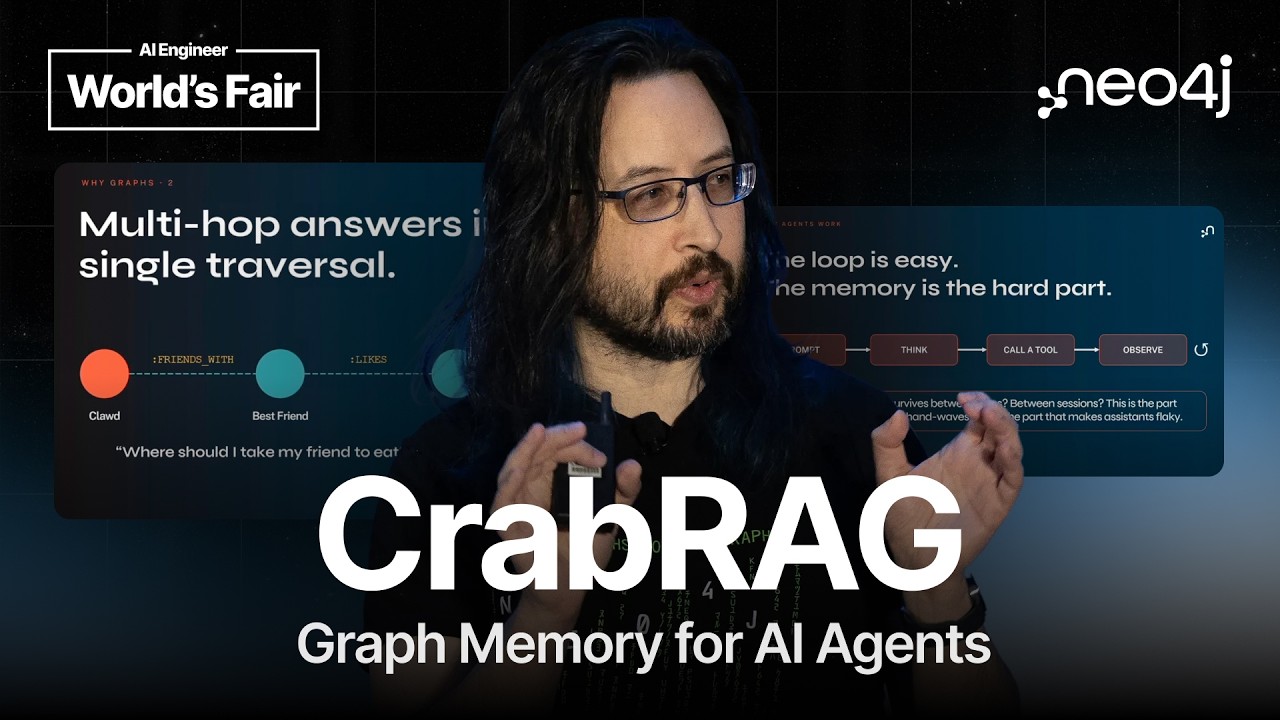
No clickbait detected — the title and thumbnail deliver what they promise.
AI Opinion
The episode convincingly argues that graph databases offer a more scalable and contextually aware memory solution for automated assistants compared to the token-intensive markdown file approach, particularly when dealing with complex relationships like identifying network vulnerabilities. While the demonstration of an agent finding exposed ports is compelling, the claim that graph memory agents *more effectively* resolve such issues than traditional methods requires further validation through broader testing and comparison; it’s possible existing tools could achieve similar results with different architectures. Listeners should investigate whether the performance gains demonstrated are consistently replicable across diverse use cases and consider alternative approaches to agent memory before committing solely to a graph-based solution.
Avatars are AI rewrites of the same facts — style changes, not substance.
Summary
The discussion centers around the limitations of current agent memory systems and explores alternative approaches using graph databases. Traditional agents often rely on markdown files, which consume significant token space—averaging at least 100,000 tokens per round—and hinder scalability. Projects like Hermes and Goose are attempting to improve this through reflective learning and pluggable memory solutions via Message Channel Protocol (MCP) servers, respectively. A key distinction is highlighted between vector stores and graph stores; the latter’s ability to represent relationships proves superior for complex queries requiring contextual understanding, as demonstrated by an agent identifying exposed network ports – a security vulnerability. The speaker emphasizes securing network management ports and introduces "Crab D" as an analogy for the common issue of agents losing context between sessions. Resources like the “Graph RAG: The Definitive Guide” book and Neo4j Graph Academy are available to facilitate learning about graph memory and agent development.
Avatars are AI rewrites of the same facts — style changes, not substance.
Key Points
Markdown Files as a Bottleneck for Agent Memory
The speaker explains that most agent memory systems rely on markdown files, which are easily readable but consume significant token space. He notes that average agents load at least 100k tokens per round due to the inclusion of everything in context, leading to inefficiencies and limitations when scaling.
Hermes Agent's Reflective Memory System
Stephen highlights Hermes agent as a notable improvement over standard systems. Unlike traditional agents, Hermes reflects on completed tasks and adds new skills or information to its memory, creating a more adaptive and efficient learning process. However, it still relies on markdown files for skill representation.
Goose Project: Treating Memory as an MCP Server
The Goose project, backed by Anthropic and part of the Agentic AI Foundation, offers a novel approach by treating memory as a Message Channel Protocol (MCP) server. This allows for pluggable memory solutions, enabling agents to retrieve, remember, or forget information through MCP commands, offering greater flexibility and potential for customization.
Comparing Vector Stores and Graph Stores for Information Retrieval
The speaker demonstrated the difference between vector stores and graph stores by presenting a scenario where a vector store struggled to retrieve relevant information while a graph store successfully identified it. This highlights that graph databases, with their ability to represent relationships between data points, are superior for complex queries requiring multi-hop reasoning and contextual understanding compared to simple vector similarity searches.
Importance of Securing Network Ports
The speaker emphasized the critical importance of not exposing management ports directly to the internet, citing examples from his own network setup. He contrasted instances with exposed ports (like Matrix and HAProxy) which were deemed 'bad' against those located within a local area network (LAN), highlighting best practices for network security.
Graph Memory Agent Identifies Security Vulnerabilities
The demonstration showcased an agent utilizing graph memory successfully identifying open ports exposed to the WAN (Wide Area Network), specifically HAProxy and OpenVPN. This ability to follow relationships within a graph database allowed the agent to pinpoint vulnerabilities more precisely than traditional methods, demonstrating the power of graph-based memory for security analysis.
Graph RAG Book and Neo4j Graph Academy Resources
The speaker announced the release of 'Graph RAG: The Definitive Guide,' co-authored with Michael Hunger and Jesús Barrasa, which covers graph memory, industry use cases, and agent development. He also promoted Neo4j Graph Academy (dev.neo4j.com/ga-rag), a free online resource offering courses on agent memory and context graphs for those looking to learn more about graph solutions.
The Crab D Analogy for Agent Memory Loss
Stephen introduces 'Crab D,' a personal assistant character who forgets everything daily, mirroring the issue of agents losing context between sessions. This analogy highlights the challenge of maintaining continuity in autonomous agents and emphasizes that current systems often reset memory files, leading to repetitive re-teaching of tasks.
Chapters
Claims & Fact Check
Average agents load at least 100k tokens per round.
Goose project treats memory as a MCP server, allowing for pluggable solutions.
Graph stores are superior to vector stores for complex information retrieval.
Exposing management ports directly to the internet is a security risk.
Graph memory agents can identify and resolve network vulnerabilities more effectively than traditional methods.
Graph RAG is a comprehensive resource for building applications on graph solutions.
Was this digest good?
More from AI Engineer
Building Turbopuffer: Gergely Orosz (@pragmaticengineer ) × Simon Eskildsen (CEO)
Aug 3, 2026
MCP Apps: Extending the Frontier — Ido Salomon & Liad Yosef
Aug 2, 2026
MCP Tasks (async): Why Aren't Any Agents Supporting Them? — Cornelia Davis, Temporal
Aug 2, 2026
When Will The Benchmaxxing Plague End? — Nick Heiner, Surge AI
Aug 2, 2026
Digest any single YouTube video — free.
3 free digests — no card, no sign-up wall.
Or just swap the domain of any YouTube link → instant digest