Clickbait Checker
The video title says:
"Wearing the Agent: From Group Chats to Glasses — Sai Krishna Rallabandi"
Reality:
The title accurately reflects the discussion about AI agents, transitioning from individual use to group dynamics and introducing a security concept (Jetou), though it doesn't fully capture the technical depth.

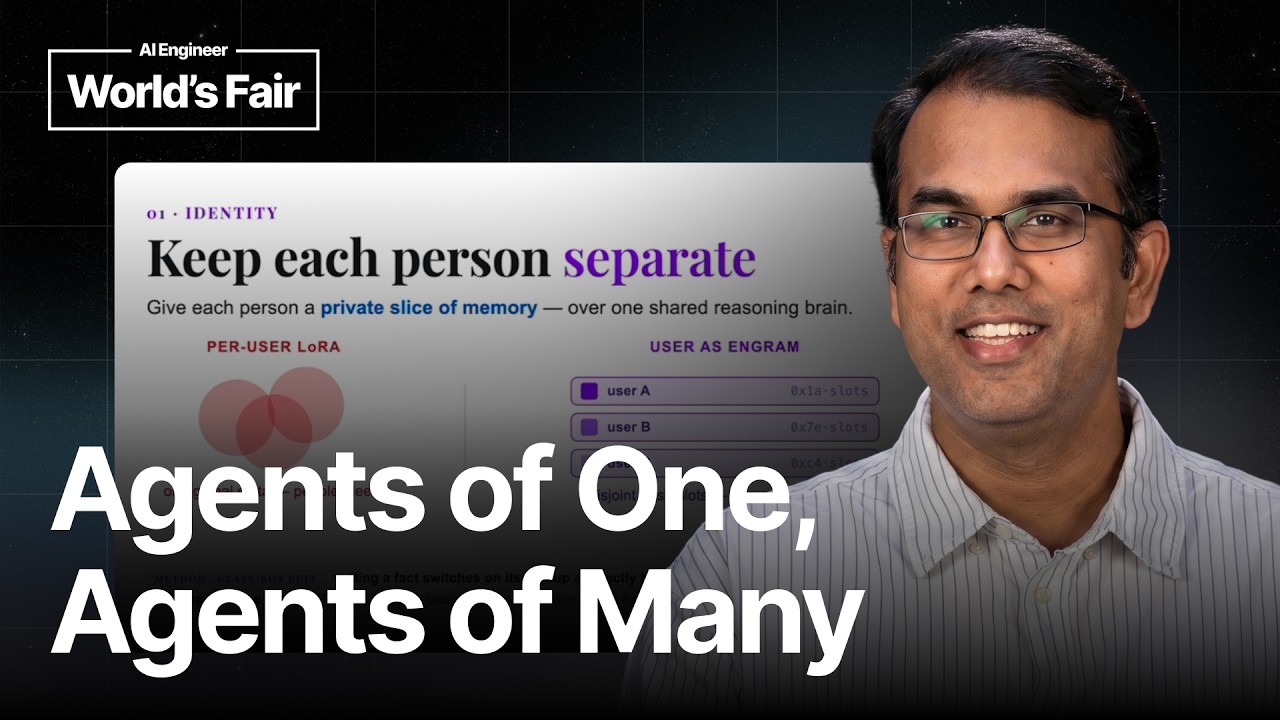
The thumbnail says:
"AI Engineer World's Fair IDENTITY Keep each person separate Give each person a private slice of memory — over one shared reasoning brain PER-USER LURA USER AS ENGRAM Agents of One, Agents of Many"
Reality:
While the thumbnail references 'AI Engineer World's Fair,' 'IDENTITY,' and concepts like personalized memory systems, the episode primarily focuses on the practical challenges of *group* agent interaction and a specific security solution (Jetou), rather than a broad exploration of individual AI identities.
AI Opinion
Rallabandi convincingly argues that current agentic AI development prioritizes individual user support, neglecting the critical complexities of group dynamics and necessitating novel security approaches like Jetou. The episode’s claims about the inadequacy of traditional LLM security methods, while plausible given the context, lack concrete technical demonstration beyond conceptual explanation; listeners should investigate how Jetou specifically addresses these vulnerabilities. Furthermore, while the need for a new social contract regarding data privacy is well-articulated, the feasibility and implementation details of layered adapters remain speculative and warrant further scrutiny.
Avatars are AI rewrites of the same facts — style changes, not substance.
Summary
Sai Krishna Rallabandi’s discussion centers on the limitations of current agentic systems, which largely focus on individual user support and overlooks the complexities of group dynamics. Deploying agents within groups introduces unique challenges related to privacy, information routing, and shared memory management that necessitate a shift in design and security approaches. To address these issues, Rallabandi introduced "Jetou," a proposed security layer for group agent memory, emphasizing that traditional LLM security methods are insufficient. Managing the large amounts of data generated by group agents requires relevance scoring to prioritize important context, and developers must consider limitations with key-value caches when serving stored memories. The discussion also highlighted the need for a new social contract regarding data privacy within shared assistant contexts, proposing layered adapters inspired by human brain function as a potential solution for granular permission control at the model level.
Avatars are AI rewrites of the same facts — style changes, not substance.
Key Points
The Current State of Agentic Systems Focuses on Individual Users
Sai Krishna observes that almost every agent built today caters to a single user, even in enterprise settings like programming assistants. This is a significant limitation as it doesn't address the complexities of group dynamics and shared information. The current focus on individual users creates challenges for future development and deployment.
Group Agent Deployment Presents Unique Challenges
Sai Krishna highlights that deploying agents in group settings introduces uniquely different challenges compared to single-user scenarios. These include considerations for privacy, information routing, and managing shared memory across multiple individuals with potentially conflicting needs or preferences. The shift necessitates a rethinking of agent design and security protocols.
Real-World Examples Demonstrate the Need for Group Agents
Sai Krishna illustrates the potential of group agents through several examples, including a conference attendee request handled privately via direct message due to privacy concerns, calendar synchronization among family members, and an agent assisting a three-year-old in learning. These examples showcase how agents can facilitate communication, organization, and education within groups while respecting individual privacy.
Introducing 'Jetou': A New Security Layer for Group Agent Memory
Sai Krishna introduces 'Jetou,' a mythological reference representing a new security layer specifically designed for group agent memory. He emphasizes that securing an agentic system cannot rely on the same methods used to secure large language models, as agents actively operate on information and require more nuanced protection against hallucinations and misuse within a group context.
Relevance Scoring for Memory Management
To manage bloated memory in group settings, a simple machine learning model or SLM can be used to identify important context and information. The paper 'Learning What To Forget' proposes using a relevance scorer that continuously evaluates the importance of data. This continual adaptation is crucial because context evolves over time in group work environments, requiring dynamic adjustments to what’s stored.
KV Cache Limitations & Injection Engines
When serving stored memories, the choice between cloud-based and local serving impacts performance. Crucially, KV caches (Key-Value caches) – a common technique for accelerating model inference – can break down when dealing with complex memory manipulations. Therefore, developing an 'injection engine' that is aware of these KV cache limitations is essential to avoid instability.
Privacy and Data Sensitivity in Shared Agents
Shared assistants create a new social contract regarding data privacy. Information shared within the agent can be either public or private depending on context, making it vital to consider the sensitivity of different types of information. For example, while a grocery list is benign, salary or health information requires careful handling and contextual awareness.
Layered Adapters for Privacy Control
To address privacy concerns, the speaker suggests drawing inspiration from how the human brain works. Instead of storing all data directly, a common shared memory layer should be implemented with individual 'LoRA adapters' (Low-Rank Adaptation) trained for each user. This approach bakes in permissions at the model level using machine learning itself, rather than relying on code.
Chapters
Claims & Fact Check
We can build basic agents in an afternoon.
Almost every agent we build today caters to one person.
We can't secure an agentic system like we secure a large language model.
A relevance scorer continuously adapts to evolving context.
KV caches can break down when memory is manipulated.
Shared assistants create a new social contract regarding data privacy.
Was this digest good?
More from AI Engineer
Teaching AI to Find Real Vulnerabilities — David Brumley, Bugcrowd
Aug 1, 2026

Rethinking Environments for Long-Horizon Work — Rayan Garg, Theta Software
Aug 1, 2026
What's Next After RLHF? — Diogo Almeida, TypeSafe AI
Jul 31, 2026

Data Quality Is the Compute Multiplier — Ari Morcos, DatologyAI
Jul 31, 2026
Digest any single YouTube video — free.
3 free digests — no card, no sign-up wall.
Or just swap the domain of any YouTube link → instant digest