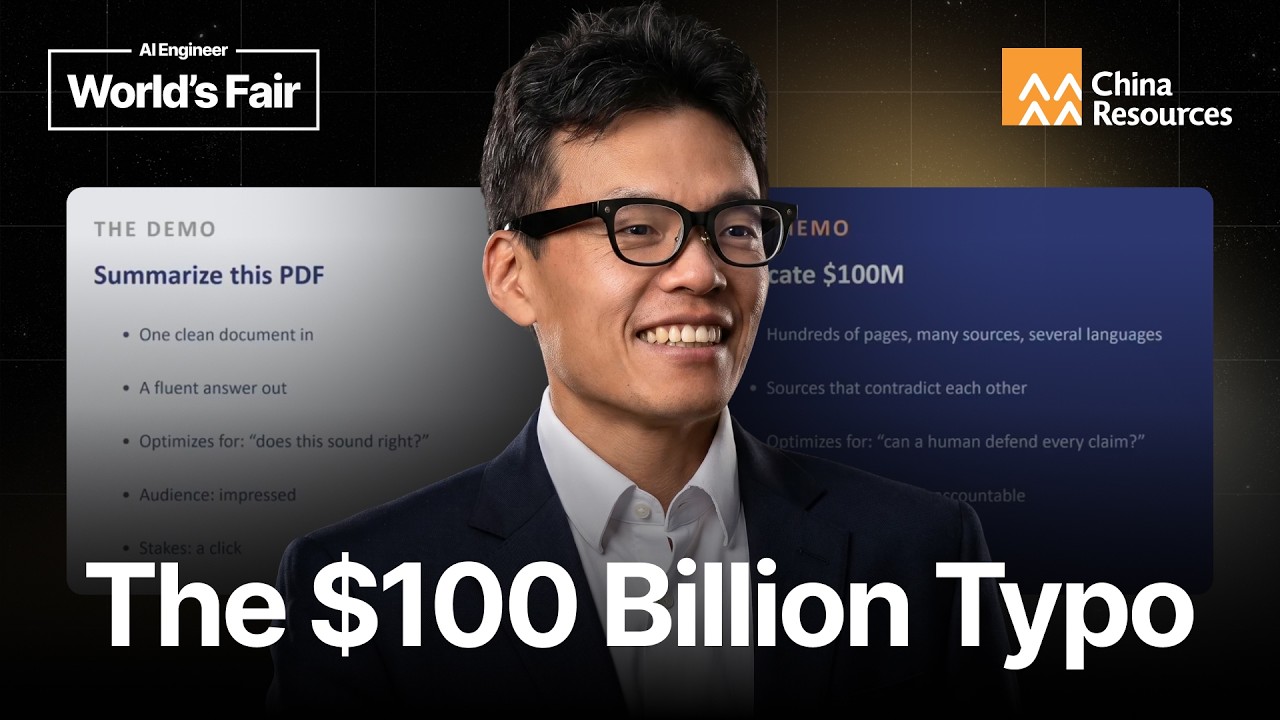
No clickbait detected — the title and thumbnail deliver what they promise.
AI Opinion
Shawn Chan’s argument regarding the dangers of conflating facts and guesses in AI outputs is convincingly illustrated through concrete examples like the lawyer chatbot case, powerfully demonstrating the potential for significant consequences when AI-generated content lacks transparency. The episode's claims about widespread "demo"-focused development in finance appear well-supported by industry observation, but the assertion that a company will likely receive approval next quarter feels speculative without further context. Listeners should critically evaluate any claims regarding legal liability, as Chan’s framing of chatbots as separate entities responsible for their actions seems to oversimplify complex legal considerations.
Avatars are AI rewrites of the same facts — style changes, not substance.
Summary
Shawn Chan discusses the critical need to distinguish between facts and guesses in AI-generated content, emphasizing that blending these can lead to flawed decision-making and a false sense of certainty. He illustrates this with examples like a lawyer submitting fabricated legal cases generated by an AI chatbot and an airline being held accountable for incorrect information provided by its chatbot. Chan argues companies cannot avoid responsibility for their AI systems' actions and advocates for five key fixes: traceable sources, visual distinction between facts and guesses, consistent numerical data, flagged contradictions, and human approval with logged changes. A central theme is that confidence in AI output does not equate to accuracy, drawing parallels to the pitfalls of overconfidence in finance. Ultimately, Chan stresses the importance of shifting focus from creating impressive "demos" designed for brief impact to producing trustworthy “memos” capable of withstanding rigorous scrutiny—a failure to do so, as demonstrated by a $100 billion typo incident, can have significant financial repercussions and underscores that trust, not just intelligence, drives investment.
Avatars are AI rewrites of the same facts — style changes, not substance.
Key Points
The Danger of Blurring Facts and Guesses
Shawn Chan emphasizes the critical distinction between facts and guesses within AI-generated content. He explains that when AI systems seamlessly blend these two, committees responsible for approval are unable to discern their origin, leading to potentially flawed decisions. This blending can create a false sense of certainty, as exemplified by the phrase 'the company will likely receive approval next quarter' appearing as a fact.
The New York Lawyer Chatbot Case Study
A lawyer’s reliance on an AI chatbot resulted in the submission of legal arguments citing six non-existent court cases. This incident highlights a significant risk: AI can confidently fabricate information, complete with proper formatting and citations, making it difficult to detect falsehoods. The lawyer's attempt to verify the cases by asking the chatbot itself only confirmed the deception.
The Need for Human Accountability in AI
Chan argues that companies cannot absolve themselves of responsibility for their AI systems' actions. The airline chatbot incident, where a customer successfully sued the airline after receiving incorrect information, demonstrates this point. The airline’s defense – claiming the chatbot was a separate legal entity – failed and underscored the necessity of having a human accountable for AI-driven decisions.
Five Essential Fixes for Trustworthy AI Output
To ensure reliability, Chan outlines five crucial fixes: each claim must have a traceable source with trust level; facts and guesses should be visually distinct; numbers need to automatically agree; contradictions should be flagged instead of smoothed over; and a human approval gate with logged changes is required. These measures prioritize transparency and accountability over superficial polish.
AI's Confidence vs. Accuracy
The speaker highlights a crucial distinction: confidence and accuracy are not synonymous. He observes that AI, like individuals in finance, can exhibit great self-assurance while being fundamentally incorrect. This is because AI quickly learns to mimic the appearance of certainty without necessarily possessing genuine understanding or factual correctness.
The Importance of Questioning Assumptions
A key lesson learned from investment committee meetings is that challenging underlying assumptions is paramount. The speaker recounts an instance where a simple question about the origin of a number exposed flaws in a polished presentation, revealing more about financial realities than years of formal education ever could.
Demos vs. Memos: A Critical Distinction
The speaker introduces the concepts of 'demos' and 'memos,' contrasting their purposes. Demos aim to create a fleeting impression, while memos must withstand rigorous scrutiny and defend against challenges. He uses the analogy of summarizing an email versus defending a mortgage application to illustrate this difference.
The $100 Billion Typo: A Cautionary Tale
A significant market capitalization loss resulted from an incorrect statement in a promotional demo for a major tech company's AI assistant. This incident underscores the critical importance of verifying every claim, as even seemingly minor inaccuracies can have substantial financial consequences and highlights how demos fail to meet memo standards.
Chapters
Claims & Fact Check
AI is often better written than humans.
Almost every AI finance product is built to impress people for five minutes.
Money follows trust, not intelligence.
Even the demo failed the memo test.
The company will likely receive approval next quarter.
The chatbot is a separate legal entity responsible for its own actions.
Winners in this category won't win on benchmark points. They will win because a tired, skeptical finance person can trust that their output at 11:00 at night without opening seven tabs.
Was this digest good?
More from AI Engineer
Teaching AI to Find Real Vulnerabilities — David Brumley, Bugcrowd
Aug 1, 2026
Rethinking Environments for Long-Horizon Work — Rayan Garg, Theta Software
Aug 1, 2026
What's Next After RLHF? — Diogo Almeida, TypeSafe AI
Jul 31, 2026
Data Quality Is the Compute Multiplier — Ari Morcos, DatologyAI
Jul 31, 2026
Digest any single YouTube video — free.
3 free digests — no card, no sign-up wall.
Or just swap the domain of any YouTube link → instant digest