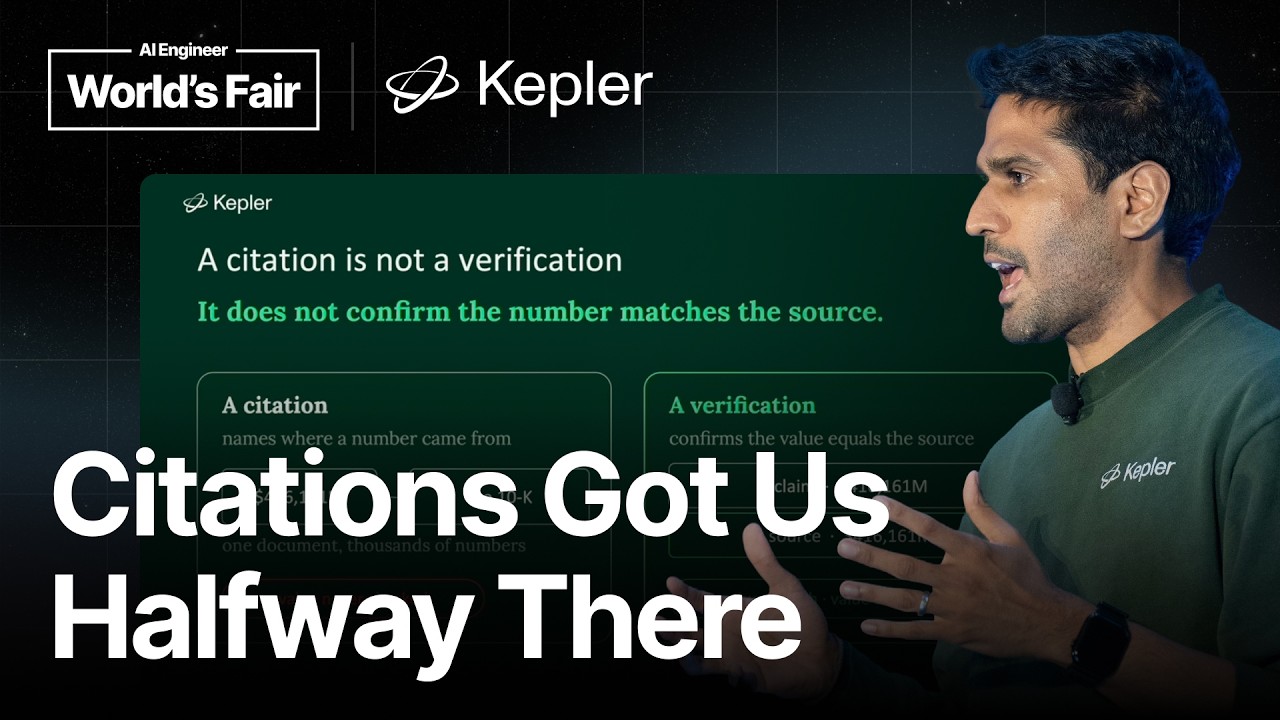
No clickbait detected — the title and thumbnail deliver what they promise.
AI Opinion
Ganesh convincingly argues that the financial services industry’s reliance on AI for data gathering has created an urgent need for verifiable outputs, drawing a compelling parallel to the pre-SSL era of online security. However, his claim that Bloomberg and FactSet are primarily used to displace culpability rests on an interpretation of industry practices that requires further scrutiny; it's plausible but not definitively demonstrated. Listeners should consider whether Kepler’s rapid consolidation approach is universally applicable or faces limitations with complex financial instruments and regulatory nuances, as well as investigate the practical challenges of scaling verifiable AI beyond finance given the diverse data types and validation requirements in fields like drug discovery.
Avatars are AI rewrites of the same facts — style changes, not substance.
Summary
Vinoo Ganesh, founder of Kepler, discusses the current state of AI in financial services and proposes a shift towards verifiable AI solutions. He observes that while AI has automated data gathering, leading to alpha decay, the industry lacks robust verification processes akin to those found in software development or medicine. This lack contributes to potential errors and burnout among professionals, as AI currently struggles to produce justifiable outputs like fairness opinions. Kepler's technology addresses this by rapidly consolidating financial statements with traceable sources, eliminating reliance on external contractors and ensuring numerical accuracy. While initially focused on finance, the concept of verifiable AI has broader applications in areas such as legal analysis and drug discovery. Ganesh likens the current stage of verifiable AI to the pre-SSL era of e-commerce, suggesting that increased trust and adoption will follow the establishment of data accuracy and provenance protocols, moving away from a focus on token consumption towards optimization and cost-effectiveness.
Avatars are AI rewrites of the same facts — style changes, not substance.
Key Points
The Shift from Production to Verification in Finance
Venu observes that current discussions around AI in finance primarily focus on increasing output (e.g., token maximization) rather than ensuring trustworthiness and verifiable results. He emphasizes that the historical bottleneck wasn't production but information gathering, which is now being automated by AI, leading to alpha decay as everyone accesses the same data sources like Tegus.
The Role of Verification Layers in Various Industries
Venu draws parallels between verification processes in software development (CI/CD, code reviews), medicine (pharmacist checks prescriptions), and finance. He highlights the lack of a robust verification layer in financial services compared to these other sectors, noting that it often relies on an overworked VP.
Bloomberg and FactSet as Displacement Mechanisms for Responsibility
Venu posits that financial data providers like Bloomberg and FactSet are utilized to shift culpability when errors occur. The belief is that because a third party vetted the information, any inaccuracies are shared across Wall Street, providing a degree of protection against individual accountability.
The Need for AI to Produce Verifiable Work Products
Venu argues that the current limitations of AI in finance, particularly its inability to produce verifiable work products like fairness opinions or investment memos, contribute to long working hours and potential burnout among financial professionals. He stresses the importance of AI moving beyond simple search technologies to generate outputs that can be justified and backed by reliable sources.
Rapid Financial Statement Consolidation with Source Tracking
Kepler's technology allows for the consolidation of financial statements in mere seconds, a process that traditionally takes much longer. A key differentiator is that each number extracted and used in the consolidated statement is directly tied back to its original source document. This eliminates reliance on contractors often employed by companies like CapIQ and Deloopa, enabling the creation of numerically accurate financial models.
Extending Verifiable AI Beyond Finance
While currently focused on finance due to its reliance on numerical data, Kepler's technology has broader applicability. The speaker envisions a future where similar verifiable AI processes are applied to areas like legal case analysis (for firms like Harvey and Legora), ensuring no relevant precedents or citations are missed, and drug discovery, guaranteeing comprehensive review of research publications without overlooking critical compounds.
The Current State: Pre-SSL Era for Verifiable AI
The speaker draws a parallel between the current state of verifiable AI and the pre-SSL era in e-commerce, when few people were comfortable sharing credit card information online. Just as security protocols dramatically increased trust and adoption in e-commerce, verifiable AI is poised to unlock significantly greater value and confidence across various industries by ensuring data accuracy and provenance.
Shifting Focus from Token Consumption to Optimization
The trend in the industry is shifting away from simply maximizing token consumption, which has become a form of rewarding vendors for high spending. Instead, there's a growing emphasis on optimization and cost-effectiveness, similar to how companies previously focused on demonstrating ROI for investments in platforms like Snowflake and Databricks. The focus now is on using the right tool for the job, even if it requires less computational power.
Chapters
Claims & Fact Check
AI is going to start doing some very powerful things in terms of producing work product, and this is inevitable.
Evals are not verifiable. You cannot take a non-deterministic LLM and eval your way to something deterministic.
The reason that people buy products like Bloomberg and FactSet is to displace culpability.
AI can now produce verifiable work product across a number of industries.
Citations got us like 50% of the way there.
The last remaining mile is going to be that personalization.
Was this digest good?
More from AI Engineer
Teaching AI to Find Real Vulnerabilities — David Brumley, Bugcrowd
Aug 1, 2026
Rethinking Environments for Long-Horizon Work — Rayan Garg, Theta Software
Aug 1, 2026
What's Next After RLHF? — Diogo Almeida, TypeSafe AI
Jul 31, 2026
Data Quality Is the Compute Multiplier — Ari Morcos, DatologyAI
Jul 31, 2026
Digest any single YouTube video — free.
3 free digests — no card, no sign-up wall.
Or just swap the domain of any YouTube link → instant digest