No clickbait detected — the title and thumbnail deliver what they promise.
AI Opinion
Eifrem’s argument that decentralized data access creates significant engineering overhead in large organizations is convincingly presented, particularly with the relatable example of violating the DRY principle. However, the claim connecting the rise of AI and Palantir directly to increased ontology adoption feels speculative; while ontologies are certainly gaining traction, attributing their popularity solely to these factors lacks concrete evidence. Listeners should investigate whether other trends, such as growing data governance concerns or broader shifts in software architecture, also contribute to this shift toward semantic layers.
Avatars are AI rewrites of the same facts — style changes, not substance.
Summary
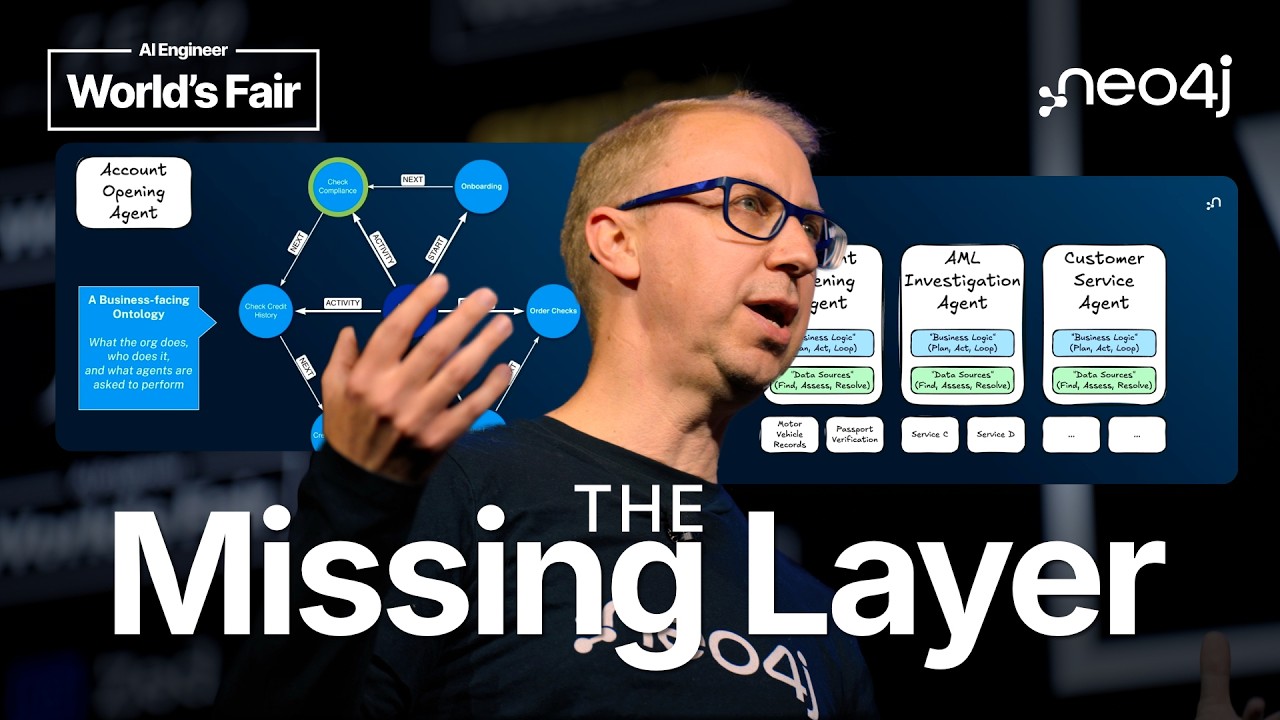
The episode addresses challenges in providing data access for AI agents, particularly within large organizations where teams often duplicate efforts connecting to disparate data sources. This violates software engineering principles and creates maintenance issues. While simple configuration methods like Markdown files offer some assistance, they are insufficient for complex enterprise environments requiring a deeper understanding of underlying data structures. Emil Eifrem proposes a solution called "thin agents on a smarter substrate," built around three pillars: a business-facing ontology to define key concepts, a technical ontology to catalog metadata about data sources, and a mapping layer connecting the two. This approach aims to streamline agent development, improve knowledge sharing, and reduce redundancy by providing a centralized and semantically rich foundation for data access—a trend potentially fueled by the growth of AI and platforms like Palantir.
Avatars are AI rewrites of the same facts — style changes, not substance.
Key Points
The Need for Data Access in AI Agent Development
Emil emphasizes that while agents primarily focus on business logic, their success heavily relies on providing them with the right data at the right time. He uses the example of an account opening agent needing to validate identity through DMV and passport verification services, illustrating how crucial data access is for effective AI agent operation.
The DRY Principle Violation in Decentralized Data Management
A significant problem arises when teams build agents independently within large organizations, as each team must rediscover and connect to data sources from scratch. This violates the 'Don't Repeat Yourself' (DRY) principle of software engineering, leading to duplicated effort, increased maintenance overhead, and cascading changes whenever underlying data structures evolve.
The Limitations of Markdown-Based Solutions
While Markdown files and similar approaches offer some assistance in managing agent configurations, they are not a complete solution. Swyx's quote on the Latent Space podcast highlights the necessity for understanding databases to effectively build agents, suggesting that relying solely on Markdown-based solutions is insufficient for complex enterprise environments.
The Three Pillars of 'Thin Agents on a Smarter Substrate'
Emil introduces the core concept of 'thin agents on a smarter shared substrate' as a solution to data access challenges. This approach is built upon three pillars: a business-facing ontology (defining key concepts in human-understandable terms), a technical ontology (cataloging metadata for all data sources), and a mapping layer connecting these two ontologies, enabling efficient agent development and knowledge sharing.
Chapters
Claims & Fact Check
Teams building agents in large organizations repeatedly face the challenge of discovering and accessing necessary data.
Relying solely on Markdown files is not a sufficient solution for managing agent configurations at scale.
The rise of AI and Palantir has contributed to the increased popularity of ontologies.
Was this digest good?
More from AI Engineer

Building Turbopuffer: Gergely Orosz (@pragmaticengineer ) × Simon Eskildsen (CEO)
Aug 3, 2026
MCP Apps: Extending the Frontier — Ido Salomon & Liad Yosef
Aug 2, 2026
MCP Tasks (async): Why Aren't Any Agents Supporting Them? — Cornelia Davis, Temporal
Aug 2, 2026

When Will The Benchmaxxing Plague End? — Nick Heiner, Surge AI
Aug 2, 2026
Digest any single YouTube video — free.
3 free digests — no card, no sign-up wall.
Or just swap the domain of any YouTube link → instant digest