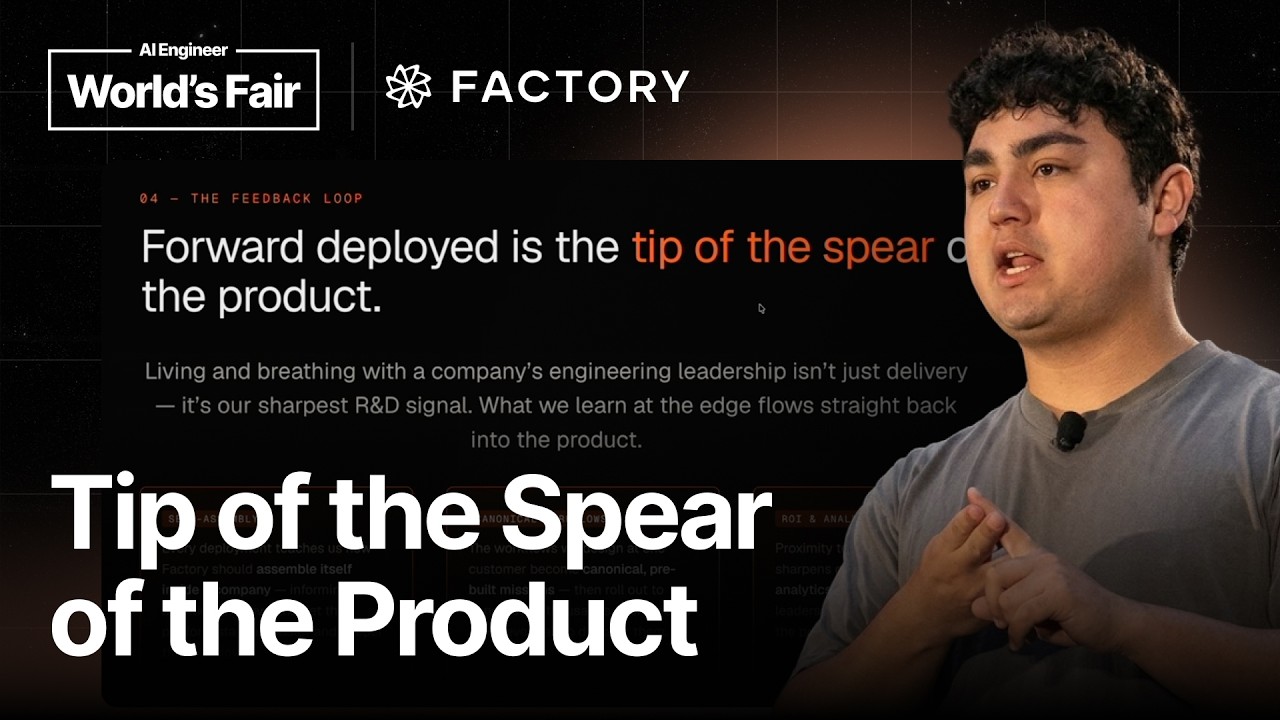
No clickbait detected — the title and thumbnail deliver what they promise.
AI Opinion
The episode most convincingly argues that Factory's shift away from direct customer integration towards using deployed engineers for product feedback is a valuable evolution in forward deployment strategies, particularly as AI adoption increases. The claim that codebases must be "agent ready," while logically sound, rests on Factory’s specific implementation and may not universally apply across all development environments; listeners should consider how broadly this principle translates. Finally, the assertion of an “autonomy ratio” above 80% represents a significant operational achievement but would benefit from external validation to confirm its accuracy and scope.
Avatars are AI rewrites of the same facts — style changes, not substance.
Summary
Factory’s approach to forward deployed engineering has evolved from the initial Palantir model of engineers directly integrating with customer codebases, now focusing on acting as a conduit for feedback and insights to improve Factory's product itself rather than providing consulting services. The company views its deployed engineers as crucial for gathering information about customer software development practices and AI implementation challenges, feeding this back into product development cycles—a process they term their "software factory." A key concept highlighted is the need for codebases to be “agent ready,” meaning structured to effectively utilize and respond to AI-driven feedback. Factory uses an analogy of Epcot to illustrate how working examples can inspire broader adoption of innovative technologies, and currently operates with a high level of automation—an "autonomy ratio" in the upper 80%—demonstrating progress towards self-managing software. Ultimately, successful forward deployed engineers possess traits like systems thinking and strong communication skills, enabling them to bridge technical and business perspectives across an organization's entire software development lifecycle.
Avatars are AI rewrites of the same facts — style changes, not substance.
Key Points
The Evolution of Forward Deployed Engineering
Eno Reyes explains that the initial model of forward deployed engineering, pioneered by Palantir, involved engineers directly accessing and integrating into customer codebases. However, this has evolved into a role where engineers act as a conduit for information between customers and product teams. This shift reflects a move away from direct consulting work towards understanding customer needs and incorporating them into the product itself.
Factory's Focus: Product Improvement, Not Consulting
Factory distinguishes itself by rejecting the traditional model of forward deployed engineers providing consulting services. Eno Reyes emphasizes that while this approach can generate revenue, it doesn’t contribute to product improvement or scalability. Instead, Factory aims for its deployed engineers to be a source of feedback and insight for product development.
Deployed Engineers as the 'Tip of the Spear'
Factory views its forward-deployed engineers as the ‘tip of the spear,’ representing a vital feedback loop. These engineers gather insights from critical customers regarding their software development and AI practices, relaying this information back to Factory’s product team for rapid adjustments and better integration within customer environments.
Factory's Software Factory Concept
Eno Reyes introduces the concept of a 'software factory,' describing it as an implicit process organizations use to translate external signals (customer feedback, bug reports, executive directives) into prioritized development plans. Factory aims to provide building blocks that automate and streamline this process, transforming raw input into actionable software changes.
Agent Readiness is Crucial for AI Success
The speaker emphasizes that simply installing AI tools isn't enough; the underlying codebase must be 'agent ready.' This means it needs to be structured and adaptable to receive and act upon feedback from AI systems. Without this foundational readiness, organizations won’t see meaningful benefits from even the most advanced AI technologies.
The Epcot Analogy for Scaling Innovation
Drawing a parallel to Walt Disney's Epcot, the speaker illustrates how creating a working example—a 'city of the future' in code—can serve as a model for broader adoption. Just as cities drew inspiration from Epcot’s urban planning innovations, organizations can leverage well-designed AI implementations to transform their entire codebase.
Autonomy Ratios and Future Codebases
The speaker discusses the concept of 'autonomy' within codebases, noting that some organizations—and even specific tools within Factory—are already operating with significant levels of automation. Factory itself has an autonomy ratio in the upper 80%, meaning a high percentage of actions are performed by AI systems without human intervention, highlighting a progression towards self-managing software.
The Role of Former Founders and Systems Thinkers
The speaker identifies key traits for success in forward deployed engineering roles. Former founders, individuals skilled in technical communication, and systems thinkers are particularly well-suited due to their ability to understand the entire software development lifecycle (SDLC), communicate effectively across different levels of an organization, and design complex systems with closed feedback loops.
Chapters
Claims & Fact Check
Forward deployed engineering is one of the hottest topics in AI.
Palantir pioneered forward deployed engineering many years ago.
Factory does not want to be doing professional services work on behalf of a customer.
Codebases must be 'agent ready' to see success from AI.
Factory has an autonomy ratio in the upper 80%.
Each stage of the SDLC represents a billion-dollar business opportunity.
Was this digest good?
More from AI Engineer
Teaching AI to Find Real Vulnerabilities — David Brumley, Bugcrowd
Aug 1, 2026
Rethinking Environments for Long-Horizon Work — Rayan Garg, Theta Software
Aug 1, 2026
What's Next After RLHF? — Diogo Almeida, TypeSafe AI
Jul 31, 2026
Data Quality Is the Compute Multiplier — Ari Morcos, DatologyAI
Jul 31, 2026
Digest any single YouTube video — free.
3 free digests — no card, no sign-up wall.
Or just swap the domain of any YouTube link → instant digest