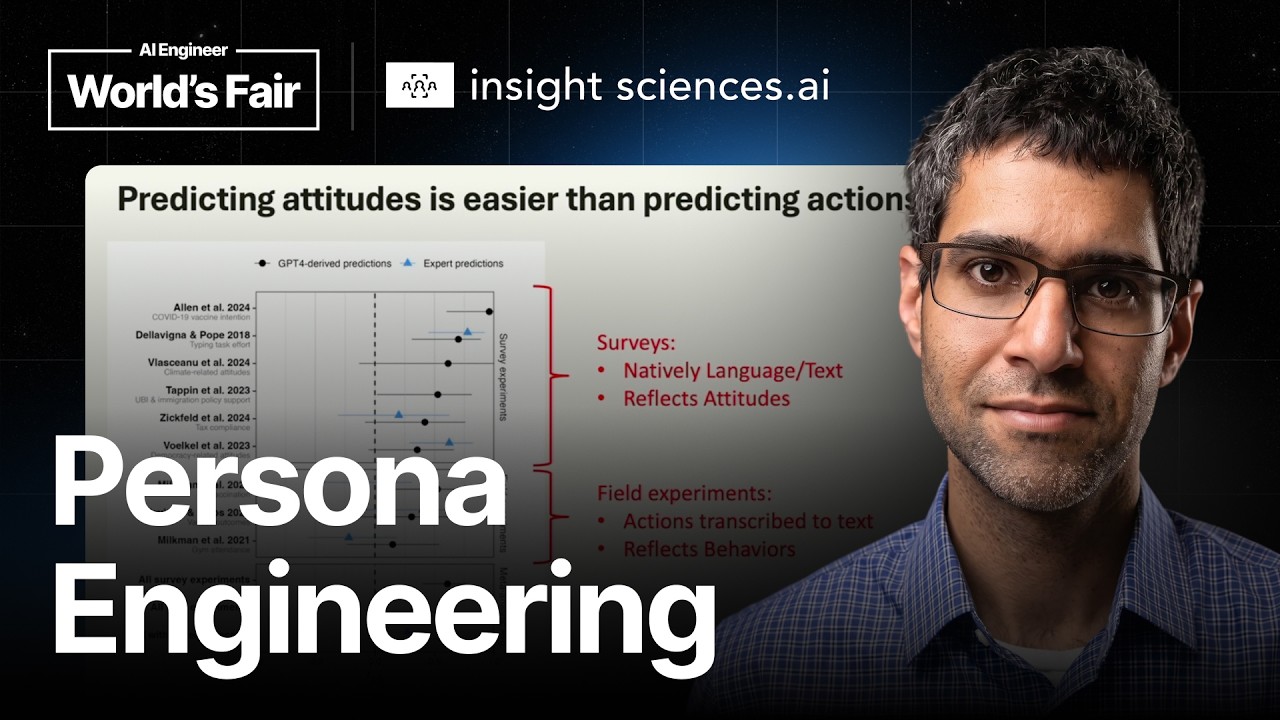
No clickbait detected — the title and thumbnail deliver what they promise.
AI Opinion
The episode convincingly argues that synthetic personas offer a novel approach to market research, particularly for exploring subjective experiences and potentially representing marginalized groups, while rightly cautioning against expecting them to artificially inflate statistical significance. The analogy to weather forecasting effectively highlights the inherent limitations in predictability, though the explanation of “shape similarity” as directly correlating with persona accuracy feels underdeveloped and requires further technical clarification. Listeners should be mindful that the observed alignment between synthetic personas and human responses is likely context-dependent and may not generalize across all demographics or situations, demanding careful validation against real-world data.
Avatars are AI rewrites of the same facts — style changes, not substance.
Summary
The emergence of synthetic personas, created by prompting large language models to simulate individuals, is rapidly changing market research and product testing. These AI-generated representations offer a new medium for simulation that goes beyond traditional mathematical modeling, allowing for the exploration of subjective aspects like feelings and choices. Initial studies suggest a significant alignment between responses from synthetic personas and those from humans, though this accuracy is subject to limitations similar to weather forecasting – predictions become less reliable over time. While synthetic personas can be valuable in gathering data, particularly for underrepresented populations, they cannot artificially boost statistical significance. Furthermore, inherent inconsistencies within human behavior create a natural "noise floor" that limits the potential accuracy of any model. Ultimately, synthetic personas are best viewed as a complement to traditional human research, especially given the increasing influence of AI agents on human actions and decision-making.
Avatars are AI rewrites of the same facts — style changes, not substance.
Key Points
Synthetic Personas are Emerging as a Tool for Market Research
The speaker introduces synthetic personas, which involve prompting large language models (LLMs) with role prompts to simulate individuals. This technique is rapidly gaining traction in market research and product testing, moving from a novelty to a significant area of investment. Companies are leveraging these AI-generated personas to gauge reactions to products and messaging, demonstrating a shift towards data-driven decision making.
Synthetic Personas Operate Within Limitations Similar to Weather Forecasting
The speaker draws an analogy between synthetic personas and weather forecasting, highlighting that both are enabled by increased compute power and data. Like weather predictions, the accuracy of synthetic persona insights diminishes over time; there's a limit to how far ahead one can reliably predict behavior using these models. Understanding these limitations is crucial for responsible application.
LLMs Offer a New Medium for Simulation Beyond Mathematical Equations
Traditionally, simulation involved mathematizing phenomena through formulas and equations. However, LLMs introduce an intermediary layer of language that allows for modeling subjective aspects like feelings, choices, and behaviors that are difficult to capture with traditional mathematical models. This new medium enables a more nuanced form of simulation.
Initial Research Shows Alignment Between Synthetic Personas and Human Responses
A study involving 1,000 humans who underwent extensive interviews and personality tests demonstrated an 83% alignment between their responses and those generated by AI agents. This suggests a potential for synthetic personas to accurately reflect human attitudes and behaviors; however, the speaker cautions that this number is normalized against inherent human variability.
Shape Similarity and Persona Accuracy
The chart presented illustrates the importance of capturing shape similarity when evaluating synthetic personas. The horizontal axis represents this measure, with a score of 1 indicating perfect identity and 0 signifying no similarity. The 'yellow' persona performed better than the 'pink' one, demonstrating its ability to understand not only the ultimate choice but also how that choice varied across different individuals.
Statistical Significance Limitations with Synthetic Personas
The speaker emphasizes a crucial limitation: statistical significance cannot be boosted using synthetic personas. While they can provide data for underrepresented populations, simply increasing the sample size doesn't guarantee statistical validity. This is analogous to weather forecasting – rerunning a forecast multiple times without changing inputs doesn’t improve its accuracy; it only refines the estimate of the model itself.
Human Consistency as a Noise Floor
A key insight is that human consistency isn't perfect. An experiment revealed that humans were only 80% consistent with themselves when re-taking surveys and personality tests two weeks later. This inherent noise level sets a practical limit on the accuracy achievable by any model, including those utilizing synthetic personas.
Synthetic Personas Complement Human Research
The speaker argues that synthetic personas should be viewed as complementary to human research rather than a replacement. They are particularly valuable in an era where AI agents increasingly mediate human actions and decision-making processes, making human-only studies insufficient. Synthetic personas can extend data collection beyond the scope of traditional human surveys.
Chapters
Claims & Fact Check
Synthetic personas are like weather forecasting.
Most coverage in the space is very shallow, doesn't go into technical details.
LLMs unlock a new kind of simulation.
Statistical significance cannot be boosted using synthetic personas.
Human consistency isn't perfect, with individuals only being 80% consistent with themselves over time.
Synthetic personas are valuable because AI agents increasingly mediate human actions and decisions.
Was this digest good?
More from AI Engineer

Teaching AI to Find Real Vulnerabilities — David Brumley, Bugcrowd
Aug 1, 2026
Rethinking Environments for Long-Horizon Work — Rayan Garg, Theta Software
Aug 1, 2026
What's Next After RLHF? — Diogo Almeida, TypeSafe AI
Jul 31, 2026
Data Quality Is the Compute Multiplier — Ari Morcos, DatologyAI
Jul 31, 2026
Digest any single YouTube video — free.
3 free digests — no card, no sign-up wall.
Or just swap the domain of any YouTube link → instant digest